
ASML's Hwaseong Campus Drives 44% Volume Surge to $1.43B, Ranking 68th as Shares Dip 1.68% on Mixed Investor Sentiment
 Aime Summary
Market Snapshot
On November 13, 2025, ASML HoldingASML-- (ASML) closed with a 1.68% decline in share price, despite a 44.09% surge in trading volume to $1.43 billion, ranking it 68th in market activity. The heightened volume reflects investor engagement amid significant operational developments, including the official completion of ASML’s Hwaseong Campus in South Korea. While the stock initially rose on news of the campus opening, it later reversed to close lower, indicating mixed sentiment among traders reacting to the company’s strategic moves and broader market conditions.
Key Drivers Behind the Movement
ASML’s recent strategic expansion in South Korea, marked by the completion of its 16,000-square-meter Hwaseong Campus, represents a pivotal shift in the company’s regional strategy. The $176 million investment establishes a dedicated repair and training hub for extreme ultraviolet (EUV) and deep ultraviolet (DUV) lithography systems, rather than manufacturing new equipment. This move underscores ASML’s focus on enhancing service infrastructure to reduce downtime for customers like Samsung Electronics and SK hynix, who rely heavily on its advanced lithography tools. By localizing repair operations and increasing parts sourcing from 10% to 50% within South Korea, ASMLASML-- aims to strengthen supply-chain resilience and improve customer support efficiency, critical factors for maintaining its leadership in the semiconductor equipment market.
The Hwaseong Campus also features a state-of-the-art training center, set to train 2,000 engineers annually in EUV and DUV technologies. This initiative addresses a persistent shortage of skilled technicians, a bottleneck in semiconductor manufacturing. By cultivating local expertise, ASML not only supports its partners’ operational needs but also reinforces South Korea’s position as a global semiconductor hub. The facility aligns with the country’s national strategy to bolster domestic supply chains and foster advanced technology collaboration, as highlighted by South Korea’s Ministry of Trade, Industry, and Resources. The campus’s emphasis on localized service and knowledge transfer reflects ASML’s broader commitment to deepening its footprint in Asia, a region critical to its long-term revenue growth.
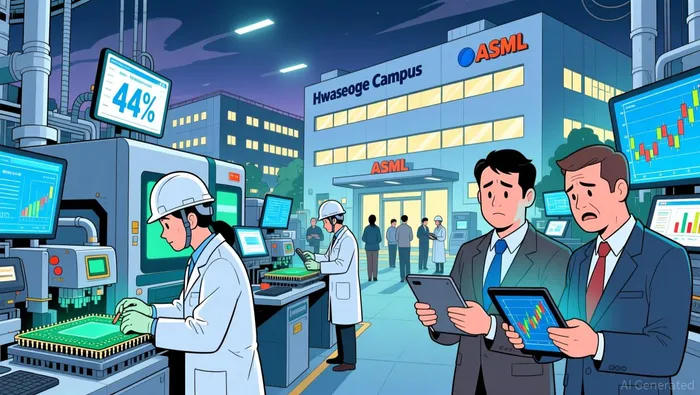
However, the stock’s mixed performance suggests investor caution amid broader market dynamics. While the campus opening signals operational progress, recent earnings reports indicate slowing revenue growth and cautious customer demand. For instance, ASML’s Q3 2025 revenue of €7.5 billion, though robust, reflects a gross margin contraction to 51.6% from 53.7% in the prior quarter. Management has also signaled a return to normalized growth in 2025, with a focus on maintaining high capital expenditures and margins despite moderating demand for EUV systems. Analysts at Seeking Alpha note that ASML’s valuation—trading at 36 times forward earnings—appears stretched given these trends, contributing to short-term volatility as investors reassess its growth prospects.
The geopolitical and technological context further complicates ASML’s trajectory. The Hwaseong Campus’s proximity to Samsung’s fabrication plants enables tighter collaboration on next-generation semiconductor processes, including sub-2 nm nodes and High-NA EUV lithography. This aligns with the global race to advance AI hardware, where ASML’s tools are indispensable. Yet, trade restrictions and supply-chain fragility remain risks, particularly as the U.S. and China navigate semiconductor export controls. ASML’s ability to balance localized operations with global compliance obligations will be critical in sustaining its dominance. The recent campus expansion, while a technical and strategic milestone, must be weighed against these macroeconomic uncertainties, which may temper investor enthusiasm in the near term.
In conclusion, ASML’s stock movement on November 13, 2025, reflects a confluence of operational progress and market skepticism. The Hwaseong Campus solidifies its role as a key enabler of South Korea’s semiconductor ecosystem, yet investor concerns about valuation and cyclical demand for its equipment linger. The company’s long-term prospects remain tied to its ability to innovate in EUV technology, navigate geopolitical risks, and maintain profitability amid shifting customer dynamics. As the semiconductor industry transitions toward sub-2 nm manufacturing, ASML’s strategic investments in Asia will likely remain a focal point for both its partners and shareholders.

Stay ahead of the market.
Get curated U.S. market news, insights and key dates delivered to your inbox.
AInvest
PRO
AInvest
PRO



Comments
No comments yet