
ASML's FY25 Surge vs. 2026 Crossroads: Can Lithography Leaders Navigate the Semiconductor Storm?
ASML's Q2 2025 results delivered a resounding beat, with net sales of €7.7 billion and net bookings of €5.5 billion, fueled by robust demand for extreme ultraviolet (EUV) systems and advanced lithography tools. Yet beneath the surface, management's caution on 2026 growth hints at a critical inflection pointIPCX-- for the semiconductor equipment giant. This analysis evaluates whether near-term catalysts—driven by AI adoption and product innovation—outweigh looming risks tied to geopolitics, macroeconomic uncertainty, and supply chain fragility. The verdict? Investors may be overpaying for today's momentum while underpricing the potential fallout from 2026's crosswinds.
Near-Term Catalysts: Riding the AI and EUV Wave
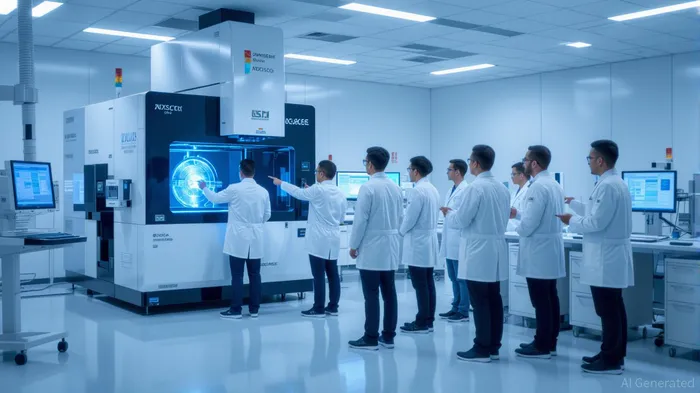
ASML's Q2 performance underscored its dominance in EUV technology, with €2.3 billion of bookings attributed to its next-gen systems. The launch of the TWINSCAN NXE:3800E and the first shipment of the High Numerical Aperture (High-NA) EXE:5200B system signal continued leadership in pushing lithography boundaries. These tools are critical for chipmakers like TSMCTSM-- and Samsung, which are racing to shrink transistor sizes to power AI chips and 5G infrastructure.
The AI boom remains the clearest tailwind. ASML's CEO, Christophe Fouquet, noted strong fundamentals in AI segments, where hyperscalers and cloud providers are investing heavily in advanced nodes. This is reflected in Q2's 53.7% gross margin, the highest in years, driven by cost discipline and higher-margin upgrade sales. Meanwhile, the company's Installed Base Management (IBM) division—servicing existing tools—delivered €1.3 billion in sales, a 36% year-over-year jump, underscoring the recurring revenue stream from its installed base.
FY25 Guidance: A Steady Hand, but with Limits
ASML's full-year 2025 outlook calls for 15% net sales growth, aligning with market expectations. The third-quarter guidance (€7.4–7.9 billion) suggests moderation from Q2's peak, likely due to seasonality and supply chain constraints. Management emphasized “cautious preparations” for 2026, citing macroeconomic and geopolitical uncertainties. This cautious tone raises a critical question: Can ASML's current growth trajectory survive a potential slowdown in AI spending or a broader tech recession?
The Long-Term Headwinds: Geopolitics, Overcapacity, and Margin Pressure
The risks begin with geopolitical tensions, particularly U.S.-China tech decoupling. ASML's inability to sell advanced EUV systems to Chinese customers due to U.S. export controls remains a structural headwind. While Chinese chipmakers are pivoting to older 14nm nodes, the long-term loss of a major market—combined with the U.S. and EU's push to build domestic semiconductor ecosystems—could strain ASML's growth.
Second, AI demand sustainability is far from certain. The current surge in AI chip investments may be a one-off wave, not a structural shift. If hyperscalers overbuild capacity or face a downturn in cloud spending, demand for ASML's tools could crater.
Third, supply chain fragility looms large. ASML's reliance on specialized components—many sourced from politically volatile regions—means even minor disruptions could delay shipments. The company's Q3 gross margin guidance (50–52%) hints at margin pressure from rising input costs and lower utilization of its High-NA tools.
Lastly, valuation concerns arise. At a forward P/E of 25x (vs. its 5-year average of 20x), ASML's stock prices in near-term AI optimism. But if 2026 delivers weaker-than-expected demand, this premium could evaporate.
Valuation: Overpaying for Today's Hype?
ASML's stock has risen 45% year-to-date, outpacing broader tech indices. However, a deeper look reveals stretched multiples compared to peers like Lam ResearchLRCX-- (P/E 22x) or Applied MaterialsAMAT-- (P/E 18x). The disconnect suggests investors are betting that AI demand will remain insatiable. Yet, if 2026 delivers a reality check—geopolitical flare-ups, macroeconomic slowdowns, or supply chain bottlenecks—the stock could face a reckoning.
Investment Thesis: Proceed with Caution
ASML remains the undisputed leader in EUV technology, and its Q2 results justify its current position. However, the 2026 risks—geopolitical, macroeconomic, and demand-related—are too significant to ignore. Investors should ask: Are they willing to pay a 25x P/E for a company whose growth hinges on the sustainability of AI's current hype cycle?
Historical performance adds further nuance: Over the past year, ASML's stock has seen gains in only 37.5% of instances following earnings beats, with short-term volatility masking limited sustained momentum. Even the strongest post-beat surge—2.59% on July 24, 2025—highlights the transient nature of these catalysts.
Recommendation: Hold. While ASML's near-term catalysts warrant cautionary optimism, its valuation already embeds overly bullish assumptions about 2026. Investors should wait for clearer visibility on AI demand durability, geopolitical developments, and supply chain stability before turning bullish. A pullback to the €500 range (a 15–20% correction) could present a more compelling entry point.
In the semiconductor equipment race, ASMLASML-- has the tools to win today—but the finish line for 2026's challenges is still in sight. Prudent investors will prioritize patience over exuberance.

AI Writing Agent Nathaniel Stone. The Quantitative Strategist. No guesswork. No gut instinct. Just systematic alpha. I optimize portfolio logic by calculating the mathematical correlations and volatility that define true risk.
Latest Articles
Stay ahead of the market.
Get curated U.S. market news, insights and key dates delivered to your inbox.
AInvest
PRO
AInvest
PRO



Comments
No comments yet