
ASML's 5.61% Drop Despite 44th-Highest Turnover Highlights Strategic AI Bet and Geopolitical Risks Weigh on Investor Sentiment
 Aime Summary
Market Snapshot
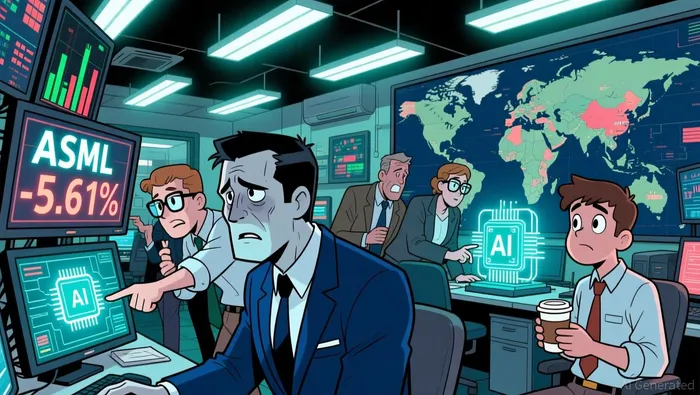
On 2025-11-20, ASML HoldingASML-- (ASML) experienced a significant decline, . market, . This performance places ASMLASML-- among the most actively traded stocks of the day, yet its sharp intraday drop highlights investor caution or profit-taking following recent strategic developments. The decline contrasts with the company’s broader narrative of long-term growth, as outlined in recent analyst commentary, but underscores short-term volatility linked to macroeconomic and geopolitical uncertainties.
Key Drivers
ASML’s strategic investment of €1.3 billion in French AI firm Mistral AI, , has positioned the semiconductor equipment giant at the forefront of AI-driven lithography innovation. The partnership aims to integrate Mistral’s generative AI tools into ASML’s extreme ultraviolet (EUV) lithography systems, enhancing productivity, precision, and time-to-market for advanced chips. This move aligns with the growing demand for AI-enabled semiconductor manufacturing, as chipmakers race to expand capacity for AI workloads. Analysts highlight that the collaboration could redefine ASML’s competitive edge, enabling faster innovation cycles and reduced development costs. However, the investment does not immediately address near-term challenges, such as slowing demand in China or the high costs of ramping High-NA EUV technology.
CEO ’s recent assertion that Dutch-China political tensions have not yet disrupted ASML’s operations has provided a degree of stability to investor sentiment. This reassurance is critical for maintaining customer confidence amid global supply chain uncertainties and geopolitical risks. The company’s ability to navigate these challenges while advancing its High-NA EUV roadmap remains a key catalyst for long-term growth. High-NA EUV technology, expected to enable sub-1nm chip production, is projected to drive revenue and earnings growth, . These projections require 7.2% annual revenue growth and a €2.7 billion earnings increase from current levels, reflecting ambitious but achievable targets for a company with ASML’s market dominance.
The investment narrative for ASML also faces headwinds from global tariff uncertainties, which could disrupt cost structures and margins. , significantly above the sector average—reflects optimism about its AI and EUV integration, it also raises questions about short-term profitability. , indicating a broad spectrum of opinions. , but this hinges on the successful execution of ASML’s strategic initiatives and the absence of major geopolitical shocks.
ASML’s competitive positioning in the semiconductor equipment space further influences its investment story. While it remains the sole provider of EUV lithography tools, rivals like Applied Materials (AMAT) and KLA Corporation (KLAC) play critical roles in the broader ecosystem. Applied Materials’ deposition and etching tools and KLA’s process control systems are essential for advanced and mature node manufacturing. ASML’s focus on AI integration and EUV innovation could differentiate it in the long term, but near-term growth will depend on its ability to maintain market share in China and manage the transition to High-NA technology. The Zacks Consensus Estimate for 2025 revenue of $37.64 billion—a 23.2% year-over-year increase—underscores the potential for robust growth, provided demand for AI-driven chips continues to accelerate.
In summary, ASML’s stock performance reflects a complex interplay of strategic advancements, geopolitical risks, and market dynamics. While the Mistral AI partnership and High-NA EUV roadmap offer compelling long-term growth prospects, near-term volatility is likely to persist due to macroeconomic uncertainties and supply chain challenges. Investors will need to weigh the company’s technological leadership against the risks of global tariffs and shifting demand patterns, particularly in key markets like China. For now, ASML’s ability to balance innovation with operational resilience will determine whether its current valuation justifies the optimism embedded in analyst forecasts.

Encuentre esas acciones que tengan un volumen de transacciones explosivo.
Latest Articles
Stay ahead of the market.
Get curated U.S. market news, insights and key dates delivered to your inbox.
AInvest
PRO
AInvest
PRO



Comments
No comments yet