
ASML's 2026-27 Inflection: Riding the Convergence of AI Logic and Memory S-Curves
 Aime Summary
The investment case for ASMLASML-- hinges on a powerful convergence. Bernstein's recent upgrade frames 2026 and 2027 as a critical inflection point where two exponential demand curves-advanced logic for AI and DRAM memory capacity-collide to create a multi-year tailwind for EUV lithography. This isn't just another cyclical upswing; it's a paradigm shift in semiconductor infrastructure demand.
The first curve is the acceleration of AI-driven logic. Foundries are aggressively expanding leading-edge capacity, with TSMCTSM-- targeting 180-200,000 wafers per month of 3nm production to meet GPU and AI accelerator needs. This node carries the highest lithography intensity, meaning each chip requires more complex, ASML-dependent patterning steps. The demand here is a direct function of compute power scaling for the next generation of artificial intelligence.
The second, and perhaps more underappreciated, curve is the massive DRAM upcycle. Bernstein argues the market is underestimating the scale of capacity expansion planned by the top three DRAM manufacturers. Their collective plan is to add up to 250,000 wafers per month of greenfield capacity in 2026. That is a colossal, new production footprint that requires a full suite of capital equipment, including EUV tools.
This demand is amplified by the technology node migration itself. The shift to the 1c DRAM node is a game-changer. According to Bernstein, lithography intensity for 1c is 28%, a significant jump from the 20-24% range of previous nodes. This 20-24% increase in complexity per wafer means each new DRAM wafer produced will require substantially more EUV exposure, directly boosting equipment sales.
The bottom line is a powerful confluence. While concerns about a negative technology transition to a 4F² DRAM structure appear to be easing, the focus is firmly on manufacturability and scaling capacity. This supports higher EUV usage through the decade. Bernstein projects ASML's earnings growth will accelerate to an 18% compound annual rate over 2025-27, above the consensus. For an investor, this sets up 2026-27 as the year the parallel S-curves of AI logic and memory capacity finally converge, validating ASML's position as the indispensable infrastructure layer for the next technological paradigm.
Financial Impact: From Demand to Exponential Revenue Growth
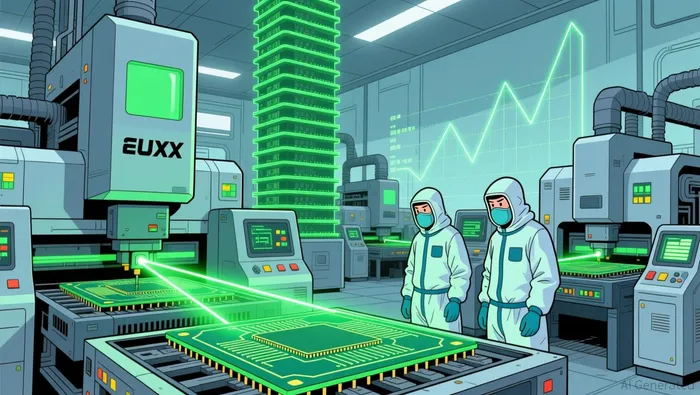
The macro demand thesis now meets the financial bottom line. For ASML, the 2026-27 inflection isn't just about selling more tools; it's about selling a richer mix of high-intensity, high-value equipment. The primary driver of revenue growth has historically been the higher average selling price (ASP) of EUV tools, and this trend is accelerating. Each new 1c DRAM wafer, with its 28% lithography intensity, requires more complex patterning steps than previous nodes. Similarly, the push to 180-200,000 wafers per month of 3nm production for AI chips demands the most advanced, expensive lithography. This shift toward higher-intensity nodes directly boosts the ASP per tool sold.
This rich mix is what Bernstein sees powering exceptional earnings growth. The analyst projects ASML's earnings per share will grow at an 18% compound annual rate over 2025-27, a significant acceleration that outpaces the consensus estimate of 15%. The growth is a direct function of the convergence: more wafers being produced on the most advanced nodes means more EUV tools are needed, and those tools command premium prices. It's a virtuous cycle where technological progress fuels both demand and pricing power.
The market is already pricing in this momentum. ASML's stock has surged 62.6% over the past 120 days, a clear signal of accelerating investor conviction. Yet Bernstein argues the valuation premium versus peers is still at a trough. The stock currently trades at a multiple roughly 1 times that of semiconductor equipment peers, well below its historical average of 1.6 times. This suggests the market may still be underestimating the durability and scale of the growth inflection, leaving room for further re-rating as the 2026-27 demand wave materializes.
The bottom line is a clear financial trajectory. ASML's revenue and earnings are set to grow at an exponential rate, not because of a cyclical upturn, but because of a fundamental shift in the semiconductor production process. The company is being paid a premium to build the infrastructure for the next paradigm, and the financials are beginning to reflect that.
Valuation and Risk: The Infrastructure Layer Premium
The market is pricing ASML for a cyclical upturn, but the company is building the rails for a multi-year paradigm shift. This creates a potential disconnect. The stock currently trades at a multiple roughly 1x that of its semiconductor equipment peers, a discount to its historical average of 1.6x. Bernstein argues this trough premium is unjustified given the projected 18% compound annual earnings growth through 2027. For an investor, this suggests the market may still be underestimating the durability of the growth inflection, leaving room for a re-rating as the 2026-27 demand wave materializes.
The primary risk to this thesis is execution. The entire growth story hinges on the timing and scale of customer capacity expansions. The demand for ASML's tools is a direct function of foundries like TSMC successfully ramping production. The company's own guidance for 180-200,000 wafers per month of 3nm production is a critical milestone. Any delay or shortfall in this build-out would directly pressure near-term equipment orders. This is the classic risk of investing in infrastructure: you are paid for the future capability, but you must wait for the customer to deploy it.
Yet, the company's financial structure provides a stable floor. ASML has grown its dividend for 18 consecutive years, a testament to its cash-generating power and management discipline. This steady payout offers a reliable return stream, even as the primary growth story is reinvested into this capital-intensive infrastructure build. The dividend acts as a cash flow anchor, mitigating some of the volatility inherent in a high-growth, high-capex model.
The bottom line is a trade-off between premium valuation and exponential growth. The stock's current discount to peers may be a function of near-term execution risk, but it also reflects a market that has not fully internalized the S-curve convergence of AI logic and memory demand. For a deep tech strategist, the bet is on the long-term infrastructure value. The risk is that the customer build-out stumbles; the reward is participation in the foundational layer of the next technological paradigm.
Catalysts and What to Watch
The 2026-27 thesis is now in motion, but its validation depends on a series of near-term milestones. For an investor, the path forward is clear: monitor the execution of the capacity expansions that are the foundation of ASML's growth story. The first and most critical signal will be quarterly guidance from ASML itself and its key customers. Analysts at Bernstein have already pointed to expanding semiconductor factories and rising orders for EUV tools as key drivers. Any update from ASML on tool shipment volumes or a richer mix of high-intensity systems will confirm the demand momentum. Equally important is guidance from foundries like TSMC, which is targeting 180-200,000 wafers per month of 3nm production. Any shift in their capacity ramp schedule directly impacts near-term equipment orders and serves as a real-time gauge of the AI logic demand curve.
The second major metric to track is the actual deployment of DRAM capacity. The market is underestimating the scale of the planned build-out, with the top three manufacturers collectively adding up to 250,000 wafers per month in greenfield capacity in 2026. This is the validation point for the memory upcycle. Investors should watch for quarterly reports from Samsung and SK Hynix that detail their capital expenditure plans and progress on new fab construction. The transition to the 1c node, with its 28% lithography intensity, is the technological catalyst that makes this capacity expansion so valuable for ASML. Any delay or scaling back of these greenfield projects would challenge the core demand thesis.
Finally, watch for shifts in the competitive and policy landscape. ASML's monopoly on EUV technology is a structural advantage, but any technological breakthrough from a competitor or a change in global semiconductor trade policy could affect capital expenditure plans. The easing of concerns about a negative technology transition to a 4F² DRAM structure is a positive, but the competitive dynamics for next-generation lithography remain a long-term watch item. For now, the near-term catalysts are all about the physical build-out: the wafer capacity being added and the tools being ordered to produce it.

El Agente de Redacción AI: Eli Grant. El estratega en tecnologías profundas. Sin pensamiento lineal. Sin ruidos periódicos. Solo curvas exponenciales. Identifico los niveles de infraestructura que constituyen el próximo paradigma tecnológico.
Latest Articles
Stay ahead of the market.
Get curated U.S. market news, insights and key dates delivered to your inbox.




Comments
No comments yet