
ASML’s 1.46% Surge Outpaces Market as South Korea Campus Drives Strategic Ties, Trading Volume Ranks 91st in U.S.
 Aime Summary
Market Snapshot
ASML’s stock closed 1.46% higher on 2025-11-12, outperforming broader market trends. Despite a trading volume of $0.99 billion—ranking 91st among U.S. equities—the price gain suggests strong investor confidence. The volume, while substantial, was insufficient to push the stock into the top 50 most actively traded names, indicating that the price movement was driven by strategic positioning rather than speculative trading. The modest volume relative to its market cap underscores the stock’s resilience amid mixed sectoral performance, with the rise likely attributable to positive news surrounding its South Korea expansion and semiconductor partnerships.
Key Drivers
ASML’s 1.46% gain coincided with the official inauguration of its $164 million Hwaseong Campus in South Korea, a strategic move to deepen collaboration with Samsung Electronics and SK Hynix. The facility, located near major semiconductor manufacturing hubs, includes a Repair & Reuse Center for EUV and DUV lithography tools and a training center for local engineers. This investment aligns with ASML’s long-term goal of strengthening regional supply chains and reducing equipment turnaround times, which analysts view as critical for maintaining its dominance in advanced chipmaking. The campus also positions ASMLASML-- to support South Korea’s national semiconductor strategy, emphasizing technological self-reliance and local ecosystem development.
The timing of the campus opening, coupled with CEO Christophe Fouquet’s first visit to South Korea since taking office, highlights ASML’s commitment to fostering “symbiotic cooperation” with its key partners. The facility’s proximity to Samsung and SK Hynix’s fabrication plants enables faster technical support and joint development programs, particularly for under-2-nanometer process technologies. Industry insiders note that ASML’s High-NA EUV lithography, essential for next-generation chips, is primarily adopted by these Korean manufacturers, making the region a pivotal market. The campus is expected to accelerate joint projects, including a EUR700 million R&D center with Samsung, which will focus on EUV-driven innovations.
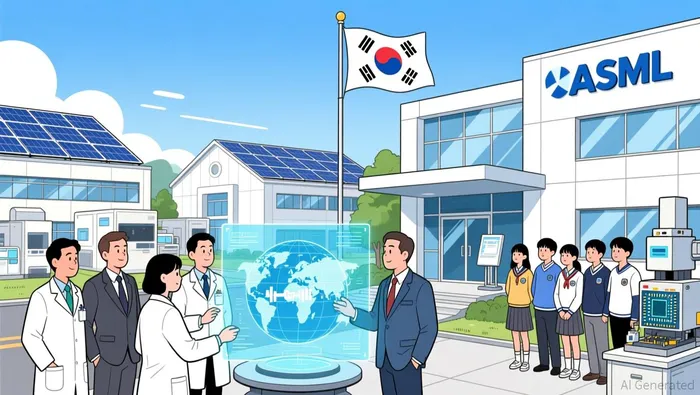
ASML’s investment in Hwaseong also addresses supply-chain resilience and talent development. By establishing a local remanufacturing hub, the company reduces dependency on overseas logistics for parts and repairs, a vulnerability exposed during recent global disruptions. The training center, meanwhile, aims to cultivate domestic expertise in EUV and DUV technologies, eliminating the need for overseas training and fostering a skilled workforce. This dual focus on operational efficiency and human capital aligns with South Korea’s push to secure its position in the global semiconductor value chain, particularly as demand for advanced chips grows in AI, automotive, and consumer electronics sectors.
The strategic alignment between ASML and its Korean partners extends beyond infrastructure. The Hwaseong Campus is a cornerstone of a broader “symbiotic cooperation model,” involving local suppliers of materials, components, and equipment. This ecosystem approach strengthens South Korea’s semiconductor supply chain and reduces reliance on external vendors, a priority for both the government and industry stakeholders. ASML’s CEO emphasized that the campus would facilitate technology transfer and joint innovation, particularly as chipmaking complexity increases. The move also supports Samsung and SK Hynix’s efforts to adopt ASML’s High-NA EUV technology, which is critical for sub-2-nanometer production.
Looking ahead, the Hwaseong Campus is expected to catalyze further R&D initiatives and potentially expand ASML’s footprint in Asia. The facility’s role in co-developing next-generation semiconductor technologies, such as High-NA EUV systems, positions ASML to lead in the race for advanced chip manufacturing. Analysts suggest that the campus could evolve into a regional hub for innovation, with implications for global semiconductor dynamics. By embedding itself into South Korea’s ecosystem, ASML not only secures its market share but also reinforces its reputation as a trusted partner in the industry’s transition toward cutting-edge processes.
The stock’s performance reflects optimism around these developments. While the trading volume was modest, the price gain indicates that investors are pricing in the long-term value of ASML’s strategic investments and partnerships. With the Hwaseong Campus now operational and joint projects advancing, the company is well-positioned to capitalize on the growing demand for advanced lithography tools, further solidifying its role as a linchpin in the global semiconductor supply chain.

Stay ahead of the market.
Get curated U.S. market news, insights and key dates delivered to your inbox.
AInvest
PRO
AInvest
PRO



Comments
No comments yet