
Asian Policy Momentum Gains Ground in 2026
 Aime Summary
The sixth annual U.S.-Taiwan Economic Prosperity Partnership Dialogue (EPPD) focused on supply chain security, critical minerals, and bilateral cooperation, highlighting strategic alignment in economic security and innovation according to official reports.
The EPPD emphasized collaboration in semiconductor and AI industries, with agreements to reduce tariffs and support cross-sector partnerships for resilient supply chains as reported.
A U.S.-Taiwan reciprocal tariff agreement reduced tariff rates to 15% for key industries and outlined $250 billion in investments in semiconductors, AI, and energy, strengthening their economic integration according to the agreement.
The sixth annual U.S.-Taiwan Economic Prosperity Partnership Dialogue (EPPD) marked a significant step in deepening economic cooperation between the two nations. Held in Washington, DC, the dialogue focused on four key areas: supply chain security, critical minerals, third-country engagement, and bilateral collaboration as detailed. The strategic directions outlined included enhancing economic security by building resilient supply chains, fostering innovation through complementary strengths in technology and manufacturing, and expanding cross-sector partnerships according to the report.
The dialogue also covered emerging areas such as AI supply chains and digital infrastructure, reflecting a broad and interconnected partnership. The collaboration is expected to strengthen economic ties and promote innovation-driven growth in both regions as stated.
One of the key outcomes of the EPPD was the reciprocal tariff agreement, which reduces tariffs for traditional industries and provides favorable treatment for semiconductors and AI products under Section 232 of the U.S. Trade Expansion Act according to the agreement. This agreement is part of a broader strategic economic partnership that includes provisions for semiconductor and semiconductor-derived products, granting them most-favored treatment as outlined.
Under the agreement, Taiwan will invest $250 billion in areas including semiconductors, AI applications, electronics manufacturing services, and energy. Additionally, the government will provide up to $250 billion in credit guarantees to support investments according to the agreement. The agreement also establishes a two-way investment mechanism to encourage U.S. investment in Taiwan's five trusted industries, further integrating Taiwanese manufacturing with U.S. technology leadership as detailed.
The U.S.-Taiwan partnership is positioned to strengthen supply-chain security and support the U.S. re-industrialization process by leveraging Taiwan's manufacturing and supply-chain expertise according to the report. This institutionalized cooperation is expected to create a more structured pathway for industrial collaboration, particularly in AI and startup ecosystems, making Taiwan an indispensable partner for the U.S. high-technology competitive strategy as reported.
The U.S.-Taiwan partnership also includes initiatives to build a 'non-red supply chain' independent of China, advancing supply-chain security, certification of uncrewed aerial vehicles, and the removal of investment-related tax barriers according to the report. These initiatives aim to keep pace with technology-driven industrial restructuring and move toward a next generation of prosperity as noted.
What Are the Key Outcomes of the U.S.-Taiwan Reciprocal Tariff Agreement?
The U.S.-Taiwan reciprocal tariff agreement is a strategic economic compact that aligns with broader industrial and technological cooperation as stated. The agreement reduces tariffs from as high as 32% to a reciprocal rate of 15%, which is not stacked on top of the Most-Favored-Nation (MFN) tariff according to the agreement. This move is intended to make Taiwan a more attractive destination for U.S. investment and to facilitate the flow of high-value goods and services between the two economies as reported.
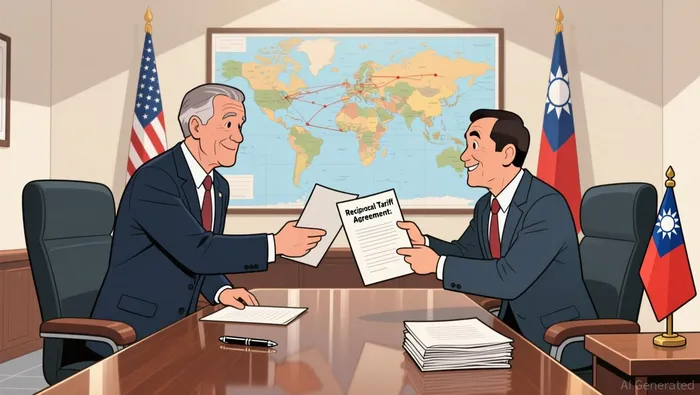
The agreement also provides special treatment for semiconductors and AI products under Section 232 of the U.S. Trade Expansion Act. This provision is designed to support the U.S. high-technology competitive strategy by giving U.S. firms access to a reliable and technologically advanced supply chain according to the agreement.
Taiwan will invest $250 billion in areas including semiconductors, AI applications, electronics manufacturing services, and energy. The government will also provide up to $250 billion in credit guarantees to support these investments according to the agreement. This level of financial commitment underscores the strategic importance of the partnership and the shared vision of economic and technological advancement as detailed.
How Does the U.S.-Taiwan Partnership Impact Global Supply Chains?
The U.S.-Taiwan partnership is expected to have a significant impact on global supply chains by promoting economic security and innovation-driven growth according to the report. The collaboration is designed to build resilient supply chains that are independent of China, thereby reducing geopolitical risks and enhancing economic stability as stated. This approach is aligned with broader U.S. and global efforts to diversify supply chains and reduce over-reliance on a single region according to the report.
The partnership also includes provisions for critical minerals and third-country engagement, further expanding the scope of collaboration beyond bilateral interests. This multi-faceted approach is intended to create a more resilient and diversified global supply chain network as reported.
The U.S.-Taiwan partnership also supports the development of industrial clusters and the export of science-park governance experience, which can help reduce institutional costs for firms and promote more efficient industrial collaboration according to the agreement. These initiatives are expected to create a more structured pathway for industrial collaboration, particularly in AI and startup ecosystems, making Taiwan an indispensable partner for the U.S. high-technology competitive strategy as detailed.
What Are the Broader Implications of the U.S.-Taiwan Economic Cooperation?
The U.S.-Taiwan economic cooperation has broader implications for global trade and investment. The partnership is positioned to strengthen supply-chain security and support the U.S. re-industrialization process by leveraging Taiwan's manufacturing and supply-chain expertise according to the report. This institutionalized cooperation is expected to create a more structured pathway for industrial collaboration, particularly in AI and startup ecosystems, making Taiwan an indispensable partner for the U.S. high-technology competitive strategy as stated.
The partnership also includes initiatives to build a 'non-red supply chain' independent of China, advancing supply-chain security, certification of uncrewed aerial vehicles, and the removal of investment-related tax barriers according to the report. These initiatives aim to keep pace with technology-driven industrial restructuring and move toward a next generation of prosperity as noted.
The U.S.-Taiwan partnership is also expected to have a positive impact on the global economy by promoting innovation-driven growth and economic security. The collaboration is designed to expand cross-sector partnerships and foster a prosperous future for both nations as reported. This strategic alignment is expected to have far-reaching implications for global trade and investment, particularly in the high-technology sector according to the report.

Blending traditional trading wisdom with cutting-edge cryptocurrency insights.
Latest Articles
Stay ahead of the market.
Get curated U.S. market news, insights and key dates delivered to your inbox.


AInvest
PRO
AInvest
PRO



Comments
No comments yet