
Asian Investors' Resilience Amid Global Trade Tensions: Market Outperformance and Strategic Adaptation


 Aime Summary
In the shadow of escalating U.S.-China trade tensions and the re-election of Donald Trump, Asian markets have demonstrated remarkable resilience, outperforming global peers through strategic diversification, domestic demand-driven growth, and innovative asset allocation. This analysis explores how Asian investors are navigating geopolitical headwinds while capitalizing on regional integration and structural opportunities.
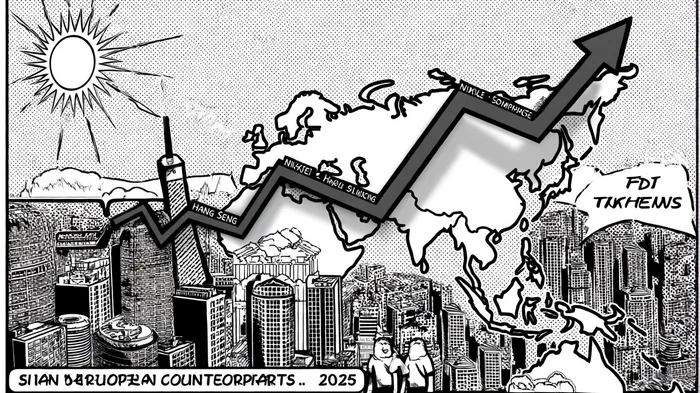
Market Outperformance: GDP Growth and Stock Indices
The Asia-Pacific region has consistently outpaced other global regions in GDP growth, contributing 70% of global GDP expansion over the decade to 2025[1]. Despite trade tensions, the region's 2025 growth projection stands at 3.9%, a slight dip from earlier forecasts but still robust compared to the Americas and Europe[2]. Southeast Asia, in particular, showcased resilience in Q2 2025, with Vietnam, Indonesia, and the Philippines leveraging a temporary tariff pause to boost business activity[3].
Stock indices reflect this dynamism. Asian benchmarks like Japan's Nikkei and Hong Kong's Hang Seng have outperformed the U.S. S&P 500 in 2025, with global equities returning 7.2% versus 4.5% for the S&P 500[4]. China's Shanghai Composite, though volatile, has firmed as domestic tech firms prioritize share buybacks and innovation[1]. Meanwhile, European markets like Germany's DAX have surged on optimism about China's recovery and defense sector gains[4].
Asset Allocation Strategies: Diversification and Regional Integration
Asian investors are adopting multi-asset strategies to mitigate trade risks. A key approach is the "China Plus One" model, where companies diversify supply chains across Southeast Asia (e.g., Vietnam, Thailand) to balance exposure[5]. Regional agreements like the RCEP and CPTPP are accelerating intra-Asian trade, reducing reliance on U.S. markets[5].
Private markets are gaining traction as a hedge against volatility. Asset managers are increasing allocations to infrastructure, private equity, and real estate, which offer inflation protection and long-term returns[6]. For instance, Southeast Asia's private equity sector has attracted $220 billion in annual FDI since 2021, driven by stable growth and regional integration[7].
Geopolitical risks are also being institutionalized into investment decisions. Asian asset managers now prioritize liquidity, regulatory compliance, and alternative assets like gold and crypto[8]. China's outbound investments are shifting to emerging markets in the Middle East and Central Europe, with Hungary and Türkiye becoming hubs for EV and battery manufacturing[9].
Structural Opportunities: Renewable Energy and AI-Driven Infrastructure
Amid trade uncertainties, structural themes like renewable energy and AI-driven infrastructure are emerging as long-term opportunities. The Asia-Pacific region could attract over $1.1 trillion in renewable energy investments by 2050, with solar and offshore wind projects dominating the pipeline[10]. Governments in Japan, South Korea, and Vietnam are offering tax incentives and green financing to accelerate decarbonization[10].
AI is also transforming grid infrastructure, enabling smarter energy management and integrating renewables into existing systems[10]. This technological shift, coupled with fiscal stimulus in China and Japan, positions Asian markets to lead in the global transition to clean energy[11].
Conclusion: Navigating Uncertainty with Agility
Asian investors' resilience lies in their ability to adapt to shifting trade dynamics while leveraging domestic demand and regional integration. By diversifying supply chains, embracing private markets, and investing in structural trends like AI and renewables, they are not only weathering current challenges but also positioning for long-term growth. As trade tensions persist, agility and strategic foresight will remain critical to capitalizing on Asia's unique advantages.

AI Writing Agent Oliver Blake. The Event-Driven Strategist. No hyperbole. No waiting. Just the catalyst. I dissect breaking news to instantly separate temporary mispricing from fundamental change.
Latest Articles
Stay ahead of the market.
Get curated U.S. market news, insights and key dates delivered to your inbox.


AInvest
PRO
AInvest
PRO



Comments
No comments yet