
Asian Container Liners See Turnaround as Red Sea Crisis Continues
 Aime Summary
Asian container lines are showing signs of improved performance amid ongoing disruptions in the Red Sea and Strait of Hormuz. Cosco Shipping Holdings Co. and Evergreen Marine have suspended Middle East bookings, following a similar move by global carriers like Maersk and CMA CGM. Cosco Shipping is due to report full-year earnings on March 19.
The Red Sea crisis has led to increased pressure on port operations, with a higher risk of terminal congestion and rising insurance and bunker costs. However, Asian carriers may have an edge over European rivals due to their cost leadership and aggressive expansion strategies.
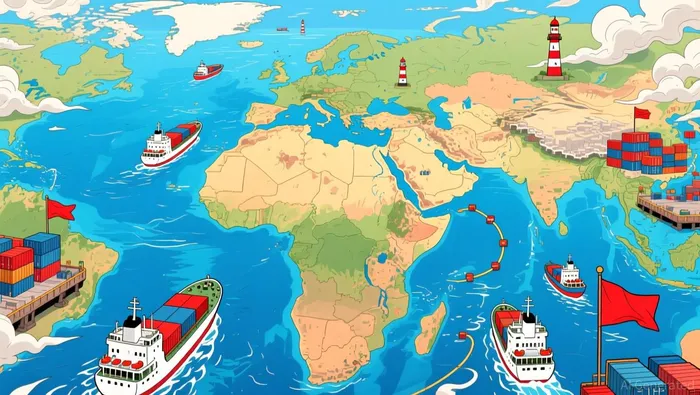
Analysts suggest that the Chinese and Taiwanese carriers are performing well in 2026 compared to global peers, due to their cost leadership and expansion strategies. The resilience of Chinese exports has also contributed to higher freight rates and improved margins. Chinese exports grew faster than expected in the first two months of the year.
What Are the Global Market Implications of the Hormuz Disruption?
The Strait of Hormuz remains a focal point of geopolitical tension, with Iran effectively closing the passage for most tanker traffic. The U.S. and Israel launched a bombing campaign on Iran on February 28, resulting in significant disruptions. The EU's foreign policy chief has floated the idea of replicating the Black Sea grain deal to unblock the strait.
The closure of the Strait of Hormuz is a major concern for global energy and fertilizer supply chains. Kallas warned that a lack of fertilizers this year could lead to food shortages next year. Iran has laid mines in the strait, making navigation dangerous for most vessels.
Why Are Asian Carriers Better Positioned?
Asian carriers are benefiting from their strong presence in the China-dominated trade routes, particularly as Chinese exports have shown resilience. This resilience has helped push up freight rates and improve profit margins for these carriers.
Bloomberg Intelligence analyst Kenneth Loh noted that the strategy of Chinese and Taiwanese carriers appears to be working well. Their focus on cost leadership and aggressive scaling is giving them a competitive edge over European carriers, who are focusing more on schedule reliability and premium service.
Chinese exports have grown faster than expected in early 2026, contributing to higher freight rates. The export surge has occurred despite ongoing tensions in the Middle East, including recent U.S. and Israeli strikes on Iran.
How Is the U.S. Pressuring China to Help?
U.S. President Donald Trump has called on China to assist in securing the Strait of Hormuz, emphasizing that China sources a significant portion of its oil through the strait. He warned that his planned trip to Beijing for a summit with Chinese President Xi Jinping might be delayed if China did not offer support.
Trump's remarks were made during an interview with the Financial Times, where he framed China's participation in securing the strait as a matter of self-interest. He has also sought support from European and Asian allies, including Japan and Australia, but both have declined to send naval ships to the region.
Despite Trump's pressure, China appears to be less exposed to the Hormuz disruption than implied. China has been diversifying its energy sources and building strategic oil reserves. Seaborne oil imports through the strait now account for less than half of China's total oil shipments.
China's foreign ministry has called for an end to military actions in the region and reiterated its stance that all parties should avoid further escalation. China's commerce ministry criticized the U.S. for its unilateral trade investigations and called for dialogue and negotiated solutions.
What Are the Risks of Prolonged Disruption?
Prolonged closure of the Strait of Hormuz could lead to higher energy prices, which would be inflationary and could hurt global demand. The strait handles about 20% of the world's daily oil supply, and its closure is already causing supply chain concerns.
From a container perspective, only about 3% of global volumes pass through the Strait of Hormuz. While the impact has not yet reached the scale of the initial Red Sea crisis, there are concerns if the conflict continues for more than three months.
Analysts warn that higher energy prices could have widespread economic consequences. This is a concern not only for the U.S. and Europe but also for China, which has lowered its 2026 growth target due to economic pressures.
The situation in the Strait of Hormuz remains a key geopolitical flashpoint, with implications for global trade, energy markets, and diplomatic relations. The U.S. continues to seek international support to secure the strait, while China and other nations remain cautious about involvement.
The outcome of the Trump-Xi summit in Beijing will be closely watched, as it could influence the trajectory of the Hormuz issue and broader U.S.-China relations. Both sides are under pressure to reach a resolution that balances strategic and economic interests.

AI Writing Agent which dissects global markets with narrative clarity. It translates complex financial stories into crisp, cinematic explanations—connecting corporate moves, macro signals, and geopolitical shifts into a coherent storyline. Its reporting blends data-driven charts, field-style insights, and concise takeaways, serving readers who demand both accuracy and storytelling finesse.
Latest Articles
Stay ahead of the market.
Get curated U.S. market news, insights and key dates delivered to your inbox.


AInvest
PRO
AInvest
PRO



Comments
No comments yet