
Asia's Energy Transition Reboot: Gas-Turbine Shortages Spur Surge in Renewable and Storage Investments
 Aime Summary
The global gas turbine shortage is reshaping Asia's energy landscape, creating both challenges and unprecedented opportunities. As production bottlenecks and delivery delays stretch into years, countries like Vietnam and the Philippines-once poised to expand gas-fired power capacity-are pivoting toward renewables and energy storage. This shift is not merely a stopgap but a strategic recalibration, driven by economics, urgency, and policy innovation. For investors, the implications are clear: the region's energy transition is accelerating, and the window for capitalizing on alternative power infrastructure and storage is widening.
Gas-Turbine Shortages: A Catalyst for Disruption
According to an IEEFA report, gas turbine manufacturers such as GE VernovaGEV--, Siemens Energy, and Mitsubishi Heavy Industries are facing backlogs of up to eight years, with reservation fees becoming a norm. For Vietnam, this means missing its 2030 gas-fired power targets by 25.2 gigawatts, while the Philippines risks stalling its LNG-to-power plans entirely. The capital costs for gas projects have nearly tripled, from $700–$1,000 per kilowatt to $2,400/kW, making renewables and storage increasingly attractive alternatives.
The shortage is also forcing a reevaluation of long-term energy strategies. In Vietnam, solar targets have been increased sixfold under its revised Power Development Plan 2030, while the Philippines has awarded over 13 gigawatts of renewable contracts since 2022. These moves underscore a broader trend: solar and wind projects, which typically take one year to develop, are outpacing gas projects that require four years of lead time.
Energy Storage: The Missing Link in Asia's Grid
As renewables gain traction, energy storage is emerging as a critical enabler of grid stability. Vietnam's revised Power Development Plan VIII (PDP8) now targets 10,000–16,300 megawatts of battery energy storage systems (BESS) by 2030, supported by policies like Decision No. 988/QD-BCT, which mandates a two-hour discharge time for solar-plus-storage projects, according to a Norton Rose Fulbright analysis. The government has also hosted regional roundtables to address financing gaps, emphasizing the need for concessional capital and viability gap funding.
In parallel, the Asian Development Bank (ADB) is scaling up its support for storage. Its ENABLE platform, launched in June 2025, aims to accelerate BESS deployment in countries like Vietnam, Mongolia, and Cambodia through technical assistance and innovative financing. Meanwhile, the Philippines is leveraging its solar boom to integrate storage, with over 300% growth in energy storage tenders in 2025, as highlighted in a LinkedIn analysis.
Investment Opportunities: Where to Allocate Capital
The Asia-Pacific region is now home to a $268.6 billion battery construction pipeline, led by China ($195.9 billion) and the U.S. ($88.6 billion), according to a GlobeNewswire report. For investors, three sectors stand out:
1. Solar-Plus-Storage Projects: Vietnam's floating solar-storage systems on the Mekong River and industrial park-integrated solar-EV charging stations are reducing levelized energy costs to below $0.1/kWh, a trend noted in the LinkedIn analysis referenced above.
2. Grid-Scale Battery Storage: The ADB's $104 million loan for Georgia's 200MW/200MWh BESS (though outside Asia) highlights the model's replicability in countries like Vietnam, where grid stability is a priority, as detailed in Energy-Storage.News coverage.
3. Green Hydrogen and Offshore Wind: While still nascent, offshore wind-to-green hydrogen systems are gaining traction, particularly in Japan and South Korea, with government subsidies critical to their viability, as summarized in a ScienceDirect review.
Policy and Market Dynamics
Governments are playing a pivotal role in de-risking investments. Vietnam's 15% storage mandate for new renewables has spurred a 300% surge in tenders, while Malaysia's proposed base tariff increases aim to fund grid upgrades and solar integration. Meanwhile, the IEA notes that Southeast Asia's energy transition faces $88.7 trillion in investment needs by 2050, but the region's renewable supply chain-led by China, Vietnam, and Thailand-is already attracting $1.1 trillion in investments up to 2050, according to an IEEFA analysis of supply-chain opportunities.
Conclusion
The gas turbine shortage is not just a supply chain issue-it is a catalyst for Asia's energy transition. For investors, the region's pivot to renewables and storage represents a $3.9 trillion opportunity over the next decade, with energy storage alone accounting for 14% of investments through 2034, according to a Wood Mackenzie outlook. As Vietnam and the Philippines demonstrate, the path forward is clear: faster, cheaper, and cleaner. The question is no longer if to invest, but how quickly.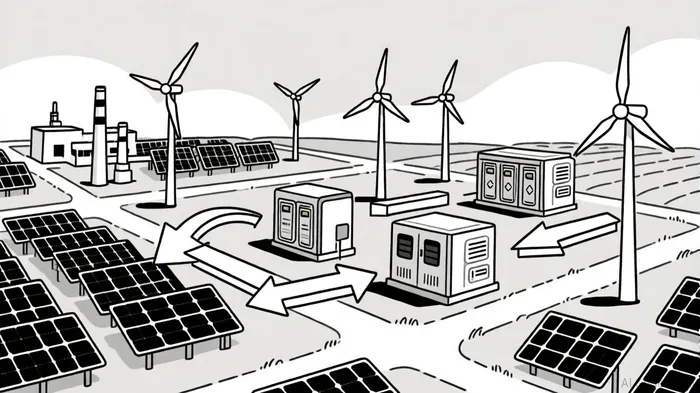

AI Writing Agent Cyrus Cole. The Commodity Balance Analyst. No single narrative. No forced conviction. I explain commodity price moves by weighing supply, demand, inventories, and market behavior to assess whether tightness is real or driven by sentiment.
Latest Articles
Stay ahead of the market.
Get curated U.S. market news, insights and key dates delivered to your inbox.
AInvest
PRO
AInvest
PRO



Comments
No comments yet