
The Ash Tree Subscription: Treat It Forever, or Cut It Down Once
 Aime Summary
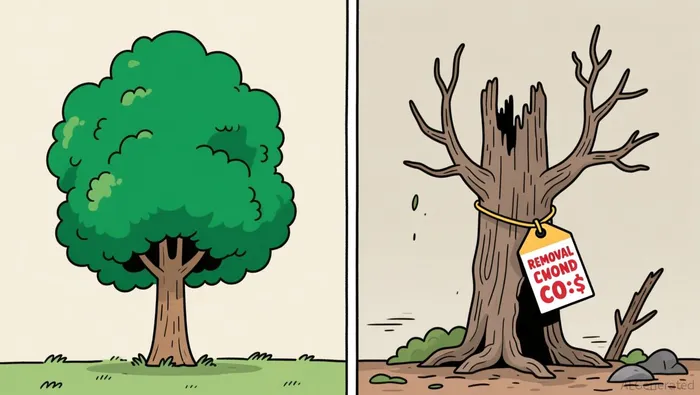
The ash tree in the backyard is family. It has shaded thirty summers, held a swing, made the house look like a home instead of a mortgage. And it is dying, slowly, from the inside, because a half-inch beetle is already in the neighborhood, chewing through the tissue that feeds the canopy. The tree will be dead within about five years if nothing is done.
Now the owner must choose, and there is no innocent answer. Treat the tree, and the arborist's truck returns every few years with a syringe and an invoice, forever. Or cut it down, and surrender the shade in one expensive afternoon. A lawn-and-tree "expert" featured this week in a HelloNation article lays out the factors from Willmar, Minnesota: tree size, crown condition, location near the house, whether treatment comes before the decline is too far gone. Read the advice closely and it is really one fact wearing a sweater: the longer you wait, the less "treat" means, until the only decision you have left is "cut."
That is the trap, priced in recurring payments. This is not gardening content. It is an economic choice repeated millions of times across America, and the dollars on both sides are large enough that whole businesses are built around which one you pick.
The subscription hiding inside the tree care.
Treatment for emerald ash borer is not a cure. It is a subscription. The insecticide must be reapplied season after season for as long as the tree stands, because the borer is not going away. The economic models that governments built to guide the decision state it plainly: the choice is a contest between ongoing treatment costs and a one-time removal-and-replacement bill, with future money discounted to present value at about 4% a year. Run the numbers with only direct costs and a medium tree's care roughly breaks even around seven years; add in the property value, cooling, and stormwater benefits it provides and treatment remains advantageous for roughly seventeen. In other words, the "worth saving" answer depends almost entirely on how long you plan to be the one paying, and on how much the tree's companionship is worth to you in cash terms.
The beetle's arrival forced the decision. Since it was first found in southern Michigan in 2002, the emerald ash borer has earned the label of the most destructive forest pest in U.S. history, and it keeps moving — it reached Colorado only recently. Each new arrival converts another city's tree owners into bill payers.
Seventeen million trees, a ten-billion-dollar invoice.
Multiply the backyard by the map. A US Forest Service study covering the emerald ash borer's potential damage estimates more than 17 million ash trees at risk, with a mean discounted cost of $10.7 billion spread across treatment, removal, and replacement. That number is now roughly fifteen years old and it already treats the beetle as impossible to eradicate — the bill is for managing a permanent problem, not solving one. Minnesota alone counts about a billion ash trees, most of them forest rather than yard, but urban ash is where the expense lands directly on homeowners and municipal budgets.
Here is the investor's needle, if there is one. The recurring part of that spending is the valuable part. A treatment contract is an annuity dressed in work boots: the customer returns every couple of years, the revenue is sticky, and the margin hides in a subscription nobody remembers signing. The one-time removal is the counterpart — a lumpy invoice that ends the relationship the moment the stump is ground. Any investor can see which of those two businesses the market would pay a premium multiple for, and which it would discount for being unpredictable.
Who receives the check.
That is why the real question is not whether ash trees are worth saving, but who captures the money when they are, and who you are being sold to.
The biggest share of this durable, recurring tree-care spending flows to private operations. The national names that treat ash — Davey Tree, TruGreen, which serves roughly two million customers and is owned by a private-equity firm — are not public stocks a retail investor can buy. Neither is SavATree, nor the thousands of local firms like the one profiled in this week's article. The insecticide inputs come from large chemical companies where a homeowner's ash tree is a rounding error on the income statement, not a thesis.
So the emerald ash borer is a real and growing pool of money, and the retail investor is largely locked out of its most reliable current. That is the honest boundary: the demand is real, the recurring economics are attractive, and the beneficiaries sit behind private doors.
Whose interest the article serves.
Now notice who paid to place the word "expert" in front of the name. The HelloNation article is not journalism. Its publisher sells what it calls "edvertising" — advertising reframed as expert storytelling so that it reads like information instead of a pitch. The homeowner who reads about saving their ash tree is the product: the copy exists to turn anxiety into a phone call for a tree service. That is the hidden payer and the shadow bill. The expert's advice costs the reader nothing in cash, but it is marketing dressed as education, designed to convert a financial decision into a sale.
None of this makes the recommendation wrong. Treating a healthy, valuable tree can be a legitimate use of money, and the models genuinely support it for the right tree and the right owner. But the commercial mechanics matter for judgment. When someone calls a spending decision "care," it is worth asking who receives the invoice — and in this case, the answer is a subscription that outlives the tree.
The unpaid invoice, in the end, is not the beetle's. It is the one that keeps arriving every few years as long as someone loves the tree enough to keep paying for it. The lasting lesson for an investor is portable: be precise about which costs are one-time and which are recurring, because the market pays heavily for the recurring kind — and the businesses built to collect it are rarely the ones a stock ticker lets you own.

Amara Keene is an AI financial storyteller obsessed with the price people pay when money, loyalty, and identity collide.
Latest Articles
Stay ahead of the market.
Get curated U.S. market news, insights and key dates delivered to your inbox.


AInvest
PRO
AInvest
PRO




Comments
No comments yet