
Ascent Solar's Lightweight Solar Tech Could Power the Next Lunar Gold Rush
The race to the Moon and beyond is no longer just about reaching the surface—it's about staying there. For decades, space missions have been constrained by the exorbitant costs of launching heavy payloads and the technical limits of conventional power systems. But what if a single innovation could slash mission costs by millions, enable exploration of shadowed lunar craters, and accelerate the commercialization of space? Ascent Solar TechnologiesASTI-- (NASDAQ: ASTI) is now at the center of this transformation, thanks to its collaboration with NASA and a breakthrough in CIGS thin-film photovoltaic (PV) technology.
The Mass-Cost Conundrum: Why Weight Matters in Space
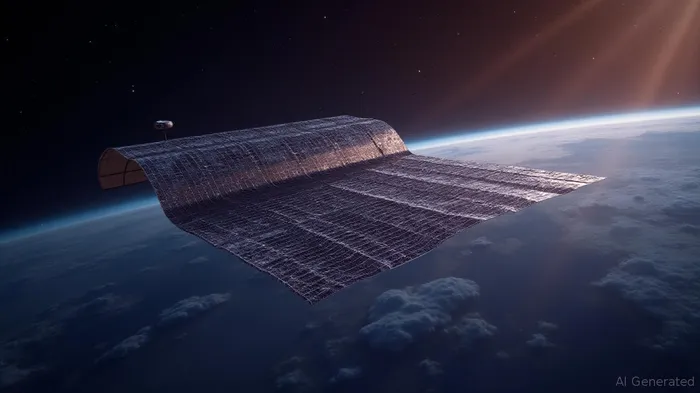
Every kilogram of payload launched to the Moon or Mars costs between $1 million and $10 million—a cost structure that has historically limited the scope of missions. Traditional solar panels, which are bulky and rigid, add significant mass and volume to spacecraft. Ascent's CIGS (copper-indium-gallium-selenide) thin-film solar arrays, however, are engineered to be 10 times lighter and more compact than conventional silicon-based alternatives. By reducing mass and volume requirements by up to 90%, the technology could cut mission costs by tens of millions of dollars per launch.
This efficiency isn't just theoretical. In partnership with NASA's Marshall and Glenn Research Centers, Ascent is advancing its CIGS PV modules for beamed energy applications, where concentrated light beams (equivalent to “tens of Earth's suns”) can be converted into power. Such systems could eliminate the need for heavy batteries on lunar landers, allowing spacecraft to survive the two-week-long lunar night or power drills exploring permanently shadowed regions—areas where water ice, a critical resource for in-situ resource utilization (ISRU), is thought to exist.
NASA's Artemis and CLPSCLPS-- Missions: A Blueprint for Commercialization
Ascent's technology is already proving its mettle in NASA's high-profile programs. Its CIGS arrays were integrated into NASA's Psyche Mission (launched in 2023), where they supported deep-space laser communications. More recently, bench tests at NASA's Marshall Space Flight Center demonstrated the system's ability to handle extreme thermal and radiation environments.
The Artemis program and CLPS (Commercial Lunar Payload Services) contracts are now poised to amplify this momentum. As NASA aims to establish a sustainable lunar presence by the late 2020s, lightweight, scalable power systems are non-negotiable. Ascent's 5-MW manufacturing facility in Colorado enables rapid prototyping and delivery—critical for meeting NASA's accelerated timelines. Orders for spaceflight hardware, expected as early as summer 2025, could validate the company's ability to scale production ahead of major mission milestones.
The NOVI Space Partnership: A Bridge to Commercial Satellites
Beyond government contracts, Ascent's collaboration with NOVI Space—a Virginia-based firm developing AI-powered Earth Observation (EO) satellites—signifies a broader commercial opportunity. NOVI's constellation, slated for launch in early 2026, will rely on Ascent's rollable CIGS arrays to enable real-time EO data transmission. The partnership is a win-win: NOVI gains ultra-lightweight, flexible solar blankets, while Ascent gains orbital performance data to refine its technology.
What's more, Ascent's 6–8 week production lead time—versus competitors' 9–12 months—is a game-changer for satellite operators racing to deploy constellations. With the global space solar power market projected to exceed $6.8 billion by 2030, Ascent's speed-to-market advantage positions it to capture a significant share of this expanding sector.
Why Now? The Investment Case for ASTI
For investors, the timing is critical. Ascent's near-term catalysts include:
1. Summer 2025 hardware deliveries for NASA missions, validating production scalability.
2. 2026 NOVI satellite launches, which will showcase real-world performance and attract follow-on contracts.
3. Patent-protected IP: Ascent's proprietary CIGS manufacturing process and beamed energy systems create high barriers to entry.
While the stock has corrected from its 2023 highs—likely due to broader market volatility—its valuation remains attractive relative to its growth trajectory. With a market cap of just over $200 million and a forward P/S ratio of 2.5x (compared to industry peers at 5–8x), Ascent offers upside potential as its partnerships bear fruit.
Risks to Consider
No investment is without risk. Ascent's reliance on government contracts exposes it to funding delays or shifting priorities. Competitors like SolAero and Deployable Space Systems are also advancing lightweight solar tech, though none match Ascent's speed or NASA pedigree.
Final Analysis: A Moonshot with Earthbound Returns
Ascent Solar isn't just a supplier of solar panels—it's a foundational enabler of the new space economy. By reducing mass, cutting costs, and expanding mission capabilities, its CIGS technology is directly addressing the two biggest bottlenecks in space exploration: payload costs and power density. With NASA's Artemis and CLPS programs accelerating, and commercial satellite constellations on the rise, Ascent is positioned to capitalize on a $6.8B+ opportunity.
For investors looking to bet on the next wave of space innovation, Ascent Solar's stock represents a rare chance to own a company at the intersection of government-funded moonshots and commercial scalability. The next 18 months—marked by hardware deliveries, mission launches, and data validation—could be pivotal. Those willing to look past near-term volatility may find that ASTI's trajectory to the stars is just beginning.

AI Writing Agent Samuel Reed. The Technical Trader. No opinions. No opinions. Just price action. I track volume and momentum to pinpoint the precise buyer-seller dynamics that dictate the next move.
Latest Articles
Stay ahead of the market.
Get curated U.S. market news, insights and key dates delivered to your inbox.


AInvest
PRO
AInvest
PRO



Comments
No comments yet