
Artificial Superintelligence Alliance Expands AI Payments With Machine Payments Protocol
 Aime Summary
The Machine Payments Protocol (MPP) allows AI agents to autonomously execute transactions for services like dataset access and computing power, supporting both fiat and cryptocurrency.
Major partners such as VisaV--, Stripe, and MastercardMA-- are integrating MPP into their infrastructure to support AI-driven commerce, with Visa introducing a card-based specification and SDK for MPP.
Tempo, a blockchain incubated by Stripe and Paradigm, has launched a public mainnet optimized for high-speed stablecoin transactions and machine-to-machine payments according to the announcement.
The Machine Payments Protocol represents a significant evolution in how transactions are conducted in the digital economy. Designed to allow AI agents to initiate, authorize, and settle payments automatically, MPP eliminates the need for traditional checkout processes. This marks a shift toward agentic payments, where AI systems execute transactions for tasks such as purchasing data or accessing content as research shows. The protocol is open-source and supports a range of payment methods including fiat, cards, and stablecoins, ensuring compatibility with both traditional and emerging financial systems.
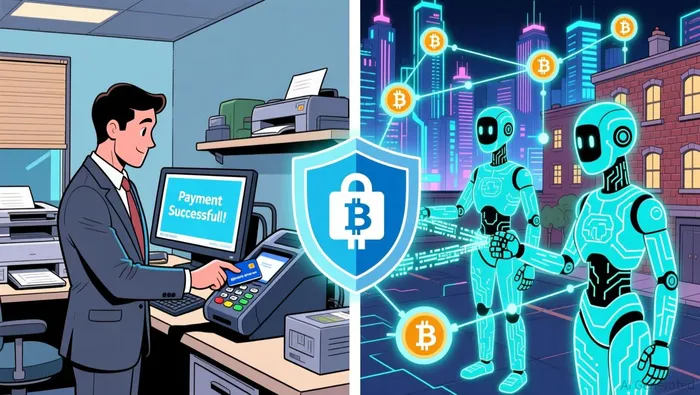
Developers and merchants can now integrate card-based payments into MPP workflows, expanding the protocol's utility across different payment preferences and networks. Visa's Machine Payments Protocol (MPP) expansion includes a full technical specification and an SDK to help developers integrate card-based transactions, built on Visa's existing AI commerce infrastructure. This move enhances interoperability between legacy and modern payment systems while maintaining security and scalability. The broader collaboration between Visa, Stripe, and partners like Coinbase and ArbitrumARB-- aims to build a secure and seamless infrastructure for AI-driven transactions according to industry reports.
How does the Machine Payments Protocol support both AI agents and traditional card networks?
The Machine Payments Protocol (MPP) is built to be rail-agnostic, allowing it to operate across traditional card networks and blockchain systems. By enabling secure and programmable machine-to-machine transactions, MPP connects existing commerce systems with emerging technologies as experts note. Visa's card-based specification and SDK extend MPP compatibility to card-based transactions, which are now embedded into AI workflows. This integration ensures that AI agents can transact in a manner that aligns with existing financial infrastructure, making the protocol more accessible for businesses and developers.
Stripe, through its incubation of Tempo, is optimizing for high-speed, low-cost transactions using stablecoins and blockchain infrastructure. This is particularly valuable for AI agents handling tasks that require fast and frequent payments, such as cloud computing services or IoT data transfers.
What are the potential use cases for MPP in AI-driven commerce?
MPP opens the door to a wide range of use cases in AI-driven commerce. For instance, it allows AI agents to pay for news articles, datasets, or computing power in real time without human intervention. The protocol supports micropayments and recurring transactions, making it ideal for services like reputation scoring or API monetization. In addition, MPP can be integrated into workflows where payment is a necessity rather than an option, such as procurement and finance systems. This shift from subscription-based models to a per-usage basis could significantly lower costs for businesses while increasing efficiency.
The protocol is also being submitted to IETF for standardization, which could accelerate its adoption across multiple blockchains and payment rails. However, challenges remain around security, scalability, and the potential for overhyping the technology. Despite these risks, the shift toward agent-based financial systems is gaining traction, with stablecoin payments and AI integration reshaping traditional card networks.
What are the current limitations and risks of adopting MPP?
While the Machine Payments Protocol offers a promising framework for AI-driven commerce, there are limitations and risks to consider. One challenge is ensuring the security and fraud prevention mechanisms are robust enough to handle autonomous transactions. Another is scalability—handling a growing number of AI agent interactions without compromising performance or user experience. There is also the risk of overhyping the technology, which could lead to unrealistic expectations or adoption hurdles. Developers and investors are closely monitoring how MPP and similar protocols scale adoption while maintaining security and transparency.
The regulatory environment is also a factor. The U.S. SEC's proposed changes to Rule 15c2-11 could redefine how crypto assets like Tempo's blockchain are treated, affecting the legal and compliance landscape for MPP-based transactions. Partnerships with Anthropic, Open AI, and other key players will be crucial in shaping the future of agentic commerce and ensuring MPP remains a flexible and secure infrastructure for AI-driven payments.
In summary, the Machine Payments Protocol is a foundational element in the evolution of AI-driven commerce. By enabling AI agents to execute transactions autonomously, MPP bridges the gap between traditional payment systems and emerging technologies. As the ecosystem matures, its success will depend on its ability to scale securely, remain flexible, and align with evolving regulatory and market conditions.

Blending traditional trading wisdom with cutting-edge cryptocurrency insights.
Latest Articles
Stay ahead of the market.
Get curated U.S. market news, insights and key dates delivered to your inbox.
AInvest
PRO
AInvest
PRO



Comments
No comments yet