
ARTIFICIAL SUPERINTELLIGENCE ALLIANCE Enables AI Agents to Execute Autonomous Payments via Machine Payments Protocol
 Aime Summary
The Machine Payments Protocol (MPP) allows AI agents to autonomously execute transactions for services like data access and computing power according to reports. - MPP supports both fiat and cryptocurrency and is designed to be interoperable across multiple blockchains and payment rails as detailed. - Major partners like VisaV--, Stripe, and MastercardMA-- are adapting to AI-driven commerce by integrating MPP into their infrastructure according to Visa's specifications.
Tempo, a blockchain incubated by Stripe and Paradigm, has launched a public mainnet optimized for high-speed and stablecoin transactions. The network supports agentic commerce by enabling AI agents to execute payments for services without requiring constant human oversight as reported. A core component of this infrastructure is the Machine Payments Protocol (MPP), which allows autonomous agents to perform transactions in real time while adhering to predefined limits according to financial reports.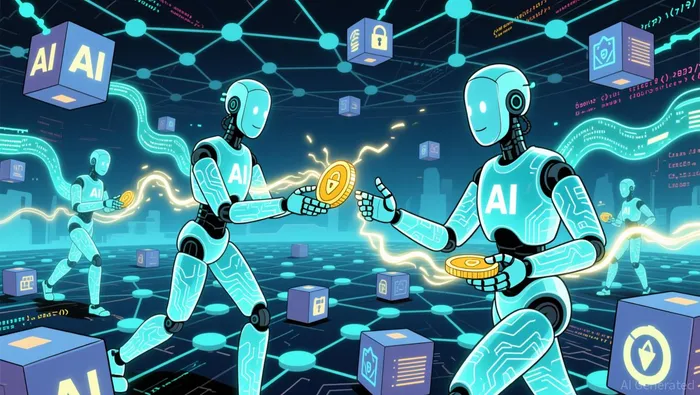
The MPP is designed to be flexible and open-source, allowing developers to adapt it for a range of use cases, including micropayments and recurring transactions as detailed. It is compatible with existing financial systems and is being submitted to IETF for standardization, which could expand its adoption and interoperability according to industry analysis.
Visa has taken a proactive approach by introducing a card-based specification and SDK for MPP, enabling AI agents to securely use credit and debit cards in agentic workflows according to reports. This integration leverages Visa's existing AI commerce platforms, such as Visa Intelligent Commerce, to ensure secure and scalable transactions. Stripe and Tempo have also partnered with other firms like Coinbase and ArbitrumARB-- to develop a broader infrastructure for AI payments as noted.
AI-driven commerce is attracting significant investment and innovation. Tempo's blockchain has raised $500 million at a $5 billion valuation and is building on Stripe's recent crypto initiatives, including white-label stablecoins and card issuance programs according to market data. However, the ecosystem still faces challenges related to security, scalability, and the risk of overhyping the technology . Critics have questioned whether MPP is truly a groundbreaking protocol or just a rebranded API .
Despite these concerns, the shift toward agent-based financial systems is gaining momentum. Stablecoin payments and AI integration are reshaping traditional card networks, prompting companies like Mastercard and Visa to invest in crypto infrastructure to remain competitive . As the market evolves, developers and investors will be watching how MPP and similar protocols scale adoption while maintaining security and transparency .
What are the core features of the Machine Payments Protocol?
The Machine Payments Protocol (MPP) enables AI agents to perform autonomous transactions for services such as dataset access, computing power, and B2B workflows according to reports. It is designed to be open-source and interoperable, allowing agents to choose the most appropriate payment method—whether fiat, cryptocurrency, or card-based as detailed. The protocol is intended to support a variety of use cases, from micropayments to recurring transactions, and it aggregates transactions for more efficient settlement according to Visa's specifications.
MPP is not limited to a single blockchain or payment network. It is compatible with multiple blockchains and rails, including Visa's global payment infrastructure, and is being considered for IETF standardization to encourage broader adoption as reported. This flexibility makes it adaptable for diverse applications, including AI-driven commerce and machine-to-machine (M2M) transactions according to financial reports.
How do major financial players support and integrate with the protocol?
Visa has played a pivotal role in expanding MPP's capabilities by introducing a card-based specification and SDK, allowing developers to integrate secure, programmable card payments into agentic workflows according to reports. This development leverages Visa's AI commerce platforms, including Visa Intelligent Commerce and the Trusted Agent Protocol, to enhance tokenization, authentication, and identity verification according to industry analysis. By doing so, Visa aims to ensure MPP becomes a universal standard for machine-to-machine transactions according to financial reports.
Stripe and Tempo have also collaborated with other major players in the fintech and crypto spaces. For example, Mastercard has invested in BVNK, a stablecoin infrastructure firm, to integrate blockchain-based systems into its operations as noted. Coinbase has also launched its x402 protocol to compete with MPP in the agentic payments space according to market data. These partnerships reflect the growing industry consensus that AI agents will require robust and standardized payment infrastructure to operate autonomously .
What are the implications and challenges for AI-driven commerce?
AI-driven commerce is reshaping traditional financial systems by introducing autonomous agents that can execute transactions without human intervention . This shift is driven by the need for faster, more efficient payment methods, particularly in B2B and AI-driven workflows . As a result, stablecoin payments and high-speed blockchain networks are becoming more relevant, challenging the dominance of traditional card networks .
However, the ecosystem still faces significant challenges. One key concern is the security of AI agents—developers must ensure that agents are not compromised or used for unauthorized transactions . Another issue is the risk of overhyping MPP and similar protocols, which may not deliver the transformative impact that some proponents claim . Despite these challenges, the industry is moving toward a future where agent-based commerce will play a central role in digital payments .
As the market continues to evolve, the success of MPP and other protocols will depend on their ability to scale adoption, maintain security, and integrate seamlessly with existing financial infrastructure . Developers and investors will be closely watching how these systems develop and whether they can sustain the level of innovation and growth currently being discussed .

Mezclando la sabiduría tradicional en el comercio con las perspectivas más avanzadas en el área de las criptomonedas.
Latest Articles
Stay ahead of the market.
Get curated U.S. market news, insights and key dates delivered to your inbox.
AInvest
PRO
AInvest
PRO



Comments
No comments yet