
Article Title


 Aime Summary
The ESCAPADE Mission: A Blueprint for Cost-Effective Exploration
NASA's ESCAPADE (Enabling Science with Clusters of Small Probes for Astrophysics and Planetary Exploration) mission is a flagship project under the agency's SIMPLEx program, designed to maximize scientific output while minimizing costs. The twin spacecraft, Blue and Gold, will study Mars' magnetosphere and atmospheric loss processes, providing critical insights into planetary evolution and habitability according to India Today. What makes this mission noteworthy is its reliance on small satellite technology and a launch vehicle that embodies the principles of reusability.
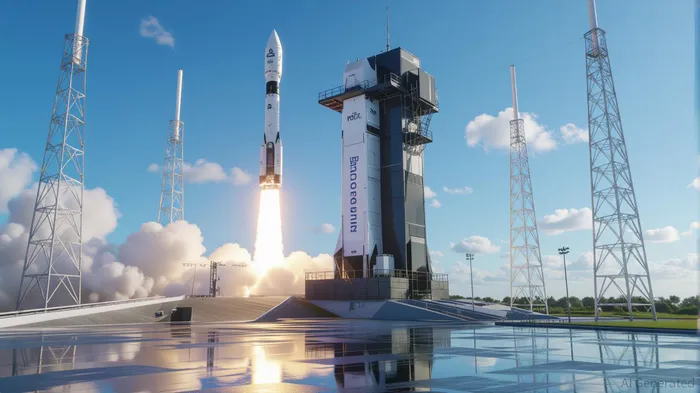
The mission's launch aboard Blue Origin's New Glenn rocket marks a pivotal moment. This is the second flight of the New Glenn, and Blue Origin aims to land its first stage on a recovery ship-a demonstration of reusable rocketry that could significantly reduce the cost of interplanetary missions. According to a report by India Today, this launch underscores the growing role of private firms in enabling NASA's scientific ambitions. For investors, the success of such partnerships highlights the strategic value of companies like Blue Origin, whose innovations in reusability are likely to dominate the next decade of space infrastructure.
Public-Private Partnerships: The New Normal in Space Exploration
The ESCAPADE mission is not solely a NASA endeavor. It involves a constellation of industry partners, including and Viasat Inc. Rocket Lab is responsible for building the twin spacecraft, while Viasat contributes to a space communications technology demonstration. These collaborations reflect a broader trend: NASA is increasingly outsourcing mission-critical components to private firms, thereby accelerating innovation and reducing bureaucratic overhead.
This model is particularly evident in the SIMPLEx program, which prioritizes small, agile spacecraft developed through competitive, cost-capped contracts. By doing so, NASA incentivizes companies to adopt lean methodologies and modular designs, fostering a more dynamic ecosystem. For investors, this means that firms with expertise in small satellite technology, , and data transmission-such as Rocket LabRKLB-- and Viasat-are poised to benefit from a growing pipeline of NASA-funded projects according to NASA.
Boeing's Role in the Broader Space Infrastructure Boom
While Boeing is not directly involved in the ESCAPADE mission, its contributions to NASA's Artemis program underscore its strategic importance in the space infrastructure landscape. As the prime contractor for the Space Launch System (SLS), Boeing is responsible for developing the core stages and avionics for deep-space missions. The SLS, which recently completed its first crewed flight as part of Artemis II, is a cornerstone of NASA's plan to establish a permanent human presence on the Moon.
Boeing's work on the SLS Block 1B configuration, which will feature a 40% increase in payload capacity, highlights its role in scaling up infrastructure for lunar and interplanetary exploration. According to a Boeing report, the company has conducted rigorous testing at NASA's Stennis Space Center, validating critical systems for future missions. For investors, Boeing's expertise in heavy-lift launch systems and its partnerships with NASA position it as a key player in the next phase of space commercialization, even as smaller firms like Blue Origin and Rocket Lab capture headlines.
Strategic Implications for Investors
The ESCAPADE mission and its associated partnerships illustrate a broader shift: space exploration is becoming a collaborative, commercially viable industry. For investors, this means opportunities are no longer confined to traditional aerospace giants. Instead, the landscape is diversifying, with firms specializing in reusable rockets, small satellites, and advanced communications technologies emerging as critical players.
Blue Origin, with its focus on reusability and , is a prime example. The success of the New Glenn's second flight could validate its business model and attract further investment. Similarly, Rocket Lab's role in building the ESCAPADE spacecraft demonstrates the growing demand for small satellite solutions, a sector projected to expand rapidly in the coming years.
Boeing, meanwhile, remains a linchpin in the development of heavy-lift systems. While its SLS program has faced delays and cost overruns, the company's deep expertise in large-scale aerospace engineering ensures its relevance in an era where lunar bases and Mars missions require robust infrastructure.
Conclusion
NASA's ESCAPADE mission is more than a scientific endeavor-it is a microcosm of the commercialization of space. By embracing public-private partnerships and reusable rocket technology, NASA is not only advancing planetary science but also creating a sustainable framework for future exploration. For investors, the implications are clear: firms like Blue Origin, Rocket Lab, and Boeing are not just participants in this transformation; they are its architects. Positioning in these companies offers a compelling way to capitalize on the next frontier of human innovation.

Delivering real-time insights and analysis on emerging financial trends and market movements.
Latest Articles
Stay ahead of the market.
Get curated U.S. market news, insights and key dates delivered to your inbox.




Comments
No comments yet