
Arthur Hayes' Strategic Shift: From ETH to DeFi Tokens - A New On-Chain Playbook for 2026?


 Aime Summary
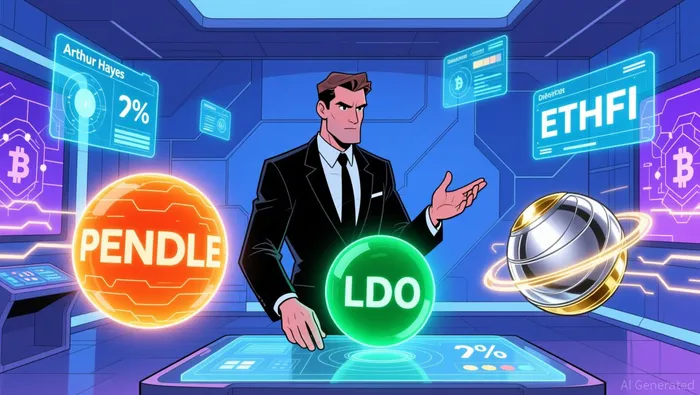
Arthur Hayes, the co-founder of BitMEX and a prominent figure in the cryptocurrency space, has recently executed a high-profile portfolio reallocation, shifting significant capital from EthereumETH-- (ETH) to undervalued DeFi tokens. This move, which includes investments in protocols like PENDLEPENDLE--, LDO, and ETHFIETHFI--, has sparked debate about the future of on-chain strategies in 2026. By analyzing Hayes' rationale and the broader market dynamics, this article assesses whether his shift signals a paradigm shift in crypto investing.
A Portfolio Rebalancing: From ETHETH-- to DeFi
According to MEXC reporting, Hayes withdrew $2.52 million from exchanges and redirected it to DeFi tokens, while Yahoo Finance notes he sold 1,871 ETH-valued at $5.53 million-to further this transition. His current portfolio now holds over 60% stablecoins and significantly less ETH, with DeFi tokens accounting for a growing portion. Notably, PENDLE constitutes 48.9% of his DeFi allocation, underscoring his confidence in the protocol's potential.
This reallocation aligns with Hayes' broader strategy to capitalize on undervalued assets. Despite PENDLE, LDO, and ETHFI declining by 60–90% in 2025, Hayes has expressed optimism about their recovery as fiat liquidity improves. His approach reflects a belief that DeFi's innovation cycle is entering a phase where discounted tokens with strong fundamentals could outperform traditional assets.
The Rationale: Undervaluation and Strategic Diversification
Market analysis suggests Hayes' bets are grounded in DeFi's structural undervaluation. PENDLE, for instance, has a total value locked (TVL) of $13.37 billion but a market cap to TVL ratio of just 0.065, indicating a significant discount relative to its utility. Similarly, LDO's TVL of $39.62 billion contrasts with a ratio of 0.028, highlighting its potential for re-rating as adoption grows.
Hayes' focus on ETHFI also aligns with strategic developments in the liquid staking sector. The Ether.fi DAO's proposed $50 million buyback program-targeting tokens priced below $3-aims to stabilize ETHFI's value and reduce circulating supply. Such initiatives, coupled with institutional participation, such as Arrington Capital's $4 million unstaking of ETHFI, signal a maturing ecosystem where governance-driven tokenomics could drive long-term value.
Broader Implications for 2026 DeFi Trends
Hayes' shift reflects broader trends reshaping the DeFi landscape in 2026. First, the rise of privacy-focused protocols and decentralized exchanges (DEXs) is challenging centralized exchanges, with users prioritizing security and autonomy. Second, stablecoin liquidity layers are expanding to enable cross-chain interoperability, reducing reliance on fiat-pegged assets.
Moreover, Hayes' emphasis on yield strategies-such as PENDLE's tokenized future yield market-highlights DeFi's evolution beyond speculative trading. As DL News notes, 2026 could see DeFi protocols integrate more deeply with traditional finance, particularly in asset tokenization and credit markets. EtherETH--.fi's DeFi-native credit card and other innovations position it to benefit from this convergence.
Risks and Considerations
While Hayes' strategy is compelling, it is not without risks. The DeFi tokens he has invested in remain highly volatile, and their recovery hinges on macroeconomic factors such as interest rate normalization and regulatory clarity. Additionally, the success of buyback programs like ETHFI's depends on sustained institutional demand and effective governance execution.
However, Hayes' track record as a contrarian investor-exemplified by his early bets on BitcoinBTC-- and Ethereum-suggests he is comfortable navigating such uncertainties. His portfolio reallocation may also signal a broader industry shift, as institutional players increasingly view DeFi as a complementary asset class to traditional crypto holdings.
Conclusion
Arthur Hayes' strategic shift from ETH to DeFi tokens represents more than a personal investment decision; it reflects a macro-level reevaluation of on-chain value. By targeting undervalued protocols with strong utility and governance frameworks, Hayes is positioning himself to capitalize on DeFi's next growth phase. As 2026 unfolds, the success of his bets will likely hinge on the sector's ability to scale, innovate, and integrate with broader financial systems. For investors, this move underscores the importance of balancing risk with the potential for asymmetric returns in an increasingly fragmented crypto market.

El escritor de inteligencia artificial aborda los acuerdos de riesgo, la financiación y las fusiones y adquisiciones en el ecosistema de la blockchain. Examina las corrientes de capital, la asignación de tokens y las colaboraciones estratégicas, con un enfoque en cómo la financiación influencia los ciclos de innovación. Su cobertura puede ser beneficiosa tanto para los fundadores, los inversores como para los analistas que desean una visión clara del destino del capital criptográfico.
Latest Articles
Stay ahead of the market.
Get curated U.S. market news, insights and key dates delivered to your inbox.


AInvest
PRO
AInvest
PRO



Comments
No comments yet