
Artemis II Astronaut Salaries: Why Pay Caps Remain Fixed
 Aime Summary
The Artemis II crew, comprising Reid Wiseman, Victor Glover, Christina Koch, and Canadian astronaut Jeremy Hansen, operates under a standardized federal pay scale that caps annual salaries at roughly $152,258 for U.S. members. This figure is derived from the General Schedule (GS) system, specifically targeting GS-13 or GS-14 levels based on experience, and does not fluctuate based on the specific mission or the distance traveled from Earth $152,258 for U.S. members. Even though the mission covered 685,000 miles over ten days, the pay remains identical to that of a senior federal employee working on the ground $152,258 for U.S. members.
The lack of mission-specific bonuses is a deliberate feature of the government employment model. While private space companies might offer equity or performance bonuses to align incentives with commercial goals, NASA astronauts are compensated as federal employees. This means their earnings are predictable and fixed, mirroring the broader government sector rather than the high-risk private sector where risk premiums are common $152,258 for U.S. members.
Canadian astronaut Jeremy Hansen falls under a similar but distinct framework managed by the Canadian Space Agency. His compensation ranges from $97,100 to $189,600, with the highest tier specifically reserved for those who have successfully completed a space mission $97,100 to $189,600. This distinction highlights that while the base pay is standardized, certain international agencies do offer a pay bump for mission completion, a nuance that differentiates their structure from the strictly capped U.S. system $97,100 to $189,600.
Why Do Astronaut Salaries Stay Flat Amid High Risks?
The reason astronaut salaries remain flat despite the inherent dangers of space travel lies in the government's standardized approach to federal employment. Salaries are adjusted periodically based on general pay schedules rather than individual mission complexity or risk levels $152,258 for U.S. members. This structure ensures consistency across the workforce but creates a scenario where the financial reward does not scale with the mission's significance or the personal risk undertaken by the crew $152,258 for U.S. members.
From an investor's perspective, this fixed compensation model underscores the difference between government service and commercial spaceflight. While the government leverages the prestige and selectivity of the program to attract talent, the private sector may eventually offer more lucrative, risk-adjusted roles as the industry matures $152,258 for U.S. members. Current industry leaders like Elon Musk and Sam Altman envision a future space-based workforce, but current government missions remain bound by these rigid federal pay scales $152,258 for U.S. members.
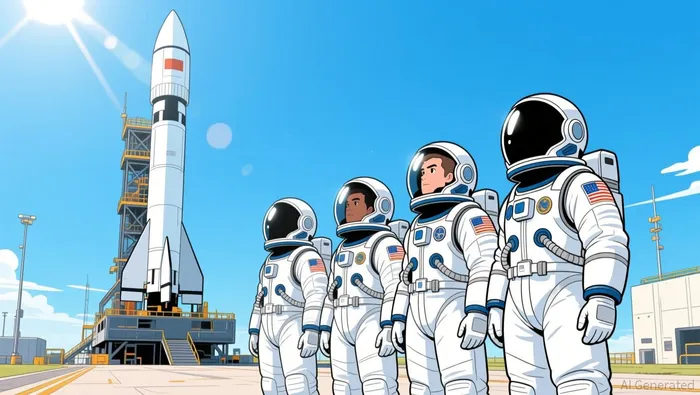
The lack of hazard pay also contrasts with other high-risk professions. For instance, while astronauts face extreme environments, their pay is comparable to skilled trades like electricians or mid-career desk jobs like software engineering managers $152,258 for U.S. members. This alignment suggests that the government views the role as a specialized public service rather than a high-risk commercial venture, relying on the non-monetary benefits of the job to justify the risks $152,258 for U.S. members.
What Do Astronaut Salaries Reveal About Space Industry Trends?
The compensation structure for Artemis II astronauts reveals a broader trend where government agencies prioritize stability over performance-based incentives. While the pay is modest compared to the risks, the job security and comprehensive benefits package remain attractive to a highly selective pool of candidates $152,258 for U.S. members. The acceptance rate of 0.125% for the 2025 class demonstrates that the prestige of the role and the opportunity to serve in a historic mission often outweigh the financial limitations $152,258 for U.S. members.
Looking forward, the space industry may see a shift as commercial entities expand their operations. The projected growth of aerospace engineers, who earn an average of $135,000 with a 6% growth rate over the next decade, suggests a potential for higher wages in the private sector $152,258 for U.S. members. However, for the foreseeable future, government missions like Artemis will likely continue to operate under these standardized pay scales, maintaining a clear distinction between public service and commercial enterprise $152,258 for U.S. members.
Ultimately, the Artemis II pay structure serves as a reminder that while the technology and risks of space exploration are advancing rapidly, the financial models for government employees remain deeply rooted in traditional federal employment practices. This stability provides a predictable framework for the space program but may limit the financial incentives available to those who choose this path over private sector opportunities $152,258 for U.S. members.

Stay ahead of the market.
Get curated U.S. market news, insights and key dates delivered to your inbox.


AInvest
PRO
AInvest
PRO



Comments
No comments yet