
Artemis 2 Launch Pad Rollout: What Retail Investors Should Know
 Aime Summary
NASA's Artemis II Moon Rocket is en route to Launch Pad 39B at Kennedy Space Center.
- The mission will test systems for long-term lunar and Mars exploration and carry astronauts farther from Earth than in decades.
- The Artemis II launch window opens as early as February 6 after readiness assessments are completed.
NASA’s Artemis II rocket and Orion spacecraft are now making their slow, historic journey to Launch Pad 39B at Kennedy Space Center in Florida. The 11-million-pound rocket is being transported at a crawl—less than one mile per hour—by a massive crawler-transporter. The rollout, beginning on January 17, is one of the final steps before the crewed mission’s wet dress rehearsal and launch window in February. For investors, this represents a pivotal moment in the broader $100+ billion space industry, signaling progress in NASA’s mission to reestablish a sustained human presence on the Moon and lay the groundwork for Mars exploration.
What Is NASA's Artemis II Mission?
Artemis II is the first crewed mission in NASA’s Artemis program, which aims to return humans to the Moon by the mid-2030s and eventually send them to Mars. Scheduled for as early as February 6, 2026, this 10-day mission will not land on the Moon but will instead send four astronauts—three from NASA and one from the Canadian Space Agency—into a distant lunar orbit. The mission will test the Space Launch System (SLS) rocket and the Orion spacecraft, both of which will play a critical role in future deep-space missions 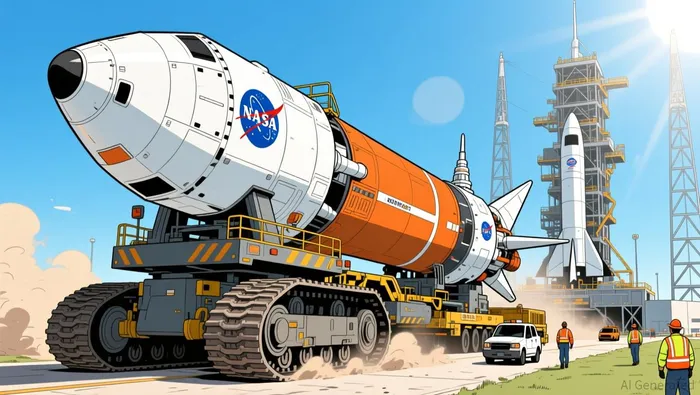 . This international partnership highlights the geopolitical and economic dimensions of Artemis II, as well as its potential to inspire a new generation of scientists and engineers as reported by BBC.
Why Is the Artemis 2 Launch Pad Rollout a Key Step for Investors?
The recent rollout of the Artemis II rocket from the Vehicle Assembly Building to Launch Pad 39B marks a major technical and symbolic milestone. It demonstrates NASA’s progress in assembling and testing the systems needed for deep-space travel, with implications for the aerospace and satellite industries. For investors, the success of Artemis II could drive demand for components, launch services, and other space-related technologies.
The mission is also a test of NASA’s readiness to move beyond uncrewed deep-space flights. Artemis I, the first mission in the series, launched a crewless Orion spacecraft in 2022. Artemis II will be the first crewed test, and its success will be crucial for future lunar landings and Mars missions. For now, the focus is on verifying the rocket’s systems, conducting a wet dress rehearsal, and ensuring astronaut safety according to Scientific American.
What to Watch as Artemis II Progresses Toward Launch
Investors and space enthusiasts should pay attention to several key developments as Artemis II moves forward:
Wet Dress Rehearsal: After the rocket arrives at the pad, NASA will conduct a full rehearsal that includes loading cryogenic fuel and simulating the launch countdown. This is a critical test to ensure the rocket’s systems work under full operational conditions.
Weather and Schedule Delays: As with any complex engineering project, there is a risk of delays. NASA will need to monitor weather conditions and conduct final readiness reviews before committing to a launch date.
Crew Health and Mission Objectives: The Artemis II crew will travel farther from Earth than any astronauts in over 50 years. Their health and the success of onboard experiments—such as the AVATAR system for simulating astronaut organs—will provide valuable data for future missions according to NASA.
Public and Private Sector Collaboration: Artemis II builds on a foundation of public-private partnerships in space. The success of this mission could encourage further investment in aerospace firms and technology startups involved in deep-space exploration .
Final Thoughts
Artemis II is more than a technical milestone—it is a sign of renewed interest in space exploration and the potential for long-term economic growth in the sector. While the mission itself is a test flight, it sets the stage for more ambitious endeavors, including lunar landings and eventual crewed missions to Mars. For retail investors, the rollout of the Artemis II rocket is a visible reminder that humanity is once again pushing the boundaries of space travel. The next few weeks will be crucial as NASA moves closer to a crewed mission to the Moon in 2026.

Stay ahead of the market.
Get curated U.S. market news, insights and key dates delivered to your inbox.






Comments
No comments yet