
Artemis 2 Cost Breakdown: What Investors Need To Know
 Aime Summary
- Artemis 2 costs approximately $4.1 billion per mission, driven by the Space Launch System and Orion spacecraft development.
- Total Artemis program spending exceeds $100 billion as NASA pivots toward a permanent lunar presence by 2028.
- The 2026 budget was secured at $24.4 billion, rejecting White House proposals to slash funding by 25%.
- Commercial space integration and geopolitical rivalry with China are key factors sustaining high government spending.
- A new trillion-dollar space economy is emerging, leveraging lunar resources and advanced manufacturing technologies.
The question of how much Artemis 2 cost has moved beyond a simple line item to a critical metric for understanding the future of the space economy. As the first crewed lunar mission in over 50 years, the Artemis program represents a massive capital commitment that signals a permanent shift in how governments and private enterprises approach deep-space exploration. The price tag is not just for a single flight but for the foundational infrastructure required to establish a sustained human presence on the Moon, which serves as a stepping stone for future Mars missions.
For investors and financially curious observers, the cost structure reveals a complex interplay of government mandates, national security imperatives, and commercial scalability. The program is no longer just about scientific discovery; it is about securing a strategic foothold in a new frontier that promises untapped resources and technological spin-offs. Understanding the financial mechanics behind Artemis 2 provides a lens into the broader economic dynamics of the emerging space sector, where public funding acts as a catalyst for private innovation.
How Much Did Artemis 2 Cost Per flight And What Drives That Price?
The cost of a single Artemis mission, including Artemis 2, is estimated at approximately $4.1 billion. This figure is not arbitrary but is broken down into specific components that highlight the immense engineering challenges involved in returning humans to the Moon. The breakdown includes roughly $1 billion for the Orion crew capsule, $300 million for the European-provided service module, $2.2 billion for the Space Launch System (SLS) rocket, and $570 million allocated for ground infrastructure. These numbers underscore the capital intensity of deep-space missions, where every component must be engineered to withstand the harsh radiation and vacuum of space while ensuring crew safety.
The high cost is driven by the complexity of the supply chain and the need for custom-built hardware that cannot be mass-produced like terrestrial vehicles. Major contractors such as Boeing and Lockheed Martin are integral to this ecosystem, managing the production of critical systems that require decades of development and rigorous testing. Despite criticisms regarding the lack of reliable accounting in early 2021, the projected estimate remains robust, with the program facing significant cost pressures as it scales toward a permanent lunar presence.
Furthermore, the financial scale of the Artemis program is immense, with total expenditures projected to reach over $100 billion by 2026. This investment is not merely for the sake of exploration but is a strategic necessity to counter China's ambitions for a permanent lunar base by 2030. The convergence of government mandates and the rise of commercial space actors like SpaceX suggests that while the upfront costs are high, the long-term economic returns could be substantial, potentially unlocking a multi-trillion-dollar space economy.
Why Is NASA Prioritizing Artemis Funding Amidst Proposed Budget Cuts?
The financial landscape surrounding Artemis 2 has become a focal point of political and economic debate, particularly regarding budget allocations for 2026 and beyond. While the White House proposed a $5.6 billion reduction to NASA's 2027 fiscal budget, which would have cut funding by nearly 25%, Congress largely rejected these cuts. Instead, the agency was allocated $24.4 billion for 2026, a figure that reflects a strategic decision to prioritize human exploration missions over other scientific endeavors.
This prioritization creates a distinct tradeoff within the agency's portfolio. The proposed cuts would have slashed the Science division by $3.4 billion, including the elimination of the STEM engagement office, and reduced International Space Station funding by $1.1 billion. Retired project managers have warned that such reductions threaten to dismantle key research capabilities and lead to thousands of layoffs at the Johnson Space Center. However, the reallocation signals a clear shift in strategic focus, aiming to achieve a lunar landing by 2028 and establishing a foothold on the Moon as a precursor to Mars exploration.
The geopolitical context is a primary driver of this funding resilience. Senator Ted Cruz and other policymakers have highlighted the new space race with China, which aims for a permanent lunar presence by 2030. This strategic imperative ensures that funding levels remain high despite the rising national debt, which stands at nearly $40 trillion. The government views the Artemis program not as a boondoggle but as a critical investment in national security and technological leadership, ensuring that the United States maintains its position as the dominant force in space.
What Are The Economic Implications Of Artemis 2 For The Space Industry?
The financial outlay for Artemis 2 serves as a validation of a new generation of deep-space hardware, opening the door to transformative commercial opportunities. The mission is expected to drive investment through public-private partnerships, where NASA purchases services from private entities rather than operating all infrastructure directly. This model is already gaining traction, with the Commercial Lunar Payload Services (CLPS) program creating recurring revenue streams for commercial landers and fostering a robust ecosystem of suppliers.
Long-term economic value is unlocked through the potential for lunar resource extraction. The Moon holds untapped rare earth elements critical for semiconductors and electric vehicle motors, which could diversify global supply chains and reduce reliance on terrestrial mining. Additionally, Helium-3, abundant on the lunar surface, is a non-radioactive isotope with applications in quantum computing, medical imaging, and nuclear fusion. These resources represent a trillion-plus dollar industry by 2035, with space tech expected to become a cornerstone of the global economy.
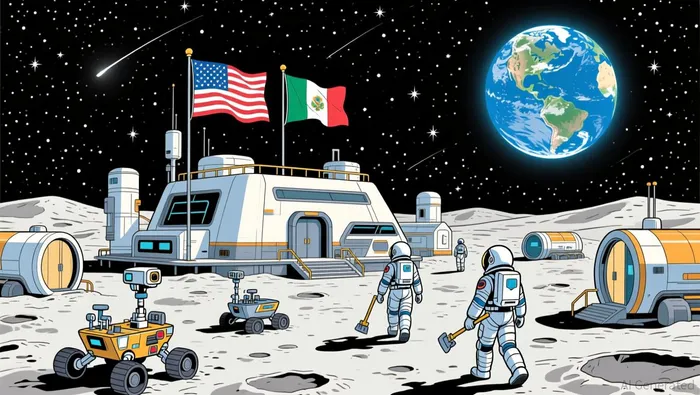
Experts argue that the Artemis program is a necessary catalyst for a new industrial era. By leveraging infrastructure financing models, the program could enable the construction of $100 billion worth of infrastructure-grade assets, securing American leadership in the next era of expansion. The mission also validates the use of AI and lunar digital twins for detailed modeling of unvisited terrain, which will be essential for future commercial activities. As the program matures, the integration of commercial space interests like SpaceX and Blue Origin will likely accelerate the pace of development, making the lunar economy a reality for investors and businesses alike.

Stay ahead of the market.
Get curated U.S. market news, insights and key dates delivered to your inbox.


AInvest
PRO
AInvest
PRO



Comments
No comments yet