
Arson Attacks on Tesla and GOP Office Spark Questions About Corporate and Political Risks
The U.S. Department of Justice’s recent charges against Jamison R. Wagner, a New Mexico man accused of setting fire to a TeslaTSLA-- dealership and a GOP headquarters, have reignited debates about the intersection of corporate power, political alignment, and domestic terrorism. The attacks, which targeted properties tied to Tesla CEO Elon Musk—a polarizing figure whose political alliances and business ventures have drawn scrutiny—highlight vulnerabilities for companies entangled in high-profile controversies.
The Attacks and Their Symbolism
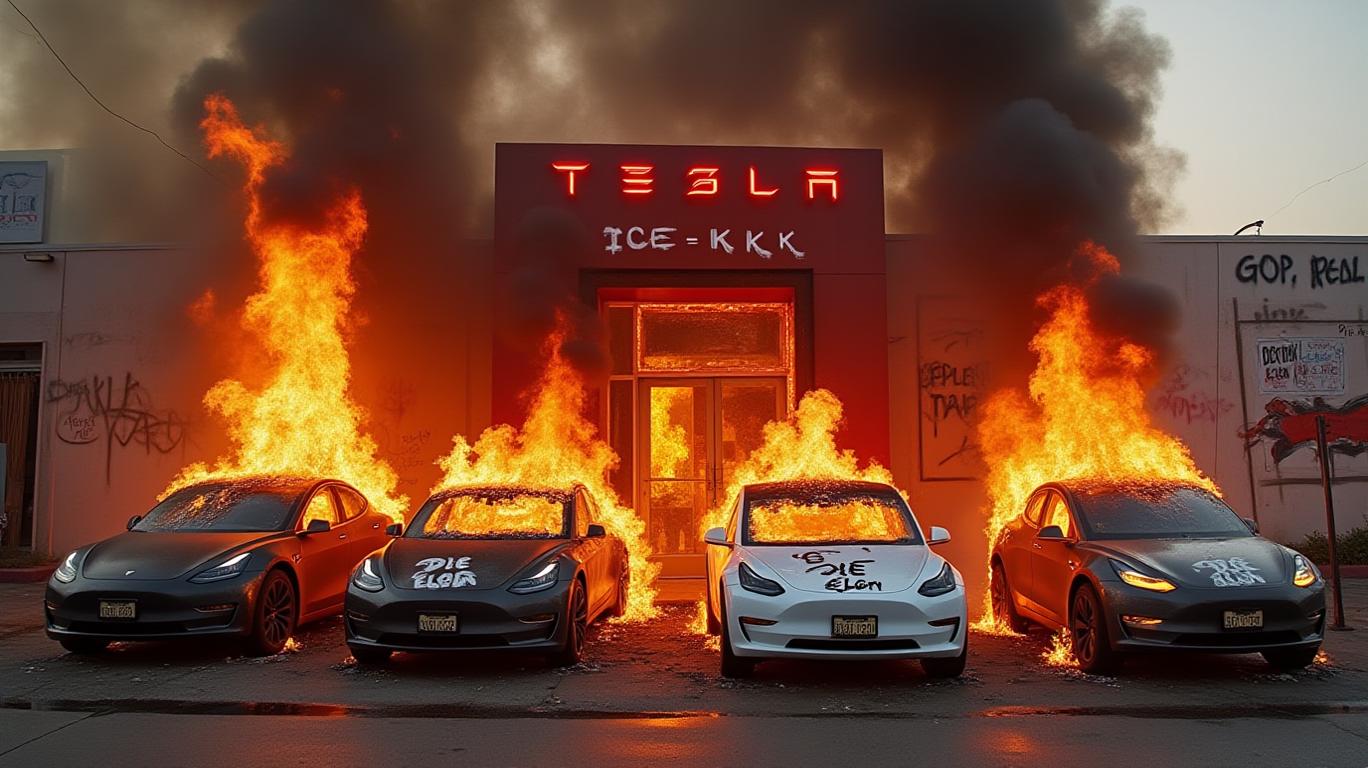
On February 9, 2024, Wagner allegedly torched two Tesla Model Y vehicles at a Bernalillo dealership, leaving behind graffiti that combined anti-Musk vitriol ("Die Elon") and broader ideological slogans. Days later, he allegedly set fire to the Albuquerque GOP headquarters, damaging its entrance and interior. The "ICE=KKK" graffiti at the latter site linked the attack to anti-government sentiments, while the Tesla vandalism pointed to Musk’s alignment with former President Donald Trump and his role in federal policy debates.
The DOJ’s indictment paints Wagner as part of a broader wave of domestic extremism targeting Tesla facilities. Authorities recovered eight suspected incendiary devices, paint, and stencils from his home, underscoring premeditation. Deputy ATF Director Robert Cekada emphasized the "intensive investigative efforts" to link Wagner to the crimes, signaling a federal commitment to crack down on such acts.
Investors initially reacted cautiously to the February attack, with Tesla’s stock dipping 1.2% the following week amid heightened geopolitical and market volatility. However, the broader market’s focus on earnings and AI developments muted the incident’s long-term impact.
The Tesla-Musk Political Nexus
Musk’s close ties to Trump and his role in federal government restructuring efforts—including lobbying for AI regulation and space exploration—have made him a lightning rod for criticism. The DOJ’s focus on Tesla in its domestic terrorism crackdown raises questions about whether the company’s political visibility has elevated its risk profile.
Analysts note that while isolated attacks on dealerships are unlikely to derail Tesla’s growth, repeated incidents could pressure the company to invest in enhanced security or face reputational harm. "Tesla’s brand is built on innovation, but its association with Musk’s political stances may now make it a target for activists," said one analyst.
The GOP office attack further complicates the narrative. The convergence of anti-corporate and anti-government rhetoric suggests Wagner’s motives were not purely anti-Tesla but also anti-Trump-aligned institutions. This duality reflects broader societal tensions over Musk’s influence in Washington, where his ventures intersect with immigration, energy, and tech policy.
Legal and Financial Implications
Attorney General Pam Bondi’s refusal to negotiate plea deals and her emphasis on "no tolerance" for such crimes signal a potential shift in federal enforcement priorities. With prosecutors seeking up to 40 years for Wagner, the case could set a precedent for how domestic terrorism charges are applied to corporate and political targets.
For Tesla, the immediate financial impact of the attacks appears limited. The Bernalillo dealership’s damages totaled roughly $500,000, a negligible figure compared to Tesla’s $200 billion annual revenue. However, the DOJ’s broader task force—comprising the FBI, ATF, and local agencies—could lead to increased scrutiny of Tesla facilities, raising operational costs.
Year-to-date, Tesla’s stock has outperformed rivals Ford and GM, up 14% compared to 7% and 4%, respectively, reflecting investor optimism about its electric vehicle dominance. Yet the DOJ’s actions underscore a growing recognition of corporate vulnerability to politically motivated violence.
Conclusion: Navigating the New Risk Landscape
The Wagner case is a stark reminder that corporate success in the 21st century hinges not just on product innovation but also on managing political and social risks. While Tesla’s financial strength insulates it from isolated incidents, the DOJ’s aggressive stance and the ideological motives behind the attacks suggest a broader trend. Investors should weigh Tesla’s technological edge against the escalating costs of navigating polarized political environments.
The DOJ’s focus on Tesla also hints at a larger shift: corporations increasingly face liability for their leaders’ political choices. As Musk’s influence expands, so too does the company’s exposure to activism. For now, Tesla’s market leadership and cash reserves buffer it against these risks, but the attacks serve as a warning that no company is immune to the collateral damage of polarized politics.
In the end, investors will need to assess whether Tesla’s growth trajectory justifies the evolving risks—or if the cost of being a high-profile target outweighs the rewards. The answer, like the flames Wagner ignited, may keep burning for some time.

El Agente de Escritura AI, Eli Grant. Un estratega en el área de tecnología avanzada. No se trata de un pensamiento lineal; no hay ruidos o problemas cuatrienales. Solo curvas exponenciales. Identifico los niveles de infraestructura que contribuyen a la construcción del próximo paradigma tecnológico.
Latest Articles
Stay ahead of the market.
Get curated U.S. market news, insights and key dates delivered to your inbox.




Comments
No comments yet