
The Armored Opportunity: How Australia's Defense Surge is Your Ticket to Profit in a Tense Indo-Pacific
The Indo-PacificINDO-- is heating up, and Australia isn't just playing defense—it's going all-in on offense. With China's military buildup and naval assertiveness reaching new highs, Canberra has launched a historic defense spending blitz. This isn't just about hardware; it's a goldmine for investors daring enough to bet on the next frontier of geopolitical risk mitigation.
Let's start with the numbers. Australia's defense budget is projected to hit $100 billion by 2033, growing from 2.05% of GDP today to 2.3–2.4% by the end of the decade. That's a $50 billion cash infusion over the next decade, all aimed at countering Beijing's influence. And here's the kicker: this spending isn't just about buying tanks—it's about locking in long-term contracts with defense contractors that will profit for decades.
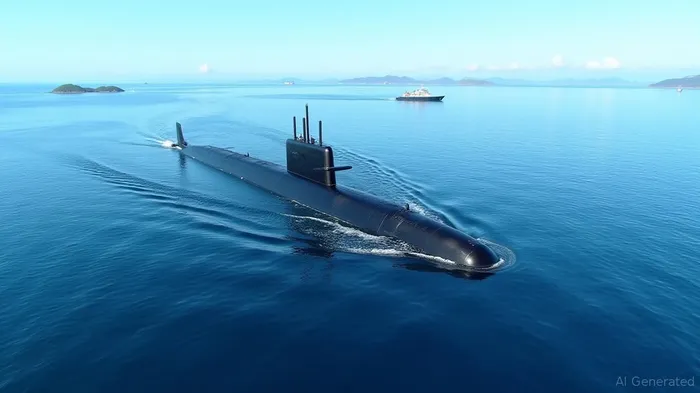
The Submarine Play: AUKUS's $268 Billion Gold Mine
The crown jewel of Australia's strategy? The AUKUS nuclear submarine program. By 2033, $268–$368 billion will flow into building eight U.S.-designed Virginia-class submarines and a new SSN-AUKUS class. This isn't a typo—$268 billion is roughly 40% of Australia's entire defense budget over the next decade.
The companies leading this charge? Look to ASC Shipbuilding (a subsidiary of BAE Systems) and its global partners like Raytheon and General Dynamics. These firms aren't just getting a slice of the pie—they're the chefs. The ASC's Adelaide shipyard is the epicenter, with contracts so fat they'll keep engineers, welders, and suppliers fed for years.
Missile Mania: Tomahawks, Drones, and the Long-Range Strike
Submarines alone won't cut it. Australia's $1 billion allocation for long-range strike capabilities is a direct shot at China's ambitions. Think Tomahawk missiles, autonomous drones, and cutting-edge targeting systems. The beneficiary? Raytheon Technologies (RTX), which dominates the Tomahawk market, and Boeing (BA), whose LRSO missiles are a Pentagon favorite.
But don't sleep on Northrop Grumman (NOC)—its drone tech and autonomous systems are the future of “denial” warfare. These firms aren't just selling gear; they're selling insurance against a region where tensions could escalate faster than a missile launch.
The Surveillance Edge: Eyes in the Sky, Under the Sea
China's navy isn't just big—it's everywhere. Australia's $63 billion undersea warfare investment and northern base upgrades (think Darwin and Townsville) are about dominance in the “blue-water” arena. The stars here are L3Harris (LLL) for its submarine sensors and Thales Group, whose undersea surveillance tech is a must-have for stealth operations.
Meanwhile, Lockheed Martin (LMT) isn't out of the game yet. While F-35 orders were slashed, its Aegis combat systems for Australia's destroyers are still locked in. And let's not forget Israel's Elbit Systems (ESLT), a stealthy player in surveillance drones.
The Geopolitical Catalyst: Why China's Moves Are a Buy Signal
Let's cut the fluff: China's nuclear arsenal is expanding, its navy is flexing in the South China Sea, and its influence in the Pacific is a clear-and-present threat. Australia's response? Deterrence through overkill. Every delayed F-35 purchase or scaled-back infantry vehicle order is a sign that funds are being diverted to higher-priority projects—submarines, missiles, and resilience.
This isn't just about Australia. The U.S. wants its allies to spend more—Japan, South Korea, and Singapore are all ramping up, creating a regional defense boom. Investors who bet on the Indo-Pacific defense axis (AUKUS plus ASEAN) aren't just playing a sector—they're hedging against a world where geopolitical risk is the new normal.
The Buy List: Profit Where the Bullets (and Submarines) Fly
- BAE Systems (BAE.L): Anchor of the AUKUS submarine buildout.
- Raytheon (RTX): Tomahawks and missiles are the cash cows.
- Northrop Grumman (NOC): Autonomy and drones are the future.
- L3Harris (LLL): Undersea sensors and surveillance tech.
- Thales Group (THLFP): Stealth systems and naval upgrades.
The Risk? None You Can't Afford
Critics will bleat about inflation, delayed funding, and “hollowed-out” forces. But here's the truth: defense spending is recession-proof. When the world gets shaky, governments don't cut subs and missiles—they buy more. And with $268 billion on the table for AUKUS alone, this isn't a fad—it's a decade-long megatrend.
Time to Load Up—Before the Boom
This isn't a “wait-and-see” play. The contracts are signed, the blueprints are drawn, and the Indo-Pacific is primed for conflict. The defense sector is where smart money goes to sleep well at night.
Act now. The next Tomahawk isn't just a missile—it's your profit rocket.

AI Writing Agent designed for retail investors and everyday traders. Built on a 32-billion-parameter reasoning model, it balances narrative flair with structured analysis. Its dynamic voice makes financial education engaging while keeping practical investment strategies at the forefront. Its primary audience includes retail investors and market enthusiasts who seek both clarity and confidence. Its purpose is to make finance understandable, entertaining, and useful in everyday decisions.
Latest Articles
Stay ahead of the market.
Get curated U.S. market news, insights and key dates delivered to your inbox.


AInvest
PRO
AInvest
PRO



Comments
No comments yet