
Arm Launches First AI Chip in Strategic Shift to Merchant Silicon Production
 Aime Summary
Arm has launched its first in-house AI CPU, the AGI CPU, marking a major strategic shift from its historical licensing model. The AGI CPU is designed for agentic AI workloads and is co-developed with Meta, the first large-scale user and partner. The chip is expected to deliver more than double the performance per rack compared to traditional x86 systems, with 136 Neoverse V3 cores and 6GB/s memory bandwidth per core.
Arm has historically served as a chip design licensor rather than a manufacturer, but this move into production silicon aims to capture more value in the AI-driven semiconductor market. The AGI CPU is being manufactured by TSMCTSM-- using 3nm process technology and represents a fundamental change in how ArmARM-- generates revenue. By entering the merchant chip space, Arm is moving away from a low-margin royalty business to a higher-margin sales model.
The AGI CPU is part of a broader strategy to position Arm closer to customers in the AI infrastructure market, particularly hyperscale data centers. The chip is backed by major tech companies like OpenAI, Cloudflare, SAPSAP--, and others, with early adopters including Meta, OpenAI, and Cerebras.
What Is the Strategic Implication of This Move for Arm?
Arm's entry into full silicon production signals an aggressive move to compete in the AI server CPU market, traditionally dominated by IntelINTC-- and AMDAMD--. The company's shift to direct sales of physical chips is expected to significantly boost revenue and earnings power compared to its previous royalty-based model.
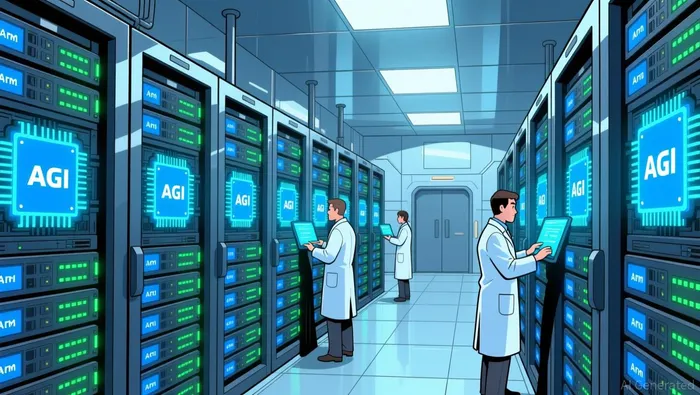
The AGI CPU is projected to generate $15 billion in annual revenue by 2031, representing a major financial upside if adoption is successful. This move aligns with the industry's shift from LLM training to agentic AI deployment, which requires more efficient CPU orchestration.
What Are the Key Risks for Arm in This Transition?
Producing silicon introduces new execution risks, including potential conflicts with existing partners and supply chain complexities. Arm's traditional model has been neutral in licensing, but entering chip production may lead to tensions with partners who rely on Arm's IP.
The company also faces execution risks in scaling up manufacturing and ensuring that the AGI CPU performs as expected in real-world data center environments. If the chip fails to meet performance expectations or faces delays in volume production, it could hinder Arm's growth narrative.
How Might This Affect the AI Infrastructure Market?
Arm's AGI CPU could disrupt the AI data center market by offering a more efficient and scalable alternative to x86 architectures. The chip's performance per rack is expected to be more than double that of traditional x86 systems, which could accelerate the shift from x86 to Arm-based CPUs in AI servers.
The move also positions Arm to compete more directly with Intel and AMD in the CPU market, as the company seeks to capture a share of the $1 trillion AI CPU market. The broader industry is already seeing a shift toward Arm-based CPUs in AI server compute ASICs, driven by hyperscalers' need for more energy-efficient and scalable solutions.
Arm is also collaborating with OEMs and ODMs such as Lenovo, Supermicro, and Quanta Computer to deliver systems using the AGI CPU. These partnerships are expected to help accelerate the adoption of the new chip in data center environments.

Stay ahead of the market.
Get curated U.S. market news, insights and key dates delivered to your inbox.


AInvest
PRO
AInvest
PRO



Comments
No comments yet