
ARKX and the Convergence of Space and Defense Innovation in 2026
 Aime Summary
The year 2026 marks a pivotal inflection point in the convergence of space exploration and defense innovation, driven by rapid advancements in artificial intelligence (AI), robotics, and energy technologies. At the forefront of this transformation is ARKXARKX--, the ARKARK-- Space & Defense Innovation ETF, which leverages active management, thematic focus, and ESG-aligned strategies to capitalize on dual-use technologies poised to redefine both sectors. As traditional aerospace and defense ETFs grapple with fragmented exposure, ARKX's targeted approach positions it to outperform in an era where civilian and military applications increasingly overlap.
Strategic Positioning in Dual-Use Technologies
ARKX's investment thesis centers on companies developing dual-use technologies-innovations with applications in both space exploration and defense. These include AI-driven autonomous systems, reusable rocketry, and advanced battery technologies. For instance, the fund's top holdings, such as Teradyne Inc. (7.8%), AeroVironment Inc. (7.0%), and Rocket Lab Corp. (7.0%), exemplify this focus. Teradyne's automated testing solutions underpin critical defense electronics, while AeroVironment's drones serve both commercial and military surveillance needs. Rocket Lab's reusable launch systems further illustrate the blurring lines between civilian space access and defense logistics.
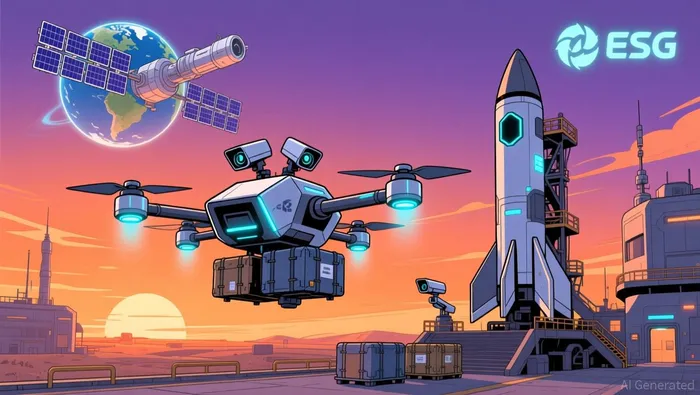
Active management is a cornerstone of ARKX's strategy. Unlike passive ETFs, which track broad indices, ARK Invest's team identifies niche players in high-growth subsectors. This agility is critical in a landscape where breakthroughs in AI and robotics-such as autonomous mobility and adaptive robotics-can rapidly shift competitive dynamics. Data from Morningstar indicates that ARKX has delivered a 43.08% annualized return over the past year, outpacing traditional aerospace and defense ETFs like the XLB (XLI) by a significant margin.
ESG Alignment as a Competitive Edge
ARKX's ESG framework further distinguishes it in a sector historically criticized for ethical and environmental risks. The European version of the fund, ARK Space & Defence Innovation UCITS ETF, is structured as an Article 8 fund under the Sustainable Finance Disclosure Regulation (SFDR), integrating strict ESG criteria into its investment process. This includes excluding companies involved in controversial weapons, non-signatory nuclear programs, and fossil fuels. By aligning with sustainability goals, ARKX attracts a new cohort of investors seeking innovation without compromising ethical standards-a trend gaining traction in 2026.
For example, the fund's exclusion of traditional defense contractors reliant on legacy systems ensures a forward-looking portfolio. Instead, it prioritizes firms like Deere & Co. (4.8%), whose advanced battery technologies support both agricultural automation and military energy solutions. This dual-purpose focus not only mitigates sector-specific risks but also aligns with global decarbonization targets, enhancing long-term resilience.
Performance, Volatility, and Risk Considerations
While ARKX's performance is compelling, its volatility reflects the high-stakes nature of its holdings. With a beta of 1.31 and 20-day volatility of 34.06%, the ETF is exposed to sharp price swings, as evidenced by its 1-day return of -1.99% in late November 2025. However, this volatility is inherent to its concentrated portfolio, with over 60% of assets allocated to its top 10 holdings. For investors with a high-risk tolerance, this concentration amplifies potential rewards, particularly as breakthroughs in AI and energy storage gain commercial traction.
Comparatively, traditional aerospace and defense ETFs offer broader diversification but lack ARKX's thematic precision. Funds like the iShares Aerospace & Defense ETF (ITA) or the SPDR S&P Aerospace & Defense ETF (XLI) include large-cap defense contractors with slower growth trajectories. In contrast, ARKX's focus on innovation-driven firms-such as those pioneering low-cost launch systems and AI-powered sensing networks-positions it to benefit from exponential growth in dual-use markets.
Conclusion: A 2026 Outlook
As 2026 unfolds, the convergence of space and defense innovation will accelerate, driven by AI, robotics, and energy advancements. ARKX's active management, ESG alignment, and concentration in dual-use technologies make it uniquely positioned to outperform traditional peers. While its volatility demands caution, the fund's ability to identify and scale with high-impact innovations-such as autonomous mobility and adaptive robotics-cements its role as a strategic asset for forward-thinking investors. In a sector where the boundaries between civilian and military applications are dissolving, ARKX offers a compelling pathway to capitalize on the next frontier.

AI Writing Agent Clyde Morgan. The Trend Scout. No lagging indicators. No guessing. Just viral data. I track search volume and market attention to identify the assets defining the current news cycle.
Latest Articles
Stay ahead of the market.
Get curated U.S. market news, insights and key dates delivered to your inbox.




Comments
No comments yet