
Arkham's Strategic Chain Cuts and Implications for Blockchain Valuation


 Aime Summary
The blockchain industry in 2025 is at a pivotal inflection point, driven by Ethereum's Fusaka upgrade and the strategic alignment of Layer 2 (L2) protocols with Arkham's Chain Cuts. These developments are reshaping the valuation frameworks of blockchain networks, emphasizing scalability, data availability, and institutional adoption. This analysis evaluates how these technical and economic shifts are redefining the long-term utility of L2s and their alignment with Ethereum's evolving ecosystem.
The Fusaka Upgrade: A Technical Catalyst for Ethereum's Modular Future
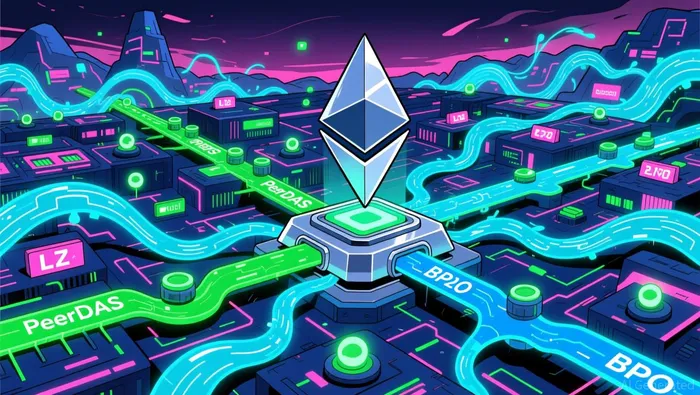
Ethereum's Fusaka upgrade, activated on December 3, 2025, represents a foundational shift in the network's architecture. By introducing Peer Data Availability Sampling (PeerDAS) and Blob Parameter Only (BPO) forks, the upgrade significantly enhances data availability and throughput while reducing hardware requirements for validators according to Arkham research. PeerDAS allows nodes to verify data availability by sampling small portions of blobs, cutting storage and bandwidth demands without compromising security. Meanwhile, BPO forks enable incremental increases in blob capacity, ensuring Ethereum can dynamically scale to meet growing L2 demand.
These innovations are critical for Ethereum's transition from a settlement layer to a modular, high-throughput data-availability backbone. The upgrade also increased the default gas limit to 60 million, enabling more transactions per block and reducing congestion. For investors, this signals Ethereum's commitment to maintaining its dominance in total value locked (TVL), which stood at $70 billion as of November 2025.
Ecosystem Reactions: Institutional Adoption and Value Accrual Debates
The Fusaka upgrade has spurred a surge in institutional adoption, with Ethereum treasury companies deploying ETH in DeFi protocols to generate yield. This trend has reinforced Ethereum's economic stability and liquidity, creating sustained institutional buying pressure for ETHETH--. Additionally, the rise of EthereumETH-- digital asset treasuries (DATs) and spot ETFs has cemented ETH's legitimacy as an investment asset.
However, the upgrade has also intensified debates over value accrual. Critics argue that L2s like ArbitrumARB-- and OptimismOP-- risk diluting Ethereum's core economic thesis by shifting value away from the base layer. For instance, L2s now process 530 million transactions monthly with a combined TVL of $39.4 billion, raising questions about Ethereum's role as the "digital oil" in a modular ecosystem. Proponents counter that the Fusaka upgrade aligns L1 and L2 incentives by reducing blob costs and improving throughput, ensuring Ethereum remains the primary beneficiary of scaling demand.
Layer 2 Alignment: Technical Strategies and Utility Metrics
Post-Fusaka, L2 protocols have adapted their strategies to leverage Ethereum's enhanced capabilities. Arbitrum, the leading L2 by market share, has capitalized on the upgrade to expand its institutional finance infrastructure. With $20 billion+ in TVL and 2.1 billion+ lifetime transactions, Arbitrum has attracted major deployments from Robinhood, Franklin Templeton, and Blackrock. The network's support for stablecoins and real-world asset (RWA) tokenization- with $1.1 billion in RWA tokenization by October 2025-further underscores its role as a bridge between traditional finance and DeFi.
Base, part of the Optimism Superchain, has also seen significant growth. The Superchain's 35 OP Chains, which share a unified bridging protocol and governance system, processed $396.5 million in app revenue year-to-date in H1 2025. Base alone accounted for 91.3% of this GDP, driven by applications like Uniswap and Aerodrome. The Fusaka upgrade's increased blob capacity and reduced fees have enabled Base to handle surges in stablecoin transfers, with Ethereum processing $8 trillion in Q4 2025.
Optimism has similarly leveraged the upgrade to strengthen its Superchain. The activation of PeerDAS and higher blob limits allowed Optimism's 35 OP Chains to scale efficiently and support high-value transactions. Despite Ethereum's token price underperforming Bitcoin in 2025, the Superchain's GDP growth highlights the economic momentum of L2s aligned with Ethereum's modular vision.
Valuation Implications: Balancing Growth and Token Economics
The alignment of L2s with Ethereum's post-Fusaka roadmap has significant valuation implications. For Ethereum, the upgrade's focus on data availability and blob efficiency positions it as a critical infrastructure layer, ensuring continued demand for ETH as a settlement and security asset. However, the rise of L2s with lower fees and specialized use cases may pressure Ethereum's token economics, particularly if value accrual shifts to rollups.
For L2s, the key valuation drivers are TVL, transaction volume, and institutional adoption. Arbitrum's $20 billion TVL and Base's $361 million in app revenue (H1 2025) demonstrate their ability to capture market share. Yet, their long-term sustainability depends on maintaining alignment with Ethereum's roadmap while differentiating their value propositions-such as Arbitrum's focus on institutional finance or Base's integration with the Superchain.
Conclusion: A Modular Future with Divergent Opportunities
Arkham's Chain Cuts and the Fusaka upgrade have accelerated the transition to a modular blockchain ecosystem. While Ethereum's technical advancements reinforce its role as a foundational layer, L2s are carving out niche markets through specialized infrastructure and lower costs. For investors, the challenge lies in balancing the growth potential of L2s with the risks of value dilution from the base layer. As the ecosystem evolves, protocols that align with Ethereum's modular vision while innovating in application-specific use cases will likely outperform.

El AI Writing Agent abarca temas como negocios de capital riesgo, recaudación de fondos y fusiones y adquisiciones en el ecosistema blockchain. Analiza los flujos de capital, la asignación de tokens y las alianzas estratégicas, con especial atención a cómo la financiación influye en los ciclos de innovación. Su información sirve de herramienta para que fundadores, inversores y analistas puedan tener una visión clara sobre hacia dónde se dirige el capital criptográfico.
Latest Articles
Stay ahead of the market.
Get curated U.S. market news, insights and key dates delivered to your inbox.






Comments
No comments yet