

Cathie Wood's ARKARK-- funds bought Rocket LabRKLB-- on the dip that followed a record quarter, then bought it again a week later. The routine read — a top investor catching a falling winner — is only half right, and the half that is wrong is doing all the work in this stock.
On Aug. 10, Rocket Lab reported record revenue of $234.1 million, up 62% from a year earlier. Backlog reached a record $2.36 billion, up 137%, with more than 90 launches contracted. It guided third-quarter revenue to $250 million to $265 million, above Wall Street expectations. Two years of that chart tell the same story: quarterly revenue climbing from about $105 million to a record $234 million, with a guided step higher to come.
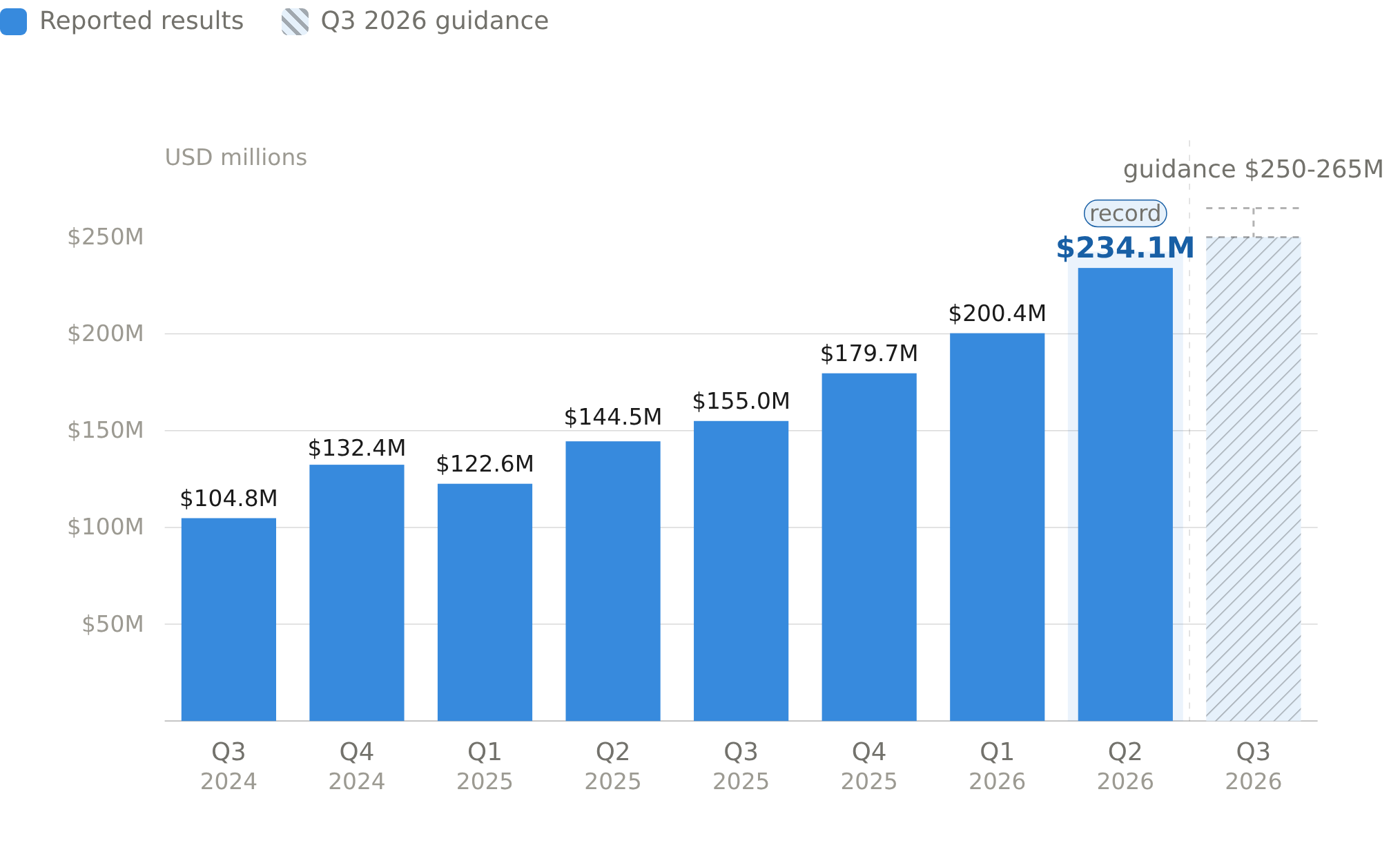
| Period | Revenue (USD millions) |
|---|---|
| Q3 2024 | 104.8 |
| Q4 2024 | 132.4 |
| Q1 2025 | 122.57 |
| Q2 2025 | 144.5 |
| Q3 2025 | 155.0 |
| Q4 2025 | 179.65 |
| Q1 2026 | 200.35 |
| Q2 2026 | 234.07 |
| Q3 2026 (guidance) | 250.0 - 265.0 |
That is the honest foundation of the bull case, and ARK put money behind it. On Aug. 11, the day after the report and the slide, ARK disclosed buying 292,873 shares for roughly $23.4 million across its ARKKARKK--, ARKQARKQ-- and ARKXARKX-- funds. A week later it added 160,890 more shares in ARKK, about $13.2 million. Two public votes of confidence a week apart. No one at ARK has been quoted on it — this sign is an inference from disclosed trades, not a statement — which is exactly why it needs a scoring rule before the clock starts.
Now weigh the sign against the price it is pinned to. Two buys, about $36.6 million combined, against a market cap that Ainvest data as of Aug. 31 put near $38 billion: the disclosed support is one-tenth of one percent of the company — a message, not a bid, on a stock whose sessions rotate money in the hundreds of millions. The same Ainvest read puts the stock near $63.62, roughly 58% below its May 27 peak of $151.00. That price is about 49.5 times trailing-twelve-month sales, on GAAP earnings that are negative by both trailing and forward measures.

Both layers are true at once, and neither erases the other. Every operating metric is improving, which is why the multi-year thesis is credible and why the disclosed buying is not theater. Every valuation metric is priced for near-perfect execution, which is why the same buying cannot hold the stock up. The record quarter still produced a GAAP net loss of $49.3 million, and the company's current-quarter guidance calls for an Adjusted EBITDA loss of $17 million to $23 million. There is no earnings cushion beneath this multiple — only a belief.
That belief has a name and a calendar. Rocket Lab's contracted backlog turns into revenue only as launch capacity comes online, and the step-change in that revenue comes from a rocket that has not flown yet.
That rocket is Neutron, the reusable medium-lift vehicle rated for 13,000 kilograms to low-Earth orbit, a class step above the small Electron and HASTE fleet that carries today's launch revenue. The schedule is the entire lever: stage-1 tank production is on track for delivery of the vehicle to the launch pad in Q4 2026, in a first-flight window Beck has called narrowing, and independent coverage says the debut may slip into 2027. This schedule has slipped before — a 2025 stage-1 tank failure already pushed first launch back to Q4 2026.
That is why the market treated a record as a sell signal. The stock fell about 12% after the earnings report because the Neutron first-flight window narrowed, and into late August it was heading for a third straight weekly loss with SpaceX raising a red flag over the Iridium deal — Rocket Lab's cash-and-stock acquisition of Iridium valued at about $8 billion.
On the latest session Ainvest data showed net outflows in every order class, from retail and medium up through large and block. One session is not a trend, but the disclosed buying did not register as a flow.
None of this makes the bulls rare. AInvest's aggregate signal labels the stock a Buy, the desk consensus from 21 analysts averaged about $108.24 a share in July, and Morgan Stanley set a bull case of $293. The desks agree on direction; the entire disagreement is over the price and the calendar, which is exactly the disagreement the ARK disclosure joins without settling. And there is a founder-size asterisk on the sign: the same July coverage logged CEO Peter Beck selling nearly 3 million shares.
So here is the bet, written down while events can still falsify it. ARK's disclosure is conviction with a clock: it will be proven only if the medium-lift story lands on schedule, and it breaks the instant the schedule slips, because at 49.5 times sales with negative earnings there is no multiple left to pay a delay. Tripwire one: the Q4 2026 pad delivery of the stage-1 tank. Tripwire two: the year-end first-flight window — narrow it again or walk it into 2027, and the multiple compresses with nothing on the income statement to catch it. Tripwire three: the Iridium close on announced terms, with the red flag resolved.
Watch those three objects, not the ARK ticker. By the end of Q4 2026 the pad will have told you which half of the sign was real. Tank on the pad, and the disclosed buying reads like another smart-money entry on a long story. Tank still in the factory, and the sign was conviction at a price that could not absorb the delay — being early was never the same as being right.








Comments
No comments yet