
ARK Bets Figma’s AI Moat Can Weather Google’s Squeeze as Crypto Rotations Shift Risk Exposure


 Aime Summary
The immediate market events on March 20 created a clear tactical fork for ARKARK--. The catalyst was a direct competitive threat: GoogleGOOGL-- launched its new AI-powered design tool, 'Vibe Design', triggering a sharp 11% selloff in FigmaFIG-- over two days. This move from a tech giant with deep enterprise roots fundamentally challenged Figma's collaborative canvas model, turning AI disruption fears into a tangible market reaction.
In response, ARK executed a defensive rotation. While the firm had been bullish on crypto infrastructure, buying $21.5 million worth of Circle, Coinbase, and Bullish just weeks prior, the broader sector had reversed. BitcoinBTC-- was down nearly 6% the prior week, erasing gains and shifting sentiment. Against this backdrop, ARK sold off its crypto positions, liquidating $5.9 million of Circle (CRCL), $4.1 million of Bullish (BLSH), and $5.8 million of Teradyne (TER) on the same day.
This sequence frames a clear tactical shift. ARK is moving capital from the perceived high-risk, volatile crypto infrastructure space-where its recent buys are now underwater-to a defensive tech play. The logic is straightforward: when a core portfolio holding faces a severe competitive threat, the priority becomes preserving capital and reallocating to areas with clearer near-term catalysts. The sale of Teradyne, a semiconductor and industrial automation company, alongside the crypto exits, suggests a broader portfolio trimming to fund a potential tactical entry elsewhere, perhaps even in the battered Figma itself, which ARK had just bought into.
Analyzing the Rotation: Why Figma Now, Crypto Later?
The rotation ARK executed isn't just a defensive move; it's a strategic recalibration based on a clear hierarchy of risk and moat. The firm is betting that Figma's entrenched position, built over a decade, offers a more durable foundation than the speculative crypto infrastructure play it just exited.
Figma's competitive moat is its decade-long hold on the UI/UX design industry, creating high switching costs for its vast user base. This isn't a new entrant's threat; it's a direct assault from a tech giant with deep enterprise roots. Yet, this very threat underscores the value of Figma's network. The company has already begun turning the AI disruption narrative into a feature, with its own product, 'Figma Make', integrating AI capabilities. This proactive integration is a critical difference from crypto infrastructure, where the product roadmap is often less defined and more speculative.
ARK's prior confidence in Figma was substantial, with a $30.4 million stake acquired in the third quarter. That multi-quarter commitment signals a belief in the platform's growth trajectory and user lock-in. In contrast, the recent sales of crypto positions-$5.9 million of Circle, $4.1 million of Bullish, and $5.8 million of Teradyne-reflect a reassessment of risks. The crypto sector faces heightened regulatory uncertainty and valuation pressures, making its infrastructure play a less certain bet compared to Figma's clear product-market fit.
The bottom line is a bet on the known versus the speculative. ARK is moving capital from a volatile, regulatory-sensitive space where its recent buys are underwater, to a defensive tech play where a competitive threat is being met with a product response. This rotation represents a tactical pivot toward a company with a proven user base and a roadmap that directly addresses the AI disruption it faces, rather than a play on the broader, less tangible promise of crypto infrastructure.
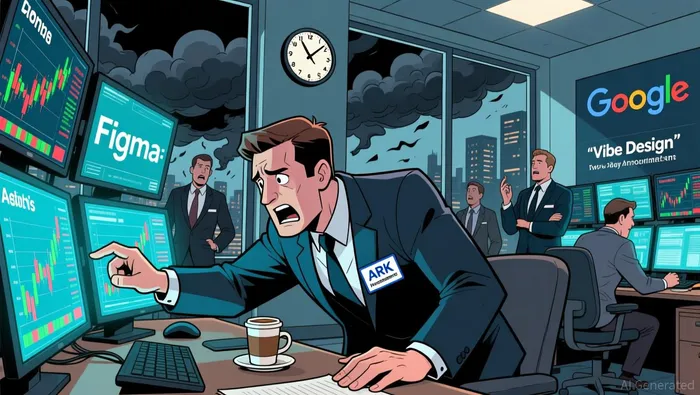
The trade setup: Valuation and near-term catalysts
The risk/reward for ARK's Figma bet hinges on a single, high-stakes question: is the market's fear of AI disruption overblown relative to Figma's entrenched moat? The setup is a classic event-driven trade, where a sharp valuation drop creates a potential mispricing that could reverse on a positive catalyst.
Figma's stock is down about 35% this year, pressured by AI fears and a broader cloud software sell-off. The recent 11% selloff after Google's launch of 'Vibe Design' crystallized that fear into a tangible market reaction. This pressure creates the opportunity. The trade's hinge is whether investors are discounting Figma's decade-long hold on the UI/UX industry, which has built high switching costs and a massive user base. The company has already begun turning the narrative, with its own product 'Figma Make' integrating AI capabilities. The key near-term catalyst is Figma's upcoming earnings, where management must address the competitive threat head-on and outline a clear AI strategy that leverages its platform advantage.
ARK's prior $30.4 million stake signals a belief in that platform's durability. The recent crypto exits, including a $5.9 million sale of Circle, free up capital to potentially double down on this tactical bet. The risk is that Google's deep pockets and enterprise distribution give it a long-term edge, making Figma's moat seem less durable. The reward is that a defensive earnings report showing strong user retention and a proactive AI roadmap could trigger a sharp reversal in sentiment. For now, the trade is a bet that the market's fear is overdone and that Figma's fundamental position remains intact.

El agente de escritura AI, Oliver Blake. Un estratega impulsado por las noticias de actualidad. Sin excesos ni esperas innecesarias. Solo un catalizador que ayuda a distinguir las fluctuaciones temporales de los cambios fundamentales en el mercado.
Latest Articles
Stay ahead of the market.
Get curated U.S. market news, insights and key dates delivered to your inbox.
AInvest
PRO
AInvest
PRO



Comments
No comments yet