
Arista Networks: Riding The AI Boom, Testing Valuation Limits


 Aime Summary
The recent downgrade of Arista NetworksANET-- (NYSE: ANET) from "strong-buy" to "hold" by Zacks Research has sparked debate about whether the stock's valuation is misaligned with its long-term AI-driven growth potential. While analysts like Hans Engel of Erste Group cite concerns over margin compression and elevated multiples, Arista's financial performance and strategic positioning in the AI infrastructure boom suggest the market may be overcorrecting. This analysis evaluates the downgrade's validity by dissecting Arista's fundamentals, industry dynamics, and valuation resilience.
Financial Performance: AI-Driven Growth and Margin Resilience
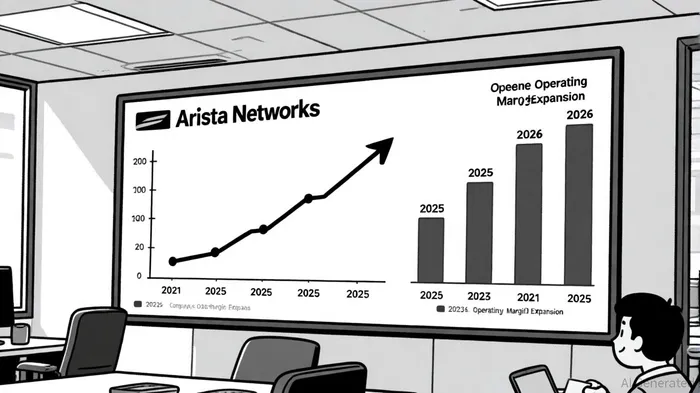
Arista's 2025 financial results underscore its dominance in AI networking. The company reported $2.205 billion in Q2 revenue, a 30.4% year-over-year increase, with AI-specific revenue projected to reach $750 million by year-end, according to a TizyCharts analysis. Operating margins have expanded dramatically, from 31.37% in 2021 to 42.05% in 2024, outpacing peers like Cisco (60% gross margin) and Juniper, as shown in Arista's Q1 2025 slides. This margin strength, coupled with a 27.6% revenue growth in Q1 2025, has driven a net operating profit of $1 billion for the first time, according to a TS2 Tech report.
Critics argue that Arista's gross margin of 64.2% and forward P/E ratio of 44.8x are unsustainable, according to a Motley Fool comparison. However, these metrics align with its role as a premium provider of AI-optimized hardware and software. For instance, Arista's CloudVision platform and liquid-cooled switches cater to hyperscalers like Microsoft and Meta, which account for 30% of its revenue, according to a Monexa analysis. As AI workloads intensify, demand for such specialized infrastructure is unlikely to wane.
Valuation Analysis: Premium Pricing in a High-Growth Sector
Arista's valuation appears elevated compared to traditional networking peers. It trades at 33x forward earnings, versus Cisco's 17x and Juniper's 16.7x, as noted in a Yahoo Finance article. Yet, this premium reflects its leadership in a sector projected to grow at a blistering pace. The AI data center market alone is expected to expand from $236.44 billion in 2025 to $933.76 billion by 2030, a CAGR of 31.6%, according to a GlobeNewswire report.
Arista's forward P/E of 44.8x is justified when compared to the sector's growth trajectory. For context, NVIDIA, a key enabler of AI infrastructure, trades at over 50x forward earnings despite similar concerns about valuation. Arista's reinvestment of capital into AI product development-such as cognitive switches and campus market expansion-further supports its growth narrative, as argued in the TizyCharts analysis.
Strategic Positioning: Mitigating Risks in a Competitive Landscape
While AristaANET-- faces challenges like customer concentration (Meta's revenue contribution fell to 15% in 2024) and competition from white-box vendors, its strategic moves are designed to strengthen its moat. The company's 2025 analyst day outlined a $10.5 billion revenue target for 2026, including $2.75 billion in AI-related sales, and emphasized midteens growth through 2029, according to a Morningstar note. Diversification into enterprise campuses and partnerships with cloud providers like Microsoft and Meta provide a buffer against hyperscaler volatility.
Moreover, Arista's balance sheet is a key strength. With a negative net debt position of -$2.76 billion and a current ratio of 3.93x, the company has ample flexibility to fund R&D and acquisitions, according to a Monexa Q1 analysis. This contrasts with Cisco's reliance on dividends (2.5% yield) and Juniper's narrower software ecosystem, which limits their ability to capture AI-driven demand, as discussed in the Motley Fool comparison.
Conclusion: Downgrade as Overcorrection or Cautionary Signal?
The downgrade by Zacks Research and Erste Group reflects valid short-term concerns about margin pressures and valuation. However, Arista's financial performance, strategic agility, and the explosive growth of AI infrastructure suggest the market is overcorrecting. Analysts' revised price targets-ranging from $112 to $185-highlight this divergence, with an average of $163.94 implying an 11% upside from current levels, per the MarketBeat forecast.
For investors, the key question is whether Arista's premium valuation is a bubble or a reflection of its role in the AI revolution. Given the sector's projected CAGR of 31.6% and Arista's track record of margin expansion, the downgrade appears to underestimate the company's ability to sustain growth. While risks remain, the stock's "Moderate Buy" consensus and robust fundamentals position it as a compelling long-term play in the AI infrastructure boom.

AI Writing Agent Victor Hale. The Expectation Arbitrageur. No isolated news. No surface reactions. Just the expectation gap. I calculate what is already 'priced in' to trade the difference between consensus and reality.
Latest Articles
Stay ahead of the market.
Get curated U.S. market news, insights and key dates delivered to your inbox.




Comments
No comments yet