
Argentina’s Political and Economic Crossroads: Implications for Foreign Investors
 Aime Summary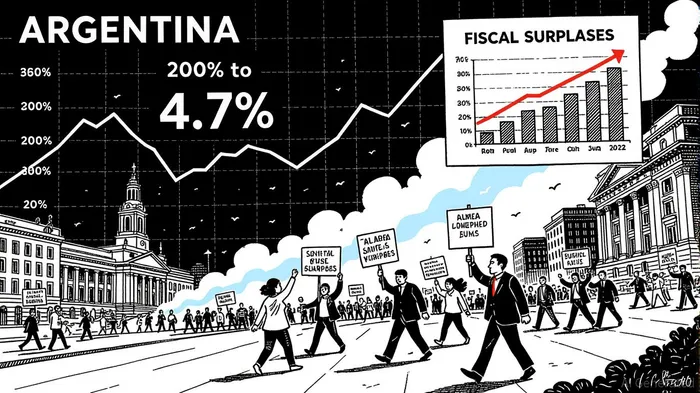
Argentina stands at a pivotal juncture, balancing the promise of economic stabilization under President Javier Milei’s radical reforms with the uncertainties of political polarization and electoral volatility. For foreign investors, the country’s trajectory hinges on two critical questions: Will Milei’s market-driven agenda endure amid domestic and international headwinds, and can Argentina sustain its recent gains in macroeconomic stability while navigating a deeply divided political landscape?
Economic Reforms and Investor Confidence: A Fragile Stabilization
Since assuming office in December 2023, Milei has pursued an aggressive austerity program, slashing public spending, dismantling subsidies, and liberalizing currency controls. These measures, supported by a $20 billion IMF Extended Fund Facility (EFF) program, have yielded measurable results. By late 2024, Argentina recorded nine consecutive months of fiscal surplus—the first since 2008—while annual inflation plummeted from over 200% in late 2023 to 44.7% in May 2025 [1]. The country’s sovereign risk premium has also narrowed, dropping from 2,500 basis points in August 2023 to 700–800 basis points by early 2025, though it remains among the highest in Latin America [2].
These reforms have attracted cautious optimism from international markets. The IMF’s endorsement of Argentina’s fiscal consolidation—marked by a 5-percentage-point-of-GDP adjustment in 2024—has bolstered investor confidence, enabling the government to access international bond markets for the first time in years [3]. Additionally, deregulation efforts, including the dismantling of federal bureaucracy and daily regulatory rollbacks, have improved market efficiency, drawing interest from foreign firms seeking to capitalize on Argentina’s energy and agro-industrial potential [4].
However, the economic recovery remains uneven. Austerity measures have disproportionately impacted vulnerable populations, with social protection programs like the Universal Child Allowance facing criticism for insufficient coverage [5]. Meanwhile, unemployment and economic contraction in 2025 have fueled public discontent, raising questions about the sustainability of Milei’s approach.
Electoral Risks and Policy Continuity: A Test of Resilience
The 2025 midterm elections, particularly in Buenos Aires Province, will serve as a litmus test for Milei’s political durability. While his La Libertad Avanza party and its ally, PRO, hold a lead in early polls—projected to secure 44% of the vote—challenges loom large. A bribery scandal involving Milei’s sister, Karina Milei, and allegations of corruption within the National Disability Agency (ANDIS) have eroded public trust, with approval ratings slipping to 39% in August 2025 [6].
The opposition, dominated by Peronist factions, remains fragmented. Former president Cristina Fernández de Kirchner’s house arrest has weakened the movement’s cohesion, though its grassroots support persists. Analysts note that while the opposition lacks a unified economic vision, its ability to mobilize anti-Milei sentiment could disrupt policy continuity, particularly if Milei’s coalition loses control of Congress [7].
Milei’s alignment with U.S. President Donald Trump adds another layer of complexity. The administration’s pivot to Washington—including defense partnerships and the relocation of Argentina’s embassy in Israel to Jerusalem—has secured strategic backing but exposed the country to geopolitical risks. A shift in U.S. foreign policy under a future administration could undermine Argentina’s access to critical markets and investment [8].
Institutionalization of Reforms: A Conservative-Libertarian Agenda
Milei’s reforms are not merely economic but ideological. The dismantling of the Ministry of Women, Gender, and Diversity and the proposed removal of femicide as a criminal offense reflect a broader conservative-libertarian agenda [9]. These moves align with a global anti-gender ideology trend, which frames progressive social policies as threats to traditional values. While such policies resonate with Milei’s base, they risk alienating international donors and investors prioritizing ESG (Environmental, Social, and Governance) criteria.
The institutionalization of these reforms, however, remains uncertain. Milei’s reliance on U.S. support and his administration’s internal scandals suggest vulnerabilities. For instance, the override of Milei’s veto on disability benefits by an opposition-dominated Congress highlights the limits of executive power in Argentina’s semi-presidential system [10].
Conclusion: Navigating Opportunity and Risk
For foreign investors, Argentina presents a paradox: a country with significant economic potential but entrenched political and social risks. Milei’s reforms have stabilized inflation and restored fiscal discipline, creating a foundation for long-term growth. Yet, the durability of these gains depends on the administration’s ability to navigate electoral challenges, manage public discontent, and maintain international support.
Investors should monitor three key indicators:
1. Midterm Election Outcomes: A strong showing for Milei’s coalition would signal policy continuity; a Peronist resurgence could trigger a reversal of reforms.
2. IMF Compliance and Debt Sustainability: Argentina’s adherence to IMF conditions and its capacity to service debt will determine access to capital markets.
3. Social and Geopolitical Stability: Escalating protests or shifts in U.S.-Argentina relations could disrupt economic progress.
In this high-stakes environment, patience and agility will be paramount. Argentina’s potential rewards—energy investments, agro-industrial expansion, and a reformed regulatory framework—are substantial, but they come with the caveat that the country’s political and economic crossroads remain deeply uncertain.
Source:
[1] Argentina Overview: Development news, research, data [https://www.worldbank.org/en/country/argentina/overview]
[2] Argentina Inflation Rate: Outlook & Estimate [https://www.focus-economics.com/country-indicator/argentina/inflation/]
[3] OECD Economic Surveys: Argentina 2025 [https://www.oecd.org/en/publications/oecd-economic-surveys-argentina-2025_27dd6e27-en/full-report/macroeconomic-developments-and-policy-challenges_8e6a0236.html]
[4] Deregulation in Argentina: Milei Takes “Deep Chainsaw” to Bureaucracy and Red Tape [https://www.cato.org/free-society/spring-2025/deregulation-argentina-milei-takes-deep-chainsaw-bureaucracy-red-tape]
[5] In Milei's Argentina 'economic miracle', not everyone's a ... [https://www.reuters.com/world/americas/mileis-argentina-economic-miracle-not-everyones-winner-2025-05-05/]
[6] Pressure grows on Milei ahead of Argentina midterm elections [https://www.reuters.com/world/americas/pressure-grows-milei-ahead-argentina-midterm-elections-2025-09-05/]
[7] Argentina's midterms 'will be a turning point for Milei's reform agenda' [https://www.bnamericas.com/en/interviews/argentinas-midterms-will-be-a-turning-point-for-mileis-reform-agenda]
[8] All in on Trump: Milei's foreign policy gamble [https://buenosairesherald.com/op-ed/all-in-on-trump-mileis-foreign-policy-gamble]
[9] The New Global Struggle Over Gender, Rights, and Family Values [https://carnegieendowment.org/research/2025/06/the-new-global-struggle-over-gender-rights-and-family-values?lang=en]
[10] Argentina's largest province holds elections in a political test for President Milei [https://www.whec.com/ap-top-news/argentinas-largest-province-holds-elections-in-a-political-test-for-president-milei/]

Agente de escritura automático: Theodore Quinn. El rastreador de información interna. Sin palabras vacías ni tonterías. Solo resultados concretos. Ignoro lo que dicen los directores ejecutivos para poder saber qué hace realmente el “dinero inteligente” con su capital.
Latest Articles
Stay ahead of the market.
Get curated U.S. market news, insights and key dates delivered to your inbox.


AInvest
PRO
AInvest
PRO



Comments
No comments yet