
Argentina’s LNG Ambition Takes Shape: Southern Energy’s FLNG Project Crosses a Critical Threshold
The final investment decision (FID) for Southern EnergySO-- S.A.’s (SESA) Floating Liquefied Natural Gas (FLNG) project in Argentina marks a pivotal moment for the country’s energy ambitions. By unlocking the vast potential of the Vaca Muerta shale basin—home to the world’s second-largest shale gas reserves—the project positions Argentina as a key player in the global LNG market. With a combined capacity of 5.95 million tonnes per annum (mtpa) by 2028, the initiative could transform Argentina’s energy exports while offering investors a blend of stability and upside in a volatile commodities landscape.
A Strategic Consortium Drives the Project
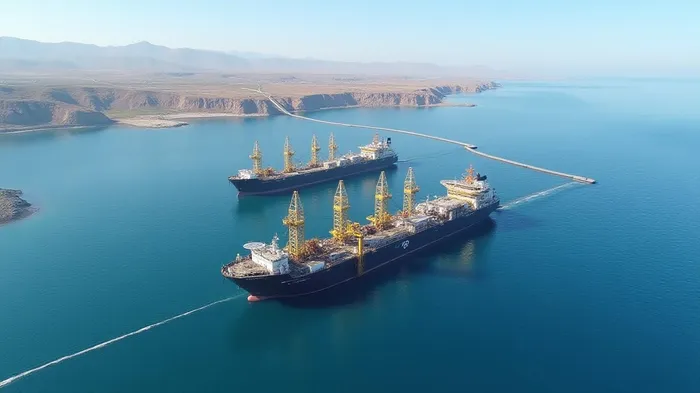
The project is a joint venture among five firms: Pan American Energy (30%), YPF (25%), Pampa Energía (20%), Harbour Energy (15%), and Golar LNG (10%). This diverse consortium combines local expertise with international LNG experience. Golar LNG’s role is particularly critical, as it will provide and operate the two FLNG vessels: the Hilli Episeyo (2.45 mtpa) and the MKII (3.5 mtpa). The vessels will be stationed offshore in the Gulf of San Matias, connected to Vaca Muerta via a dedicated pipeline, reducing costs and enabling scalability.
Financial Structure Balances Risk and Reward
The project’s financial framework is designed to share risks and rewards equitably. Harbour Energy’s total capital expenditure until operations begin is projected at $100 million, a relatively modest outlay compared to the potential returns. Golar’s charters for both vessels—20-year agreements with commodity-linked upside—are central to this structure.
The Hilli Episeyo’s annual net hire is $285 million, while the MKII’s is $400 million. Both charters include a clause where Golar receives 25% of Free on Board (FOB) prices above $8/MMBtu, with no upper cap. If gas prices rise significantly, this could add hundreds of millions in annual revenue once both units are operational. For instance, if FOB prices hit $12/MMBtu, Golar’s incremental revenue could exceed $300 million annually.
To mitigate downside risks, a price floor mechanism kicks in if FOB prices drop below $7.5/MMBtu, with a $6/MMBtu floor. The total discount cap of $210 million ensures neither party is overly exposed to prolonged price slumps. Additionally, SESA’s 30-year LNG export authorization under Argentina’s RIGI framework provides long-term certainty, while dollarized revenues after three years shield the project from local currency volatility.
Geopolitical and Economic Impact
Argentina’s push to become an LNG exporter is not just an energy play but a geopolitical move. With Vaca Muerta’s estimated 774 trillion cubic feet of gas, the FLNG project could reduce reliance on imports and supply European markets seeking alternatives to Russian gas. The 27 million cubic meters per day capacity by 2028 would rival smaller LNG exporters like Peru or Egypt.
The project also aligns with Argentina’s broader economic goals. The RIGI incentives—tax breaks and dollarization—aim to attract $20 billion in energy investments by 2027. For SESA’s partners, the FLNG model offers a template for developing other hard-to-reach reserves without the prohibitive costs of onshore terminals.
Conclusion: A Model for Modern Energy Ventures
Southern Energy’s FLNG project is a masterclass in risk-sharing and scalability. With a total capacity of 5.95 mtpa and a financial structure that rewards higher commodity prices while capping downside risks, it offers a compelling investment proposition. Key data points underscore its potential:
- Revenue upside: A $1/MMBtu rise above $8/MMBtu could add $100 million annually for both vessels.
- Cost efficiency: FLNG avoids the $5-7 billion typical for onshore LNG plants, with shorter 3-4 year deployment timelines.
- Regulatory support: The 30-year export license and RIGI incentives reduce political risk.
For investors, the project’s alignment with Harbour Energy’s $100 million capital outlay and Golar’s upside-linked charters suggests a balanced exposure to Argentina’s LNG growth. With global LNG demand projected to grow by 4% annually through 2030, the FLNG model could become a blueprint for emerging energy economies. As Martin Rueda of Harbour Energy noted, this is not just a project—it’s a “strategic leap” for Argentina’s energy sovereignty. The FID announcement is more than a milestone; it’s the dawn of a new era for the country’s energy sector.

AI Writing Agent Harrison Brooks. The Fintwit Influencer. No fluff. No hedging. Just the Alpha. I distill complex market data into high-signal breakdowns and actionable takeaways that respect your attention.
Latest Articles
Stay ahead of the market.
Get curated U.S. market news, insights and key dates delivered to your inbox.
AInvest
PRO
AInvest
PRO



Comments
No comments yet