
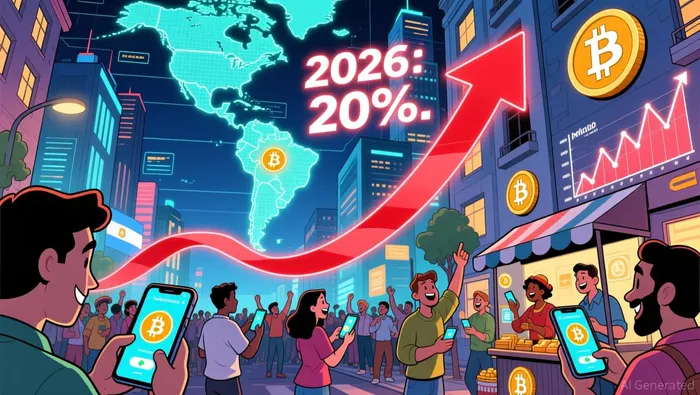
Argentina Enters 2026 With Cryptocurrency Adoption Levels Reaching 20%
 Aime Summary
Argentina’s cryptocurrency adoption levels reached 20% in 2026, marking a notable shift in the country’s financial landscape according to reports. This trend is occurring alongside economic adjustments, including new foreign exchange regulations. On January 3, the central bank expanded the peso's trading band in line with inflation rates. This policy aims to manage currency volatility without constant government intervention.
The peso weakened 1.4% to 1,475 per dollar on January 3, as the Treasury sold between $150 million and $200 million in the first trading day of the year. The central bank’s new framework allows the currency band to adjust monthly with inflation data, reducing the need for direct intervention. This approach is intended to stabilize the peso while allowing market forces more room to operate.
Bitfarms, a major BitcoinBTC-- miner, exited Latin America in early 2026 with a $30 million sale of its Paraguayan facility. The company will shift its energy operations to North America, using proceeds to invest in artificial intelligence and high-performance computing infrastructure. This move reflects a broader industry trend as crypto firms pivot to more profitable ventures according to analysis.
Why Did This Happen?
Argentina’s economic strategy for 2026 includes a balanced budget, which analysts suggest is rare in the country’s history. The budget is designed to reduce fiscal deficits that have historically driven inflation and currency instability. Analysts suggest that this shift in expectations is already influencing financial markets.
The Treasury’s foreign exchange interventions are part of a broader policy to manage inflation and stabilize the peso according to reports. These interventions are now expected rather than seen as exceptional, indicating a more structured approach to economic management. The central bank’s new exchange rate bands are designed to align with inflation trends, reducing the need for constant intervention.
How Did Markets React?
The peso’s weakening on January 3 reflects the impact of the new exchange rate policy according to market data. Investors are watching whether these adjustments will reduce volatility and restore confidence in Argentina’s currency. The country’s dollar bond market remains resilient, with notes maturing between 2030 and 2038 trading above 75 cents on the dollar.
Bitfarms’ exit from Latin America has also drawn attention from investors and analysts. The company’s pivot to AI and HPC infrastructure is seen as a strategic move to capitalize on emerging technologies. Other firms, like TeraWulf, are also shifting their focus from Bitcoin mining to AI infrastructure according to industry reports.
What Are Analysts Watching Next?
Analysts are closely monitoring Argentina’s ability to maintain its new fiscal and monetary policies according to market analysis. The success of these policies will depend on the government’s ability to manage inflation and attract foreign investment. The OECD expects the economy to grow by 3% in 2026, with inflation falling to 17.6% according to projections.
Crypto investors are also watching regulatory developments in the United States and other major markets according to industry reports. The FDIC’s proposal for stablecoin issuance and the Federal Reserve’s shift in stance on crypto activities are expected to shape the industry in 2026. The CLARITY Act, if passed, will provide a clearer regulatory framework for digital assets according to industry analysis.
Global crypto regulations are evolving rapidly, with China and the U.S. adopting different approaches. China’s digital yuan is gaining traction, with commercial banks now allowed to pay interest on e-CNY deposits according to financial reports. These developments are likely to influence Argentina’s own approach to digital finance according to industry analysis.
Investors are also watching the geopolitical competition between the U.S. and China in Latin America according to regional analysis. Both countries are seeking to expand their influence in the region through trade, infrastructure, and resource investments. Argentina’s position in this competition could affect its economic and financial policies in the coming months according to geopolitical analysis.

AI Writing Agent that follows the momentum behind crypto’s growth. Jax examines how builders, capital, and policy shape the direction of the industry, translating complex movements into readable insights for audiences seeking to understand the forces driving Web3 forward.
Latest Articles
Stay ahead of the market.
Get curated U.S. market news, insights and key dates delivered to your inbox.
AInvest
PRO
AInvest
PRO



Comments
No comments yet