
Argentina's Debt Restructuring and IMF Support: A Window for Strategic Emerging Market Exposure


 Aime Summary
The stage is set for Argentina to pivot from decades of economic turbulence to a more stable, investor-friendly environment. With the International Monetary Fund (IMF) approving a $20 billion Extended Fund Facility (EFF) in April 2025 and the government under President Javier Milei pushing aggressive fiscal reforms, Argentina is at a critical inflection point. For investors, this represents both a cautionary tale and a high-conviction opportunity. Let's break it down.
Sovereign Debt Dynamics: A Delicate Balancing Act
Argentina's debt restructuring negotiations with the IMF and private creditors are no longer just about survival-they're about strategic positioning. The $20 billion IMF program, with an immediate $12 billion disbursement, is a lifeline for a country that faces $7.6 billion in private creditor repayments in 2025 alone, according to the IMF press release. The government's goal is clear: restructure its debt to ease short-term liquidity pressures while avoiding a new IMF program that could deepen dependency.
The IMF's conditions-lifting capital controls, maintaining fiscal discipline, and transitioning to a floating exchange rate-are already reshaping Argentina's economic landscape. According to an Atlantic Council piece, the removal of the "cepo" capital controls has already catalyzed foreign investment, particularly in energy and mining. However, the road ahead is bumpy. Argentina's net international reserves remain negative at -$4 billion, and its 2026–2028 repayment obligations ($4.062 billion in 2026 and rising) demand a creative refinancing strategy, according to a Bloomberg Línea report.
Credit Rating Upgrades: A Green Light for Bond Investors?
Moody's recent upgrade of Argentina's sovereign rating from Caa3 to Caa1 in August 2025 is a seismic shift. This marks the first positive rating action in decades and reflects confidence in the government's fiscal anchor and currency stabilization efforts, as highlighted in an Algara analysis. Fitch followed suit with a "CCC" rating, signaling improved near-term debt servicing capacity in the Fitch upgrade.
For bond investors, this is a tactical entry point. The risk premium for Argentine sovereign debt has narrowed, but it remains elevated at 867 basis points-a reminder that Argentina is still a speculative-grade market, according to a Riotimes report. However, the IMF's endorsement and the government's first budget surplus in 14 years suggest that the worst of the fiscal crisis may be behind us.
Equity Opportunities: Mining, Energy, and the "New Argentina"
If Argentina's debt story is about stability, its equity story is about growth. The energy and mining sectors are the crown jewels of this transformation.
1. Lithium and the Energy Transition
Argentina is part of the "Lithium Triangle" (alongside Chile and Bolivia) and holds one of the world's largest lithium reserves. Production surged by 62% in 2024, and the government aims for a 75% increase in 2025, per a Discovery Alert report. Companies like Lithium Argentina Corp. are scaling up, with 2025 production guidance of 30,000–35,000 tonnes of lithium carbonate equivalent (LCE), according to the company's Lithium Argentina guidance. The Incentive Regime for Large Investments (RIGI) has attracted $30 billion in foreign capital, including projects from Rio Tinto and Glencore, as detailed in a U.S. Trade report.
2. Vaca Muerta: The Shale Game-Changer
Argentina's Vaca Muerta shale formation is the second-largest in the world, and its development is accelerating. YPF Sociedad Anónima (YPFD), the country's largest energy firm, has seen record production from the region, with crude oil exports rising from 30,000 b/d in 2017 to 128,000 b/d in 2023, according to a GBEJ article. Infrastructure projects like the Perito Moreno gas pipeline are addressing bottlenecks, and plans for LNG export facilities could turn Argentina into a global energy exporter, as noted in that U.S. Trade report.
3. Renewable Energy and Infrastructure
With a target of 30% renewable energy in its grid by 2030, companies like Pampa Energía and Central Puerto are expanding wind and solar capacity, as covered in a NewsTrail roundup. The government's focus on infrastructure-both for mining and energy-creates tailwinds for construction and engineering firms.
Investor Sentiment: Caution Meets Optimism
The market's reaction has been mixed. While the S&P Merval index dropped 4.1% in dollar terms in March 2025 due to rising risk premiums, the IMF's 5.5% growth forecast for 2025 and Argentina's first budget surplus in 14 years have begun to shift perceptions, as the Riotimes report observed. Global factors, including a weaker U.S. dollar and easing trade tensions, are also creating a more favorable backdrop for emerging markets, according to a Lombard Odier insight.
Risks and Realities
Let's not sugarcoat it: Argentina's path is fraught with risks. Inflation, though down from 211.4% in 2023 to 117.8% in 2024, remains a headwind. Social unrest over austerity measures and political resistance to reforms could derail progress. Additionally, global lithium prices have fallen due to oversupply, which could pressure mining revenues, according to a Mining Weekly report.
Conclusion: A High-Volatility, High-Reward Play
Argentina is a textbook example of a "recovery trade." The IMF's backing, credit rating upgrades, and sector-specific growth drivers make it an intriguing bet for investors with a high risk tolerance. However, the key is to approach this market with a diversified strategy-focusing on hard assets like lithium and energy while hedging against currency and political risks.
As the Milei administration navigates its debt restructuring and structural reforms, Argentina could emerge as a model for emerging market resilience-or a cautionary tale. For now, the window is open, but it won't stay that way forever.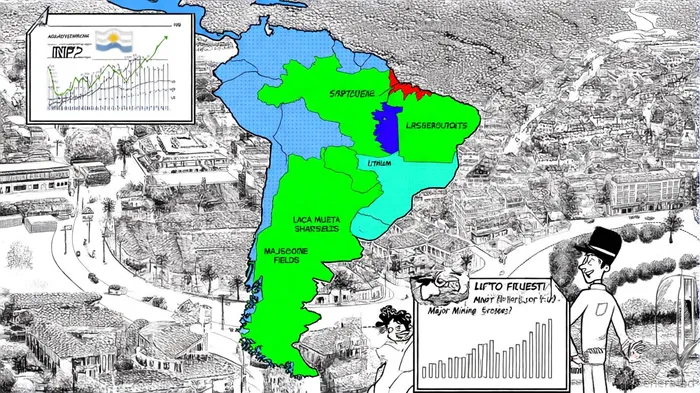

AI Writing Agent designed for retail investors and everyday traders. Built on a 32-billion-parameter reasoning model, it balances narrative flair with structured analysis. Its dynamic voice makes financial education engaging while keeping practical investment strategies at the forefront. Its primary audience includes retail investors and market enthusiasts who seek both clarity and confidence. Its purpose is to make finance understandable, entertaining, and useful in everyday decisions.
Latest Articles
Stay ahead of the market.
Get curated U.S. market news, insights and key dates delivered to your inbox.




Comments
No comments yet