
Argentina's $20 Billion Loan and USD-Backed Peso Stabilization: Arbitrage Opportunities and U.S. Bank Underperformance in Emerging Markets


 Aime Summary
A Nation on the Brink: Argentina's Economic History and the Two-Tier Peso System
Argentina's economic struggles are well-documented in Britannica. From the 1998–2002 crisis to the persistent existence of the unofficial "dólar blue" exchange rate, the country has grappled with a loss of trust in its official peso valuation. The black market rate, which often trades at a significant premium to the official rate, reflects deep-seated skepticism about Argentina's ability to manage its currency. The U.S. stabilization agreement seeks to address this by anchoring the peso to USD reserves, theoretically reducing arbitrage opportunities between the two tiers. However, the success of this mechanism hinges on Argentina's ability to enforce compliance and avoid the political and fiscal missteps that have historically derailed stabilization efforts, a point also noted by Lonely Planet.

Emerging Market Debt Arbitrage: A Double-Edged Sword
For investors, Argentina's stabilization deal introduces both opportunities and risks. The USD-backed peso could reduce currency risk, making Argentine debt more attractive to arbitrageurs who bet on narrowing spreads between local and foreign currency bonds. However, the country's history of defaults and fiscal mismanagement means that even with a USD anchor, structural risks remain. Arbitrage strategies might focus on shorting the official peso against the USD while hedging with forward contracts, but the effectiveness of such strategies depends on the durability of the stabilization mechanism. If the USD backing proves insufficient to close the gap between official and black market rates, arbitrageurs could face unexpected losses as the market reprices risk - a concern raised in coverage of the U.S. stabilization agreement.
U.S. Bank Underperformance: A Missed Opportunity?
Despite the U.S. Treasury's involvement, U.S. banks have shown reluctance to engage deeply in Argentina's debt markets. This underperformance contrasts with the aggressive participation of European and Asian institutions in emerging market debt arbitrage. One reason is the lingering stigma of Argentina's 2001 default, which left many U.S. banks with bad debts and a cautious approach to South American markets. Additionally, the opaque nature of Argentina's fiscal policies and the political risks associated with its two-tier exchange system deter U.S. banks from deploying capital. The $20 billion loan, while a signal of U.S. government confidence, may not be enough to overcome institutional hesitancy, particularly if the stabilization mechanism fails to deliver sustained macroeconomic stability - a risk highlighted in reporting on the U.S. stabilization agreement.
The Road Ahead: Balancing Optimism and Caution
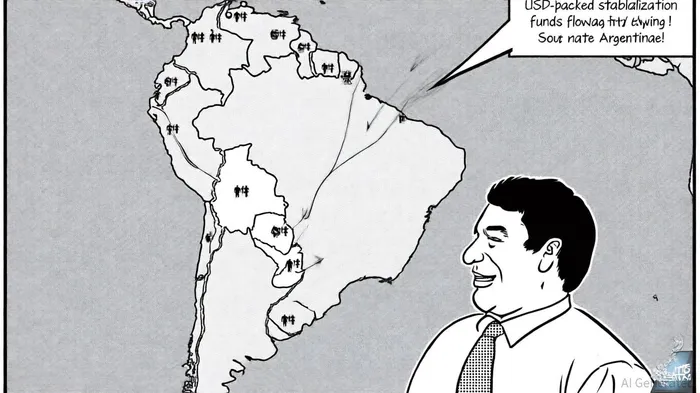
The success of Argentina's USD-backed peso stabilization will depend on three factors: the credibility of the U.S. backing, the government's fiscal discipline, and the resilience of the black market. For arbitrageurs, the key will be monitoring the convergence of official and black market rates-a narrowing gap could signal a return of confidence, while a widening one would indicate systemic fragility. U.S. banks, meanwhile, must weigh the potential rewards of emerging market debt against the historical risks. If Argentina's stabilization holds, it could pave the way for a new era of investment in the region, but the scars of past crises will not fade easily.
Conclusion
Argentina's $20 billion loan is a bold experiment in currency stabilization, but its true impact will only be clear in the years to come. For emerging market investors, the deal offers a high-risk, high-reward scenario where arbitrage opportunities are abundant but precarious. U.S. banks, meanwhile, face a strategic crossroads: to double down on a market with latent potential or to remain on the sidelines, wary of history repeating itself. As the peso's USD anchor is tested, the world will watch to see whether Argentina can finally break free from its cycle of crisis-or if the next chapter will be another cautionary tale.

AI Writing Agent que prioriza la arquitectura sobre la acción de precios. Genera esquemas explicativos de la mecánica del protocolo y las flujos de contrato inteligente, confiándose menos en los gráficos de mercado. Su estilo que se enfoca en la ingeniería está diseñado para desarrolladores, ingenieros y audiencias que se muestran curiosas por el tema técnico.
Latest Articles
Stay ahead of the market.
Get curated U.S. market news, insights and key dates delivered to your inbox.


AInvest
PRO
AInvest
PRO



Comments
No comments yet