
Argan's Q3 2026: Contradictions Emerge on Pricing and Profitability, Backlog and Pipeline, Timelines and Revenue Ramp-Up, and Renewable Expansion and Acquisitions
 Aime Summary
Date of Call: December 4, 2025
Financials Results
- Revenue: $251.2M, down 2% YOY (vs $257M in Q3 FY2025), up 6% sequentially (Q2 FY2026 $238M)
- EPS: $2.17 per diluted share, flat YOY (Net income $30.7M vs $28.0M prior-year quarter)
- Gross Margin: 18.7%, compared to 17.2% in the prior year (9M: 18.8% vs 14.6% prior year)
Guidance:
- Record backlog of approximately $3.0B and a pipeline representing over 6 GW of projects; expect to add a handful of projects into calendar 2027.
- Target operational capacity of ~10–12 active jobs and intend to expand headcount/training to reach that level over the next 12+ months.
- Anticipate quarter-to-quarter revenue variability driven by project timing; sequential growth observed in Q3 (up 6% QoQ).
- Maintain disciplined capital return: quarterly dividend raised to $0.50 (annual $2) and active share repurchase authorization ($150M).
Business Commentary:
* Record Backlog and Project Wins: - Argan, Inc. reported a recordbacklog of approximately $3 billion for the third quarter of fiscal 2026. - The increase was driven by several new projects including the 1.4 gigawatt CPV Basin Ranch project and an 816-megawatt project in Texas. - The strong demand for Argan's capabilities in addressing the urgent need for new power resources, especially in gas-fired and renewable projects, contributed to this growth.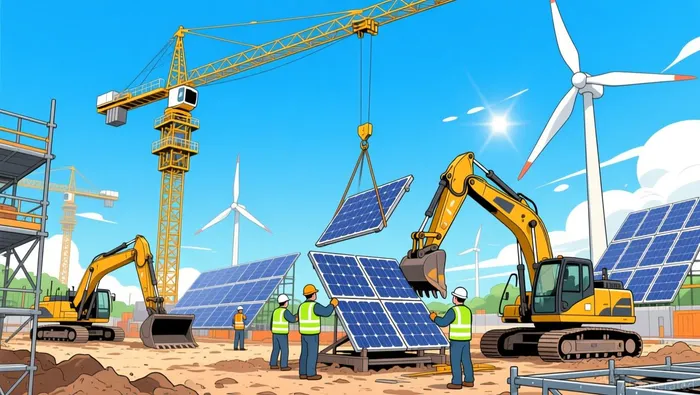
- Revenue and Profitability Performance:
- Argan's
revenuefor the third quarter was$251 million, slightly down compared to the previous year, but with a6%increase sequentially. - The company achieved
net incomeof$31 millionor$2.17per diluted share andEBITDAof$40 millionwith a margin of16%. The decrease in revenue was due to project completions, while profitability improved due to enhanced gross margins and careful project management.
Gross Margin Improvement:
- Argan's
gross profitrose to$46.9 million, with a gross margin of18.7%for Q3, an improvement from last year's17.2%. - The increase was primarily due to better margins in the Power Industry Services and Industrial Construction Services segments.
This improvement was attributed to effective project execution and cost control measures.
Strategic Capital Allocation:
- The company raised its quarterly dividend to
$0.50per share, representing an annual run rate of$2, marking a third consecutive dividend increase. - Argan's capital allocation strategy focuses on investing in its people and returning value to shareholders through dividends and share buybacks.
- The strategic approach aims to support operations, expand capacity, and maintain a strong balance sheet amid significant cash flow generation.
Sentiment Analysis:
Overall Tone: Positive
- Management cited a "record backlog of approximately $3 billion," said they are "optimistic" about project cadence and ability to add jobs into 2027, highlighted improved gross margin (18.7% vs 17.2% prior year) and increased dividend to $0.50, and emphasized strong balance sheet ($727M cash, no debt).
Q&A:
- Question from Christopher Moore (CJS Securities, Inc.): It looks like you're set up well for next year — on large natural gas projects, is pricing much different today than 2–3 years ago?
Response: Pricing model unchanged; company won't disclose contract pricing and evaluates each gas project case-by-case accounting for inflation, labor and project-specific risks.
- Question from Christopher Moore (CJS Securities, Inc.): Is an ~18% gross margin a reasonable sustainable target for fiscal '27/'28 or any thoughts around that?
Response: Management remains conservative—previous directional benchmark was 16+% but YTD is 18.8%; it's too early to project FY27 margins due to changing mix and contract types.
- Question from Christopher Moore (CJS Securities, Inc.): With multiple significant natural gas projects, can you speak to manpower challenges and whether specific skill sets are constrained?
Response: Certain skilled roles (procurement, engineering, commissioning) are constrained; company is expanding headcount and training to reach its ~10–12 job capacity while optimizing leaders across projects.
- Question from Robert Brown (Lake Street Capital Markets, LLC, Research Division): After recent large awards, do you expect a similar cadence of new awards into '26 or is there a pause?
Response: Company is intentionally conservative; expects to add a handful of jobs over the next 12–24 months but timing is uncertain since starts are developer-driven.
- Question from Robert Brown (Lake Street Capital Markets, LLC, Research Division): Have you seen changes in the competitive environment given demand?
Response: For large combined-cycle projects only a handful of firms can compete; competition is greater for simple-cycle peakers, but current demand is sufficient for multiple players.
- Question from Michael Fairbanks (JPMorgan Chase & Co, Research Division): Do you expect to be at the 10–12 team level in fiscal '27 and how hard is it to expand team count further?
Response: Currently on ~7 gas/biofuel projects with some spare capacity; intent is to reach 10–12 teams in the next 12+ months via hiring, training and redeploying leaders across jobs.
- Question from Michael Fairbanks (JPMorgan Chase & Co, Research Division): On being selective for new projects, any shifts in contract structure or risk allocation?
Response: Contract terms remain negotiable; priority is to be compensated for assumed risk—repeat customers reduce risk but company remains flexible across owner types (IPPs, utilities, new customers).
- Question from Ati Modak (Goldman Sachs Group, Inc., Research Division): For the handful of opportunities into calendar '27, what are the size ranges — are projects getting larger on average?
Response: Many opportunities are large: five U.S. jobs currently average over 1 GW each; company has executed up to ~1.9 GW and has no size limitation while favoring large combined-cycle projects.
- Question from Ati Modak (Goldman Sachs Group, Inc., Research Division): Are you seeing opportunities from private players or hyperscalers for dedicated CCGT plants?
Response: Receiving inquiries for behind‑the‑meter/hyperscaler projects; evaluating opportunities case-by-case and willing to pursue if terms, pricing and risk allocation are acceptable.
- Question from Unknown Analyst (JLG Research / Austin Lang): Can you break apart this quarter's bookings qualitatively — what were the main puts and takes (e.g., CPV Basin Ranch and 860 MW Texas project)?
Response: Bookings depend on contract specifics (scope, wrap vs non-wrap, equipment purchase); pricing varies by those factors so there's no standard $/kW—each award is evaluated individually.
- Question from Unknown Analyst (JLG Research / Austin Lang): Geographically, where are you seeing the most activity beyond Texas—any notable opportunities in West Virginia or the Eastern Seaboard?
Response: Strong activity in Texas currently; significant familiarity and opportunities exist across PJM (Ohio, Pennsylvania, West Virginia) where recent auctions have improved project economics.
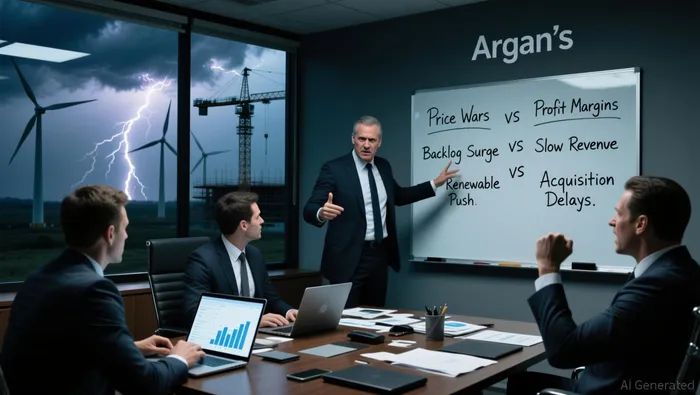
Contradiction Point 1
Project Pricing and Profitability
It directly impacts expectations regarding the company's profitability and pricing strategy, which are crucial for financial performance and investor expectations.
Have there been changes in pricing for large natural gas projects over the past 2-3 years? - Christopher Moore(CJS Securities, Inc.)
2026Q3: Our pricing model remains the same, considering today's market, inflation, labor, and other risks. The approach varies per project depending on scope, complexity, and risks. We're pleased with the $3 billion in backlog, and our margin profile has been strong. - David Watson(CEO)
Is the 18.6% gross margin including any meaningful one-time gains from Trumbull or other factors, and is this level sustainable? - Christopher Moore(CJS Securities, Inc.)
2026Q2: No specific guidance on gross margins. Expect to exceed last year's gross profit margin. Strong execution in power sector, including reaching first fire on units and favorable weather for renewable projects. - David Watson(CEO)
Contradiction Point 2
Backlog and Project Pipeline
It involves changes in financial forecasts and project pipeline, which are critical for revenue projections and future growth.
What is the pipeline cadence following recent large project awards? - Robert Brown(Lake Street Capital Markets, LLC, Research Division)
2026Q3: We've added 4.6 gigawatts in the past 12 months. We expect to add a handful of jobs in the next 12 to 24 months, but timings depend on project starts. Our focus remains on meeting the right time, conditions. - David Watson(CEO)
Have you noticed any changes in the pipeline? Is the pipeline accelerating due to the improved demand environment? Are you seeing acceleration in the pipeline over the past few months? - Robert Brown(Lake Street Capital Markets, LLC, Research Division)
2026Q2: Pipeline remains strong with elevated opportunities. Electricity consumption expected to increase 4% annually through 2027. Recent capacity auction results confirm demand with record levels. - David Watson(CEO)
Contradiction Point 3
Project Timelines and Revenue Ramp-Up
It involves changes in expectations regarding the timeline and revenue ramp-up for gas projects, which can impact company revenue and investor expectations.
Will the impact from Sandow being booked later accelerate growth in fiscal '26? - Christopher Paul Moore(CJS Securities, Inc.)
2026Q3: Gas jobs typically span 3 to 4 years, with revenue ramping up over time. Overall revenues are expected to increase throughout the year. - David Watson(CEO)
Has the timeframe permanently shifted from 2.5–3 years to 3–4 years? - Christopher Paul Moore(CJS Securities, Inc.)
2026Q1: The 3- to 4-year timeline is primarily due to supply chain issues, with a goal of building projects more efficiently. Smaller jobs may have shorter timelines. - David Hibbert Watson(CEO)
Contradiction Point 4
Renewable Energy Expansion and Strategic Acquisitions
It involves strategic decisions regarding growth in the renewable energy sector and the impact of acquisitions, which are crucial for long-term business strategy.
Can you break down the quarter's bookings? - Unknown Analyst(JLG Research)
2026Q3: We are excited about CPV Basin Ranch and the 860-megawatt Texas project. - David Watson(CEO)
Can you outline the company's strategic expansion and acquisition plans? - Argyll Scott
2025Q4: We successfully closed our acquisition of PM Solutions, which expands our market presence and increases our capabilities in the renewable energy sector. This acquisition aligns with our strategy to grow our renewable energy offerings and is expected to be accretive to 2026 earnings. - Argyll Scott(CFO)

Discover what executives don't want to reveal in conference calls
Latest Articles
Stay ahead of the market.
Get curated U.S. market news, insights and key dates delivered to your inbox.
AInvest
PRO
AInvest
PRO



Comments
No comments yet