
Argan's 2026 Q3 Earnings Call: Contradictions Emerge on Pricing, Backlog, Gross Margins, Labor, and Project Pipeline
 Aime Summary
Date of Call: October 31, 2025
Financials Results
- Revenue: $251.2M, down 2% YOY (vs $257M in Q3 FY2025); up 6% sequentially from $238M in Q2 FY2026
- EPS: $2.17 per diluted share (net income $30.7M), flat YOY (vs $2.17 / $28M in Q3 FY2025)
- Gross Margin: 18.7%, compared to 17.2% in the prior year (YTD 18.8% vs 14.6% for first 9 months)
Guidance:
- Maintain capacity target of approximately 10–12 concurrent jobs.
- Expect to add a handful of projects over the next 12–24 months, but timing is uncertain (next job could be next quarter or up to a year).
- Directional margin benchmark remains conservative at "16%+"; YTD gross margin is 18.8% but FY27 margins are unclear due to project mix.
- Continue returning capital: quarterly dividend raised to $0.50, active share repurchase authorization, and selective M&A evaluation.
Business Commentary:
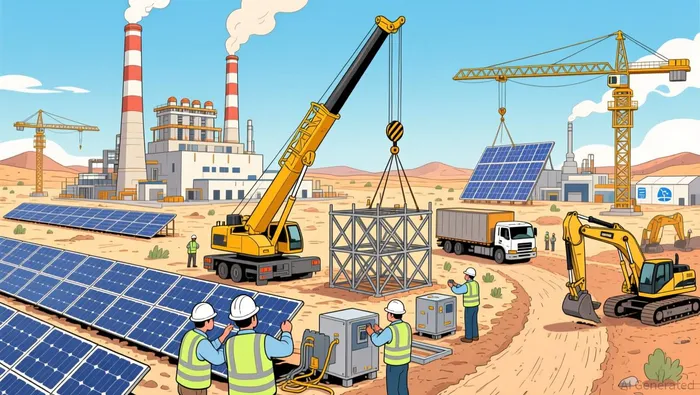 * Record Revenue and Backlog Growth: - Argan Inc. reported
 revenue of $251 million for Q3, a slight 2% decrease compared to the same period last year but with 6% sequential growth. - The company achieved a record backlog of approximately $3 billion, reflecting strong demand for their capabilities. - The revenue decline is attributed to the completion of large projects in the previous year, while the backlog growth is due to new projects like the 1.4 gigawatt CPB Basin Ranch project and the 86-megawatt Texas project.- Improved Gross Margin and Profitability:
- Argan reported an improved gross margin of
18.7%for Q3, compared to17.2%in the same quarter last year. - Net income for the quarter was
$31 million, or$2.17per diluted share, showing strong profitability. The improvement in margins and profitability is due to better project execution and increased efficiency in their Power Industry Services and Industrial Construction Services segments.
Dividend Increase and Shareholder Returns:
- Argan raised its quarterly dividend to
$0.50per share, representing a year-over-year increase of33%. - The company has returned approximately
$109.6 millionto shareholders through a share buyback program since November 2021. - The dividend increase and capital returns reflect the company's strong financial performance and commitment to shareholder value.
- Strong Project Pipeline and Future Growth:
- The company has added over
6 gigawattsof new thermal and renewable power plants to its backlog, with expectations of continuing to add projects in fiscal 2027. - Argan remains optimistic about its project cadence and plans to reach capacity of approximately
10 to 12 jobsfor the foreseeable future. - The strong pipeline is due to the urgent demand for new power resources to support the grid and the aging infrastructure, with a focus on natural gas plants to maintain grid reliability.

Sentiment Analysis:
Overall Tone: Positive
- Management highlighted a record backlog of approximately $3.0B, improved gross margin (18.7% vs 17.2% prior year), strong cash ($727M) with no debt, raised the quarterly dividend to $0.50, and described the company as "energized" and "optimistic" about continued project additions and long-term growth.
Q&A:
- Question from Christopher Moore (CJS Securities): It looks like you're set up exceptionally well for next year and fiscal '28. For large natural gas projects, is pricing much different today than 2–3 years ago?
Response: Management said they do not disclose pricing; pricing models factor current market conditions (inflation, labor, risks) and vary by contract—no one-size-fits-all.
- Question from Christopher Moore (CJS Securities): Is an ~18% gross margin a reasonable sustainable target for fiscal '27–'28?
Response: They remain conservatively guided to a '16%+' benchmark, noted YTD margin of 18.8%, but said it's too early to forecast FY27 margins due to changing project mix.
- Question from Christopher Moore (CJS Securities): With multiple large gas projects, what manpower challenges exist and are there special skill sets shared across projects?
Response: Key shared skill sets include procurement, engineering and commissioning; labor is an ongoing challenge, but they're adding headcount and targeting capacity of ~10–12 concurrent jobs.
- Question from Robert Brown (Lake Street Capital Markets): Regarding the pipeline cadence after recent large awards, do you expect similar award rates in the next 6–12 months or a pause?
Response: They expect to add a handful of jobs over the next 12–24 months but timing is uncertain since starts are developer-driven; backlog is strong at ~$3B.
- Question from Robert Brown (Lake Street Capital Markets): Have you seen changes in the competitive environment with increased demand?
Response: For large combined-cycle projects the competitive field is limited to a few capable firms; more competitors exist for simple-cycle/peakers, but there's ample work overall.
- Question from Michael Fairbanks (JPMorgan): Do you expect to reach 10–12 teams in fiscal '27, how many teams could work on CCGT simultaneously, and how hard is it to expand further?
Response: Currently working on ~7 gas/biofuel projects with capacity to reach 10–12 teams in FY27; Trumbull completion will free capacity and they're expanding staff and reallocating leaders to grow capacity.
- Question from Michael Fairbanks (JPMorgan): What types of projects/customers are you selectively pursuing and have contract structures/risks shifted?
Response: They remain flexible on contract terms, only pursue projects where compensation matches risk, favor repeat IPP/utility customers for lower risk but evaluate new customers as well.
- Question from Ati Modak (Goldman Sachs): For the handful of opportunities into calendar '27, what are the size ranges—are projects getting larger on average?
Response: Many current U.S. opportunities are very large—five jobs average over 1 GW each; no size limit and larger projects are a preferred/"sweet spot."
- Question from Ati Modak (Goldman Sachs): Are you seeing opportunities from private players or hyperscalers for dedicated CCGT plants?
Response: They receive inquiries for behind‑the‑meter/hyperscaler projects and will evaluate them case-by-case; flexibility and a lean team support competitiveness.
- Question from Austin Ling (JLG Research): Can you qualitatively break apart the quarter's bookings (e.g., CPV Basin Ranch and the 860 MW Texas project)—what are the puts and takes?
Response: Bookings depend on contract specifics (scope, whether equipment is procured by Argan or customer, and risk allocation); pricing varies by project so per‑kW comparisons are not meaningful.
- Question from Austin Ling (JLG Research): Geographically, where are you seeing the most opportunities—beyond Texas, any in West Virginia or the Eastern Seaboard/PJM?
Response: Texas activity is strong, but opportunities exist across PJM (Ohio, Pennsylvania, West Virginia); improved PJM auction pricing is encouraging further gas plant development.
Contradiction Point 1
Project Pricing and Backlog
It involves changes in the company's pricing strategy and backlog size, which are critical for financial planning and investor expectations.
Has pricing for large natural gas projects changed significantly in the past 2-3 years? - Christopher Moore (CJS Securities, Inc.)
20251205-2026 Q3: Our pricing model takes into account today's market, inflation, labor, and other risks. Pricing varies by project, scope, and complexity. We're proud of our current $3 billion backlog. - David Watson(CEO)
Have large natural gas project prices changed significantly compared to 2-3 years ago? - Christopher Moore (CJS Securities, Inc.)
2026Q3: Our pricing model remains the same, taking into account today's market, inflation, labor, and other risks. Pricing varies depending on project scope and complexity. We are pleased with our $3 billion in backlog. - David Watson(CEO)
Contradiction Point 2
Gross Margin Guidance
It involves changes in financial forecasts, specifically regarding gross margin expectations, which are critical indicators for investors.
Is an 18% gross margin target reasonable for fiscal 2027 and 2028? - Christopher Moore (CJS Securities, Inc.)
20251205-2026 Q3: We remain intentional about our guidance, with a 16% margin benchmark. This year, we've exceeded 18%. It's too early to predict fiscal '27 margins, but we're excited about future opportunities. - David Watson(CEO)
Is an 18% gross margin range a reasonable target for fiscal '27 and '28? - Christopher Moore (CJS Securities, Inc.)
2026Q3: We are intentionally conservative with our directional guidance on margins. We’ve exceeded a 16% margin benchmark year-to-date. Given the changing mix of projects, it's too early to predict fiscal year '27 gross margins. - David Watson(CEO)
Contradiction Point 3
Gross Margin Expectations for Fiscal 2027
It involves changes in financial forecasts, specifically regarding gross margin expectations, which are critical indicators for investors.
Is an 18% gross margin range a reasonable target for fiscal years 2027 and 2028? - Christopher Moore(CJS Securities)
20251205-2026 Q3: We remain intentional about our guidance, with a 16% margin benchmark. This year, we've exceeded 18%. It's too early to predict fiscal '27 margins, but we're excited about future opportunities. - David Watson(CEO)
Have there been changes to your financial model or pipeline due to the demand environment for this or next year? - Robert Brown(Lake Street Capital Markets, LLC, Research Division)
2026Q2: Expect an operating margin of 12% to 14%. Last year, we achieved an operating margin of 11.6%. We have a record backlog and expect to be at the midpoint of our guidance range. - David Watson(CEO)
Contradiction Point 4
Labor and Workforce Management
It involves changes in the company's approach to labor management, which can impact project timelines and overall operational efficiency.
Will you reach your 10-12 team capacity target in fiscal '27? - Michael Fairbanks(JPMorgan)
20251205-2026 Q3: Labor is always a challenge. We have skilled employees and are adding headcount to handle the workload. Our capacity is around 10-12 jobs, and we're working to expand this. - David Watson(CEO)
How do you plan to increase capacity—organically or through M&A? - Drew Chamberlain(JPMorgan Chase & Co, Research Division)
2026Q2: Our capacity remains the largest in our peer group with 10 to 12 jobs. We've added 1,200 employees year-to-date and expect to end the year at approximately 14,000 employees, providing significant flexibility in staffing and capacity. - David Watson(CEO)
Contradiction Point 5
Backlog and Project Pipeline Expectations
It involves differing expectations about the potential size of the backlog and the timing of project additions, which could impact investor expectations regarding future growth and revenue.
Do you expect a similar rate of project additions in 2026? - Robert Brown (Lake Street Capital Markets)
20251205-2026 Q3: We're excited about our $3 billion backlog. We aim to add more jobs over the next 12-24 months, but project starts depend on customer timelines. - David Watson(CEO)
What is the pipeline for the rest of the year and its size/potential? - Robert Duncan Brown (Lake Street Capital Markets, LLC, Research Division)
2026Q1: Well, I mean, that's the guidance, right? It's significantly over $2 billion. As you know, we have project capacity in that 10-plus range between renewable and gas jobs. And so we've just started several new jobs, right? We just started a 700-megawatt power plant that we announced in December. We just started Tarbert and Sandow Lakes, and we're continuing to work on the Trumbull job, and we expect to add several more to the mix. So that should absolutely result in a backlog that gets us significantly above $2 billion. - David Hibbert Watson(CEO, President & Director)

Discover what executives don't want to reveal in conference calls
Latest Articles
Stay ahead of the market.
Get curated U.S. market news, insights and key dates delivered to your inbox.
AInvest
PRO
AInvest
PRO



Comments
No comments yet