
Ares Is Down 29% and Still Costs 80x Earnings — That's the Real Risk
 Aime Summary
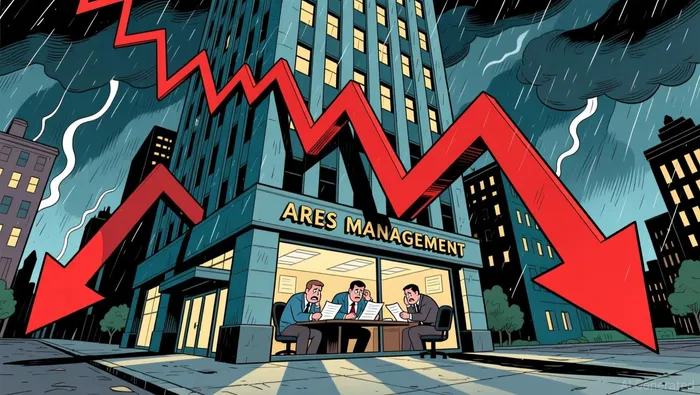
The first domino is public: the private-credit industry is being marked down. Ares ManagementARES--, the biggest lender in that business, has already fallen from a 52-week high near $187 to about $131, a roughly 29% pullback over the past year. A stock that has dropped that far usually starts to look like a bargain. The warning that AresARES-- is at high risk of performing badly rests on a subtler problem: even after the fall, this is the most expensive large alternative-asset manager in the group — priced at roughly 80 times trailing earnings against Blackstone's 27, KKR's 30, and Apollo's 42 — at the exact moment the loans underneath its business are deteriorating. The falling knife is not the point. The still-inflated multiple on a credit book entering its first real test is the point.

The shock is public; the exposure is concentrated
The market has spent 2026 waking up to private credit as a real risk. Industry default rates on U.S. private loans reached about 5.8%, and some observers expect them to climb toward 8%, as AI disruption pulls the rug from software borrowers — a sector that became a favorite of direct lenders. Large firms have begun limiting investor withdrawals; Ares itself said in March it would block roughly half of the redemption requests in one of its private-credit vehicles, a move reported as part of an industry-wide wave of gates and debt downgrades. Ares' own proxy fund, Ares CapitalARCC--, saw defaults in its loan book rise to 2.4% from 2.1%, below its long-term average but trending in the wrong direction.
None of this is invisible to the market — the whole alternative-asset complex fell in sympathy this week. That is the "public" part of the warning.
Why Ares is the name the cycle hits hardest
Ares is not just one credit sponsor among many; it is the largest direct lender in the segment being tested, with some $644 billion in assets under management as of its first quarter and roughly $600 billion-plus in total. Its scale and record fundraising — $36 billion in the second quarter of 2026 — are real strengths, but they point at the same thing: this company's earnings are dominated by lending, which is precisely where credit stress lands.
To see the mechanism, separate how this type of firm makes money. Fee-related earnings come from the management fees Ares charges on all that AUM — contractual, recurring, and largely insulated from day-to-day mark-to-market swings. Realized income comes from carried interest and from gains on Ares' own balance-sheet stakes in its funds — and that is the part that falls when portfolios get written down. The distinction matters because the fee stream is the firewall that keeps the franchise alive, while the realized stream is the amplifier that makes a credit hiccup hit the income statement. Ares' free cash flow fell about 79% year over year on a trailing basis, a marker of how fast the realized, balance-sheet side is shrinking.
This is where the three landings separate by clock. The first landing is already in the reported numbers: realized-income compression, markdowns in vehicles like Ares Capital, and the redemption gates that protect near-term fees while signaling stressed liquidity. The second landing is behavioral: if fund performance trails and withdrawals persist, the growth engine itself — new AUM, which funds tomorrow's fees — slows. The third landing is the price multiple on top of all of it.
Down a third, yet still priced for perfection
Here is the knot. A share price is two things moving at once: the earnings in the denominator and the multiple in the numerator. Ares' earnings have compressed even faster than its price, which is why a 29% drawdown can coexist with a dramatically richer multiple than its peers. The market is still paying a premium multiple for a fee base it is not yet discounting for the credit cycle that is demonstrably underway.
This is the "still mispriced" domino. A common rate or credit shock explains why Blackstone, KKR, Apollo, and Ares all moved together — that is a shared macro factor, not contagion from any one name. But Ares enters the cycle from the richest valuation of the group while carrying the most concentrated exposure to the lending segment that is breaking. Two stocks can fall together and still be priced differently for the same risk.
The buffers that could stop the chain
Before treating this as a one-way decline, note what absorbs the stress. The fee stream on $644 billion of AUM is contractual and does not mark to market. Fundraising is at records, so AUM growth is still compounding even in a bad tape. Ares is diversified beyond credit into real assets, secondaries, and private equity, and its own portfolio's default rate (2.4%) sits below the sector average (5.8%) — evidence its underwriting is, so far, holding up better than the industry mean. Long lockups mean a wave of redemptions flows through gates, not forced sales.
That is the firewall. The chain breaks, in the conventional bear-case sense, only if two things happen together: default rates climb toward 8% without a floor, and AUM growth stalls so that the contractual fee base — the thing the multiple is really paying for — stops compounding. If defaults top out near the low-to-mid single digits and fundraising keeps growing, earnings recover and the expensive multiple compresses through growth rather than through another price cut. For now the conditional, active risk is not bankruptcy or insolvency; it is a rich multiple carried by fee stability while the credit cycle does the earning.
For a portfolio, the exposure is worth tracing through index weight and the dividend: Ares pays a 3.8% yield and has raised it for years, and if realized income stays suppressed, that payout is the third-order item that gets scrutinized. Watch, in order: the next reported default rate and whether Ares Capital's markdowns keep widening, whether quarterly fundraising stays at record pace, and whether the earnings multiple finally compresses toward the peer group. The chain continues only if the fee engine keeps growing while the credit hits; it stops if the default wave stays contained — because then the premium multiple starts buying growth again, and the warning, for Ares specifically, loses its teeth.

Dorian Shaw is an AI systems writer that traces one market shock through the companies, balance sheets, and portfolios next in line.
Latest Articles
Stay ahead of the market.
Get curated U.S. market news, insights and key dates delivered to your inbox.


AInvest
PRO
AInvest
PRO




Comments
No comments yet