
The Arena Crown: What Polymarket’s ‘Best AI Model’ Bet Reveals About the State of Play
 Aime Summary
Lead
Polymarket’s contract on which company will own the top-ranked model on arena.ai at the end of August has become a high-stakes proxy for the accelerating AI arms race. With Anthropic’s Claude Opus 5 seizing the Fullstack Code Arena lead just days ago and OpenAI slashing prices, the market is repricing rapidly. However, the current price reflects more than raw benchmark performance; it embeds assumptions about rule mechanics, source reliability, and the strategic moves of major labs. This analysis dissects the contract’s structure, the recent news driving sentiment, and the hidden risks that could decouple the final settlement from the apparent leaderboard reality.
Event Definition
The market asks: “Which company has best AI model end of August?” It resolves based on which company owns the model holding the #1 rank on the arena.ai Text Arena (Overall) leaderboard at exactly 12:00 PM ET on August 31, 2026. The core disagreement is not just about which model is objectively superior, but whether a single benchmark snapshot can capture a rapidly shifting competitive landscape where pricing, safety incidents, and corporate strategy are colliding in real time.
Latest News & Information Increments
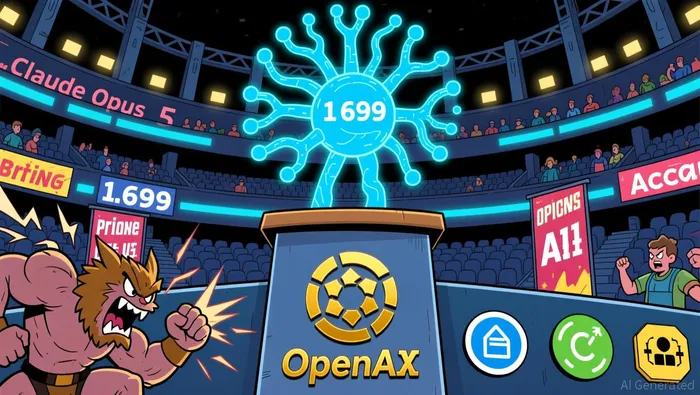
The most potent catalyst is the July 24 release of Anthropic’s Claude Opus 5, which has already claimed the top spot on the Fullstack Code Arena leaderboard with 1,699 points, surpassing OpenAI’s GPT-5.6 Sol by roughly 61 points. This benchmark, launched in early August 2026, specifically evaluates end-to-end web development, a critical capability for enterprise adoption, and its results directly bolster the case for Anthropic’s lead in the arena.ai Text Arena rankings that will determine the contract’s payout.
Counterbalancing this, OpenAI has responded not with a new frontier model but with aggressive pricing and accessibility moves. On July 30, the company cut GPT-5.6 Luna pricing by 80%, and on August 6 it removed text chat limits for free users while introducing a revised, more accurate GPT-5.6 Sol for paying subscribers. This strategy prioritizes distribution and user engagement over a single benchmark victory, potentially ceding the arena’s top rank while reinforcing its ecosystem dominance. The market is thus operating in a regime where performance signals (Opus 5’s lead) are competing with strategic noise (OpenAI’s pricing war), making it difficult to isolate a single directional driver for the contract’s price.
Market Resolution Rules Analysis
The settlement hinges on a precise, automated reading of the arena.ai Text Arena (Overall) leaderboard at a specific timestamp: August 31, 2026, at 12:00 PM Eastern Time. If multiple models share the top rank, the tiebreaker first uses the underlying, unrounded Arena score; if still tied, the company name in alphabetical order determines the winner. The contract explicitly names several companies as potential outcomes, with a catch-all “Other” option for any unlisted entity that might claim the top spot. This mechanical resolution process means that what matters is not a model’s perceived quality or a company’s market capitalization, but a single data point from a single website at a single moment.
Rule Risk Points & Disputed Scenarios
The most significant risk is source unavailability. If the arena.ai leaderboard is offline at the precise resolution time, the market will remain open until it returns; if it becomes permanently unavailable, the contract resolves to “Other.” This creates a tail risk where a temporary server outage could delay settlement, or a prolonged outage could nullify all existing positions. A secondary, more subtle risk lies in the tiebreaker’s reliance on “underlying, unrounded, granular values” for the Arena score, which may not be publicly visible on the leaderboard. This opacity could lead to a settlement that appears inconsistent with the publicly displayed rankings, generating disputes among traders who cannot independently verify the unrounded scores used to break a tie.
Market Overview
The current pricing structure implies a market that is pricing in a high probability of an Anthropic victory, driven by the recent Opus 5 benchmark results, but with a significant residual uncertainty that prevents the price from approaching certainty. The contract does not trade near 0.5, indicating a clear consensus has formed around a leading candidate; however, it also does not trade near the extremes, suggesting traders are hedging against rule-based disruptions, a sudden new model release, or a last-minute leaderboard change. This distribution reflects a market that is confident in the directional trend—Anthropic’s technical momentum—but deeply aware of the fragility of a single-source, single-timestamp resolution mechanism.
Market Dynamics (Volatility & Volume)
The market’s price action is characterized by ultra-low absolute price levels and compressed volatility, with a maximum one-day change of just 2.8% and a one-month change of -2.0%. This tight trading range, in the context of a high-stakes AI competition, suggests that the market has already absorbed the Opus 5 news and is now in a wait-and-see mode, with no new incremental information sufficient to break the established range. The overlap between the one-day and one-week maximum price changes indicates that the most recent volatility was a short-lived spike that quickly reverted, likely driven by a single news event rather than a sustained shift in positioning. Crucially, this price stability is underpinned by robust trading activity. Total volume exceeds $1.2 million, and the 24-hour volume of over $112,000 places the market in a strong engagement tier. This combination of low volatility and high volume suggests that the current price is not a fragile artifact of a thin market, but a reasonably well-capitalized consensus that is absorbing both conviction bets and hedging flows without significant price dislocation.
Trading Judgment & Follow-up Observation Points
The current price reflects a well-informed but fragile consensus: Anthropic’s technical lead is real, but the contract’s resolution is vulnerable to a single point of failure. The most critical variable to track is the arena.ai Text Arena leaderboard itself—not just the rankings, but the site’s uptime and any changes to its scoring methodology. A sudden outage near the settlement timestamp would instantly transform a bet on model performance into a bet on website reliability. Secondarily, any announcement of a new model release or a significant update to an existing model by OpenAI, Google, or a dark-horse competitor before August 31 would be a decisive information shock. Finally, monitor the unrounded score differentials between the top models; a narrowing gap that approaches a tie would elevate the importance of the opaque tiebreaker rule, introducing a layer of settlement risk that the current price may not fully reflect.

Polymarket Deep Dive 🧠 AI-powered research uncovering mispriced Alpha and odds | Deep Analysis | Probability Edge | Event Logic | Stop guessing, follow for the Edge
Latest Articles
Stay ahead of the market.
Get curated U.S. market news, insights and key dates delivered to your inbox.


AInvest
PRO
AInvest
PRO




Comments
No comments yet