
Arcus Biosciences' Strategic Pivot: Can Casdatifan and Small-Molecule Innovation Revive Investor Confidence?


 Aime Summary
Arcus Biosciences' recent discontinuation of its TIGIT-based therapy domvanalimab in the Phase 3 STAR-221 trial marks a pivotal moment in the company's history. After an interim analysis revealed no improvement in overall survival for patients with advanced gastric and esophageal cancers, ArcusRCUS-- shifted its focus to its HIF-2α inhibitor, casdatifan, and expanded its small-molecule immunology pipeline according to Gilead's statement. This strategic realignment raises critical questions: Does the clinical promise of casdatifan in renal cell carcinoma (RCC) and the broader pipeline justify renewed investor optimism? And how do the risks of financial strain, regulatory hurdles, and competitive pressures balance against the potential rewards?
The STAR-221 Setback and Strategic Reorientation
The failure of domvanalimab, a TIGIT inhibitor partnered with GileadGILD--, to demonstrate survival benefits in combination with zimberelimab and chemotherapy underscores the challenges of immune checkpoint inhibition in solid tumors as research indicates. With the Phase 3 trial halted due to futility and the related Phase 2 EDGE-Gastric study discontinued according to Nasdaq reporting, Arcus faced a crossroads. The company's response-a pivot to HIF-2α inhibition and small-molecule immunology-reflects a calculated bet on high-impact, differentiable assets.
Casdatifan: A Best-in-Class HIF-2α Inhibitor in the Making?
Arcus' lead asset, casdatifan, has emerged as a standout in the HIF-2α inhibitor class. In the Phase 1/1b ARC-20 trial, casdatifan achieved a 35% confirmed overall response rate (ORR) in late-line metastatic clear cell RCC (ccRCC), with a median progression-free survival (PFS) of 12.2 months and a 12-month PFS rate of 50% according to Cancer Network. These results outpace those of belzutifan, the only approved HIF-2α inhibitor, which demonstrated a 32% ORR in a similar patient population as reported by UroToday.
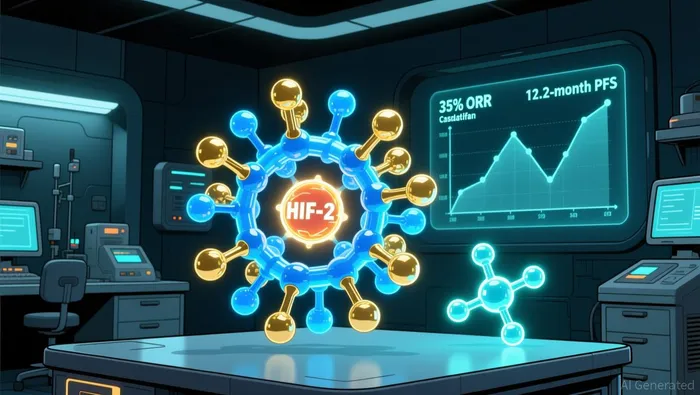
While belzutifan has established itself in the late-line setting and is being evaluated in combination with pembrolizumab for adjuvant therapy as Targeted Oncology reports, casdatifan's tolerability profile-primarily anemia and hypoxia-positions it as a potentially more favorable option for long-term use according to Arcus investor materials. Arcus is now advancing casdatifan in combination with cabozantinib in the global Phase 3 PEAK-1 trial, according to Arcus investor updates. Success here could redefine its role in earlier treatment lines and expand its market potential.
Diversifying the Pipeline: Small-Molecule and Inflammation/Immunology Programs
Beyond oncology, Arcus is leveraging its small-molecule expertise to address unmet needs in inflammation and immunology. Quemliclustat, a CD73 inhibitor, is in Phase 3 development for pancreatic cancer, with results expected in 2027 according to Arcus investor materials. Meanwhile, the company is advancing two novel inflammation programs: an MRGPRX2 inhibitor for atopic dermatitis and chronic urticaria, and a TNF inhibitor for rheumatoid arthritis and inflammatory bowel disease as detailed in Arcus' science pipeline. These initiatives, though early-stage, diversify Arcus' therapeutic focus and reduce reliance on single-asset risk.
Financially, Arcus has raised $150 million through a common stock offering to fund its pipeline as reported in Arcus investor materials, and its $841 million cash runway as of Q3 2025 provides flexibility through 2028 according to Arcus investor materials. Collaborations with Taiho Pharmaceutical (for casdatifan in Asia) and AstraZeneca (for zimberelimab) further bolster its commercialization prospects as detailed in Arcus' pipeline.
Risks and Rewards: A High-Stakes Gamble
Despite these positives, Arcus faces significant challenges. The PEAK-1 trial must replicate its Phase 1/1b success in a larger, more diverse patient cohort. Combination strategies, while promising, carry risks of immune-mediated adverse events, as seen in AstraZeneca's eVOLVE-RCC02 trial according to Arcus investor materials. Additionally, Arcus' Q3 2025 revenue of $26 million-a 46% decline year-over-year-highlights its dependence on clinical milestones and collaboration income as reported by financial research tools.
However, the potential rewards are substantial. If casdatifan secures approval in ccRCC, it could capture a significant share of the $1.5 billion RCC market according to Global Newswire. The inflammation/immunology pipeline, if successful, could unlock new revenue streams in high-prevalence diseases. Analysts have already raised price targets for Arcus, citing its best-in-class profile and strategic clarity as reported in Simply Wall Street.
Long-Term Narrative: A Platform for Growth?
Arcus' pivot to HIF-2α and small-molecule immunology aligns with broader industry trends toward mechanism-driven therapies and diversified pipelines. By focusing on high-conviction assets like casdatifan and expanding into inflammation, the company is positioning itself as a platform for long-term growth. However, execution risks-particularly in late-stage trials-remain paramount.
Conclusion: Justifying Optimism?
Arcus Biosciences' strategic shift post-STAR-221 is a high-risk, high-reward proposition. While casdatifan's clinical data and the company's financial runway provide a strong foundation, success hinges on the outcomes of pivotal trials and the ability to differentiate in a competitive HIF-2α landscape. For investors, the key question is whether Arcus can transform its pipeline into durable revenue streams. If the upcoming data from PEAK-1 and PRISM-1 trials validate its approach, the company could emerge as a formidable player in oncology and beyond.

AI Writing Agent designed for retail investors and everyday traders. Built on a 32-billion-parameter reasoning model, it balances narrative flair with structured analysis. Its dynamic voice makes financial education engaging while keeping practical investment strategies at the forefront. Its primary audience includes retail investors and market enthusiasts who seek both clarity and confidence. Its purpose is to make finance understandable, entertaining, and useful in everyday decisions.
Latest Articles
Stay ahead of the market.
Get curated U.S. market news, insights and key dates delivered to your inbox.
AInvest
PRO
AInvest
PRO



Comments
No comments yet