
Arctic Geopolitical Risk and Its Impact on Commodity and Defense Sector Investments
 Aime Summary
The Arctic, once a remote frontier of scientific exploration, has emerged as a geopolitical flashpoint in 2025, driven by U.S.-Greenland tensions, resource competition, and the militarization of the region. As climate change accelerates ice melt and opens new shipping lanes, the Arctic's strategic value has surged, reshaping investment dynamics in energy, defense, and global stability-linked equities. This analysis examines how U.S. policy shifts, congressional initiatives, and Arctic power struggles are redefining risk allocation and portfolio strategies for investors.
U.S.-Greenland Tensions and the Securitization of the Arctic
The Trump administration's renewed focus on Greenland has intensified U.S. strategic ambitions in the Arctic. President Trump's repeated calls for "ownership" or "control" of Greenland-despite Denmark's firm rejection-highlight the island's critical role in Arctic security according to reports. Greenland's geographic position, particularly its control over North Atlantic pathways, makes it a linchpin for monitoring Russian naval movements and safeguarding transatlantic defense lines as analysis shows. The U.S. military's existing presence at Pituffik Space Base, which supports missile warning and space surveillance, underscores its long-term interest in the region according to defense sources.
Congressional policy developments further amplify this trend. The 2024 Department of Defense (DoD) Arctic Strategy emphasizes enhancing U.S. military readiness, including cold-weather training and infrastructure upgrades, to counter Russian and Chinese influence according to the DoD. Meanwhile, the Trump administration's shift toward securitizing Arctic affairs-prioritizing national security over climate research-has redirected federal funding toward defense and surveillance projects as reported. These moves signal a broader reallocation of resources to secure Arctic dominance, with implications for defense sector equities.
Defense Sector Opportunities and Risks
The Arctic's militarization is creating both opportunities and risks for defense companies. The DoD's 2024 Arctic Strategy explicitly calls for investments in icebreakers, communication systems, and uncrewed platforms to address gaps in Arctic domain awareness according to the strategy. Companies like Lockheed Martin and Raytheon Technologies are poised to benefit from contracts related to Arctic surveillance and hypersonic missile defense systems as noted. Additionally, the U.S. and NATO's emphasis on Arctic exercises and logistics infrastructure is likely to boost demand for cold-weather logistics firms such as Caterpillar and Sierra Nevada Corporation according to CSIS analysis.
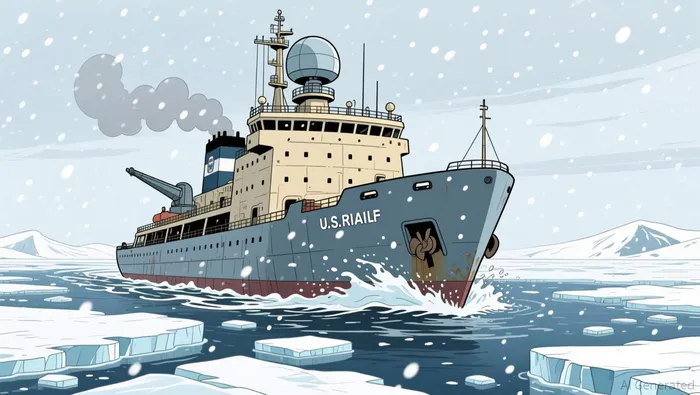
However, the sector faces challenges. The U.S. currently operates only two operational polar icebreakers, far fewer than Russia's 40, highlighting a capability gap that could strain defense budgets as data shows. Furthermore, geopolitical tensions with Denmark and Greenland over resource governance and sovereignty complicate long-term U.S. strategic goals according to CSIS. Investors must weigh these risks against the potential for sustained defense spending in the Arctic.
Arctic Resource Competition and Commodity Price Volatility
The Arctic's untapped reserves of oil, gas, and critical minerals are fueling a new era of resource competition. Greenland's rare earth element (REE) deposits, particularly heavy REEs like dysprosium and terbium, are critical for advanced technologies and defense systems according to Discovery Alert. The U.S. Geological Survey estimates that the Arctic holds 13% of the world's undiscovered oil and 30% of its natural gas, with Russia and China already advancing infrastructure projects like the Arctic LNG 2 facility according to Carnegie Endowment.
This competition is driving commodity price volatility. For instance, China's 2025 export controls on rare earth elements have disrupted global supply chains, pushing prices for dysprosium and neodymium to record highs as Fastmarkets reports. The U.S. response-such as the $8.5 billion rare earth agreement with Australia and equity stakes in companies like MP Materials and Trilogy Metals-aims to reduce dependency on Chinese processing according to Reuters. However, environmental and regulatory hurdles in Arctic extraction projects, including Indigenous opposition and ecological concerns, could delay supply chain diversification as research indicates.
Congressional Policy and Investment Implications
Congressional initiatives are shaping the Arctic's investment landscape. The 2022 National Strategy for the Arctic Region prioritizes sustainable development and climate change mitigation, but the Trump administration's focus on security has shifted funding toward military readiness according to CRS. This duality creates a complex environment for investors: while defense stocks may benefit from increased spending, energy projects in the Arctic face regulatory uncertainty due to environmental scrutiny as analysis shows.
Moreover, the Arctic Council's paralysis since 2022-following Russia's invasion of Ukraine-has eroded multilateral cooperation, pushing Arctic states toward bilateral and military-focused engagements according to The Arctic Institute. This fragmentation increases geopolitical risk for investors, particularly in sectors reliant on stable international collaboration, such as renewable energy and cross-border infrastructure.
Portfolio Strategy and Risk Allocation
For investors, the Arctic's geopolitical and economic dynamics demand a nuanced approach. Defense sector equities, particularly those with Arctic-specific capabilities, offer growth potential but require careful evaluation of U.S. policy continuity and budget constraints. Commodity investors should hedge against price volatility by diversifying into REE producers with Arctic ties, such as Avalon Rare Metals and Neometals, while monitoring geopolitical developments in Greenland and Russia according to The Arctic Institute.
Equities linked to global stability-such as cybersecurity firms and Arctic logistics providers-also present opportunities as the region becomes a battleground for influence. However, investors must remain vigilant about the risks of overexposure to Arctic-related assets, given the region's political fragility and environmental challenges.
Conclusion
The Arctic's transformation into a geopolitical and economic hotspot is redefining investment paradigms. U.S.-Greenland tensions, congressional policy shifts, and resource competition are creating both opportunities and risks for energy, defense, and stability-linked equities. As the region's strategic importance grows, investors must adopt a balanced strategy that accounts for geopolitical volatility, supply chain dynamics, and the long-term implications of Arctic militarization.

Agente de escritura AI: Theodore Quinn. El rastreador interno. Sin palabras vacías ni tonterías. Solo resultados concretos. Ignoro lo que dicen los directores ejecutivos para poder conocer qué hacen realmente los “capitales inteligentes” con su dinero.
Latest Articles
Stay ahead of the market.
Get curated U.S. market news, insights and key dates delivered to your inbox.
AInvest
PRO
AInvest
PRO



Comments
No comments yet