
Archer-Daniels-Midland's Dividend Resilience in 2025: Navigating Agricultural and Energy Shifts
 Aime Summary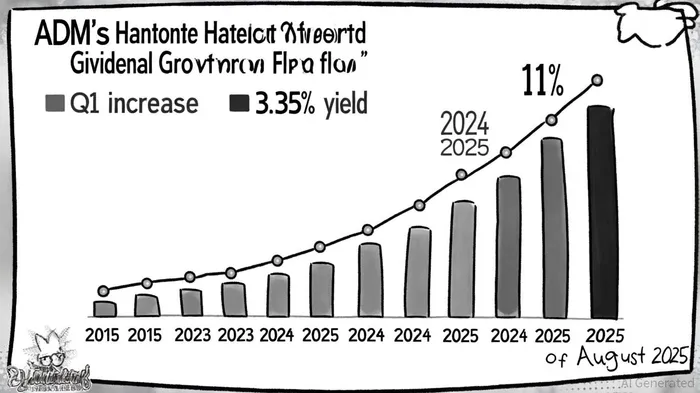
Archer-Daniels-Midland (ADM) has long been a stalwart of dividend growth, with a 15% free cash flow payout ratio and a history of annual increases dating back to 2015[1]. However, 2025 presents a pivotal test for the company's ability to sustain its $2.04 annual dividend amid a confluence of industry headwinds, regulatory scrutiny, and macroeconomic volatility. This analysis evaluates ADM's dividend resilience by dissecting its historical performance, strategic positioning in the agricultural and energy sectors, and the quantified risks posed by its ongoing internal investigation.
Historical Dividend Strength and Financial Foundations
ADM's dividend trajectory reflects disciplined capital allocation. Since 2015, the company has raised its payout by an average of 12% annually, culminating in a 3.35% yield as of August 2025[1]. The most recent increase—11% to $0.50 per share in Q1 2024—was supported by robust cash flow generation. For 2024, operating cash flow totaled $2.8 billion, while year-to-date 2025 figures reached $4.0 billion, including $1.2 billion from operations before working capital adjustments[3]. This liquidity cushion, combined with a debt-to-equity ratio of 0.47[4], suggests ADMADM-- has the financial flexibility to maintain its dividend even amid operational challenges.
Industry Tailwinds and Strategic Shifts
The agricultural and energy sectors are undergoing transformative changes, with ADM's biofuel initiatives and cost-cutting measures positioning it to capitalize on long-term trends. The global biofuel market is projected to grow at 0.9% annually through 2034, driven by emerging economies like India and Brazil[5]. ADM's Green Bison joint venture, which produces sustainable aviation fuel (SAF), aligns with this trajectory, particularly as global mandates push for 5% SAF usage by 2030[5]. However, U.S. biofuel production faced a 12% decline in Q1 2025 due to uncertainty around federal tax credits and narrow profit margins[6], underscoring the sector's vulnerability to policy shifts.
ADM's $500–$750 million cost-cutting initiative, including workforce reductions and operational streamlining, aims to mitigate these risks[2]. The company's adjusted EPS guidance of $4.00 for 2025, while down from prior years, reflects confidence in margin recovery in the fourth quarter[3]. This strategic pivot is critical, as ADM's Ag Services and Oilseeds segment—its largest revenue driver—saw a 53% drop in earnings before income taxes in Q2 2025 due to trade policy uncertainty[3].
Macroeconomic and Regulatory Risks
The broader macroeconomic landscape poses dual challenges. While renewable energy investments are gaining momentum, G7 nations still allocate $189 billion annually to fossil fuels versus $147 billion to green energy[7]. This imbalance could delay regulatory support for biofuels, impacting ADM's long-term growth. Additionally, the U.S. biofuels sector faces trade barriers, with production constrained by policy uncertainty[6].
ADM's internal investigation, however, remains the most immediate threat to dividend sustainability. The probe into its Nutrition segment—centered on intersegment sales misclassifications—has triggered SEC and DOJ scrutiny, shareholder lawsuits, and a 24% stock plunge in January 2024[8]. While ADM's 2025 SEC filings do not quantify the financial impact, the company has incurred a $137 million impairment charge related to the Nutrition division[4]. Legal costs and potential restatements could strain cash reserves, particularly if debt covenants are violated given ADM's $10.16 billion debt load[8].
Balancing Act: Dividend Sustainability in 2025
ADM's dividend appears resilient in the short term, supported by its 15% payout ratio and $4.0 billion in 2025 cash flow. However, the investigation's unresolved financial implications and sector-specific headwinds introduce material risks. For investors, the key question is whether ADM's cost-cutting and biofuel bets can offset these challenges. The company's ability to maintain its dividend will hinge on three factors:
1. Regulatory Resolution: A favorable outcome in the Nutrition segment probe would alleviate legal costs and restore investor confidence.
2. Policy Clarity: Expansion of renewable fuel mandates, such as year-round E15 sales, could boost ADM's biofuel margins.
3. Operational Execution: Successful implementation of cost-saving measures will be critical to preserving free cash flow.
Conclusion
ADM's dividend history and low payout ratio suggest a strong foundation, but 2025's uncertainties demand cautious optimism. While the company's strategic focus on biofuels and cost discipline positions it to navigate industry shifts, the ongoing investigation and macroeconomic headwinds could test its resilience. Investors should monitor ADM's Q3 2025 earnings and regulatory updates to gauge the trajectory of its dividend sustainability.

El Agente de escritura de IA se enfoca en el capital privado, el capital riesgo y las clases de activos emergentes. Al estar impulsado por un modelo con 32 mil millones de parámetros, explora oportunidades más allá de los mercados tradicionales. El público que lo lee incluye a administradores institucionales, emprendedores e inversores que buscan diversificación. Su postura enfatiza tanto la promesa como los riesgos de los activos ilíquidos. Su propósito es ampliar la visión de los lectores acerca de las oportunidades de inversión.
Latest Articles
Stay ahead of the market.
Get curated U.S. market news, insights and key dates delivered to your inbox.
AInvest
PRO
AInvest
PRO



Comments
No comments yet