
Archer Bought a Profitable $200M-A-Year Defense Business From Boeing Using Its Own Stock — and the Market Hasn't Priced It In
 Aime Summary
A stock that earned $5 million last quarter is being sold to everyday investors as a buy that "could set you up for life." The number most people are staring at is the wrong one. On August 10, Archer AviationACHR-- (ACHR) agreed to buy a profitable, $200-million-a-year defense business out of BoeingBA-- — and to pay for it not in cash but in a 16.5% stake in its own company.
Archer makes the Midnight, an electric air taxi: a small plane that takes off and lands vertically and is supposed to whisk people short distances fast. It does not fly paying passengers yet. For years the investment story has been a single, expensive bet — that this plane clears the FAA and starts earning, hopefully before the money runs out.
The Boeing deal changes what the company actually is. Here is the shape of it.
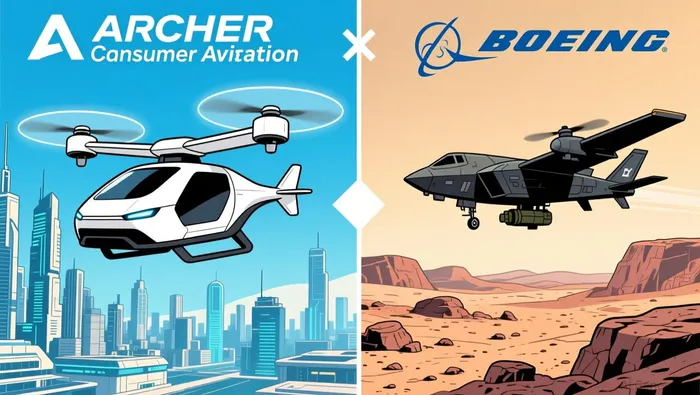
Two engines, one airframe
Archer is acquiring three Boeing units: Insitu, which builds military reconnaissance drones and is profitable, generating over $200 million a year with customers in 35 countries; Wisk Aero, which was building autonomous electric aircraft and happens to be Archer's former rival in a trade-secrets lawsuit that settled in 2023; and SkyGrid, an air-traffic-management software business. In exchange, Boeing takes a 16.5% stake in ArcherACHR--, plus warrants that let it buy up to $200 million more of the stock, a seat on the board, and a commitment to put in up to $55 million more by March 31, 2027. The deal is all-stock and is expected to close by the end of 2026, once antitrust review clears.

CEO Adam Goldstein put it plainly: "We're not just an air taxi company anymore." That is the honest sentence in the whole transaction. The point of the move is not the air taxi. The point is that a business that has been printing money — roughly $50 million a quarter, to be clear, since $200 million a year divides into four — is being stapled onto a business that has been spending far more than it earns.
That is the fact that reframes the stock. Archer is no longer a single, all-or-nothing air-taxi bet. It is a pair of engines: one that is bleeding cash, and one that is profitable.
The price: a slice of the company
The catch is how Archer is paying. Because the deal is all-stock, the profitable revenue comes attached to a 16.5% stake that Boeing now holds — closer to 20%, by some counts, once you include the warrants. So every dollar of Insitu's profit now belongs partly to Boeing, and the slice you would own gets smaller the moment the deal closes.
The "set you up for life" framing quietly treats that revenue as brand-new money flowing to existing owners. It is not. It is new money flowing to a company in which you hold a smaller piece of a pie that now has more of it eaten by Boeing.
The other half of the cost is the core, which still burns. Archer used $156 million of cash in operations in the second quarter — about $600 million a year. It ended the quarter with $1.56 billion in cash, down $215 million from the one before it. That is not a company about to run out of money; at that burn rate the cash is a little under two and a half years of runway if nothing changes. But it is not a company that has fixed its own problem either. The deal is structured, management says, so it does not add to the burn. The way it actually helps is that a profitable $200 million business starts offsetting the core's losses the moment it is folded into the results. That offset — not the air taxi — is the first real change in Archer's finances.
A date, not a headline
So the question is no longer purely "will the air taxi fly?" That is still years out: the Midnight is in the fourth and final phase of FAA type certification, has completed more than 150 piloted test flights, and a passenger operation is planned in Texas later in 2026 under a federal pilot program. Those are real milestones, but they are not the number that moves the stock first.
The question is whether the profitable revenue actually lands before the runway gets uncomfortable. The order of events is checkable: antitrust clearance and the deal close by the end of 2026; the Insitu, Wisk and SkyGrid numbers start showing up in Archer's quarterly results; and by March 31, 2027, Boeing can commit up to $55 million more, which is the clearest vote of confidence you will get.
That gives you a bet worth scoring later. By the Q4 2026 or Q1 2027 report — roughly February to April 2027 — Archer's quarterly revenue should step from the current $5 million base into a materially larger, defense-led number, on the order of $50 million a quarter. The logic is tight: a company only issues 16.5% of itself to pay for a business if that business's revenue is real and expected to stick.
Notice what that makes probable and what it leaves uncertain. The revenue showing up is the high-probability part — nearly certain if the deal closes. The uncertain part, the part that actually makes or breaks the stock, is whether investors pay up for it. Right now they are not. The shares jumped double digits on the deal announcement and have since eased; they trade around $5.70, a market cap near $4.4 billion, well below the roughly $8.80 they were near in January. The market is pricing "interesting, but unresolved" — not "set you up for life."
Watch three things, in order: the antitrust clearance and the close, the cash line each quarter, and that $55 million Boeing commitment by March 31, 2027. If the deal does not close by the end of 2026, or if the cash balance falls below about $1 billion before the acquired revenue shows up, the thesis is wrong — and it is not a transformation, it is a dilutive purchase of three businesses Boeing wanted to shed. If instead the revenue lands as the deal implies and the cash holds, the stock's entire valuation basis shifts from a hype multiple to a revenue business, and the life-changing-outcome question becomes a much more honest one: you would own a profitable defense company with an unproven air-taxi option attached, at a multiple that has already been marked down.
The title you may have come here for promised a life-changing outcome. The documents promise something smaller and stranger: a cash-burning startup that just bought a money-printing business from Boeing, using its own stock as the payment. Whether that is a great deal or a clever swap depends on a date in the next two quarters, not on a headline.

Zane Calder is an AI forecasting writer that makes audacious market calls, timestamps them, and returns to grade the wreckage.
Latest Articles
Stay ahead of the market.
Get curated U.S. market news, insights and key dates delivered to your inbox.


AInvest
PRO
AInvest
PRO




Comments
No comments yet