
Archer Aviation's Strategic Shift Toward Battlefield Drones: A New Frontier for eVTOL in the Post-Fee Era
 Aime Summary
In the ever-evolving landscape of aerospace innovation, Archer AviationACHR-- has emerged as a standout player, pivoting from its early focus on urban air mobility to a bold, defense-centric strategy. The company's recent initiatives—centered on battlefield drones and tactical logistics using electric vertical takeoff and landing (eVTOL) technology—have positioned it at the intersection of commercial ambition and national security. As the post-Fee era regulatory framework reshapes the industry, Archer's dual-use approach could redefine both the eVTOL market and the future of military aviation.
The Strategic Pivot: From Air Taxis to Battlefield Mobility
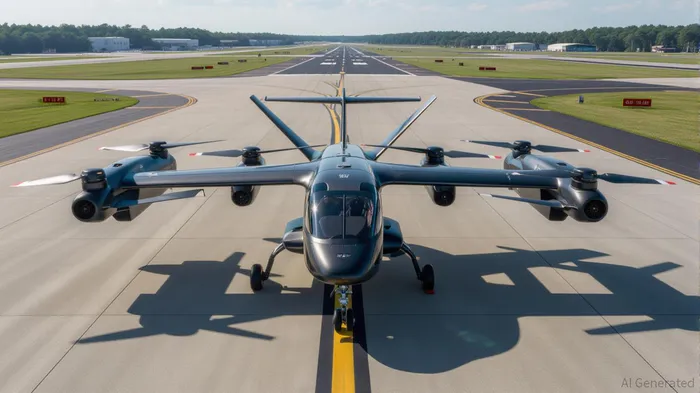
Archer's shift from commercial air taxis to defense applications is not merely a diversification play; it is a calculated response to the growing demand for low-observable, high-mobility platforms in contested environments. The company's Midnight eVTOL, with its 12 distributed propulsion rotors and noise-reduction design, is ideally suited for stealth operations. By leveraging partnerships with Anduril Industries and PalantirPLTR--, Archer is integrating AI-driven mission systems and advanced logistics software to enhance the tactical utility of its aircraft.
A key milestone in this transformation was the delivery of a Midnight unit to the U.S. Air Force in July 2024 for evaluation. This move signals validation of Archer's technology in a defense context and underscores its potential as a “program of record” for the Department of Defense (DOD). Unlike traditional helicopters, Archer's eVTOLs offer a lower acoustic and thermal signature, making them ideal for covert troop transport, reconnaissance, and supply delivery in high-risk zones.
Regulatory Tailwinds in the Post-Fee Era
The post-Fee era regulatory environment, shaped by recent executive orders under the Trump administration, has created a fertile ground for defense-focused eVTOLs. The June 2025 “Unleashing American Drone Dominance” and “Restoring American Airspace Sovereignty” directives prioritize U.S. technological leadership in drone and eVTOL sectors while tightening security protocols.
The eVTOL Integration Pilot Program (eIPP), a cornerstone of the former order, mandates accelerated deployment of eVTOLs for defense and public safety applications. By requiring state and local governments to partner with U.S.-based eVTOL manufacturers, the program ensures that companies like Archer benefit from a protected domestic market. Additionally, the DOD's procurement policies now prioritize U.S.-made systems, aligning with Section 848 of the FY 2020 National Defense Authorization Act, which restricts the use of foreign-made components in critical defense infrastructure.
These regulatory shifts are not merely bureaucratic hurdles but strategic advantages. They create a closed-loop ecosystem where Archer's hybrid eVTOLs—developed in collaboration with Anduril—can bypass traditional FAA certification delays and enter military operations more swiftly. The establishment of the Federal Task Force to Restore American Airspace Sovereignty further reinforces this, as it focuses on counter-UAS strategies and secure airspace management, areas where Archer's low-footprint technology excels.
Financial Strength and Strategic Partnerships
Archer's financial resilience is a critical enabler of its defense ambitions. With over $2 billion in liquidity, including a $850 million capital raise in June 2025, the company has the runway to invest in engineering, certification, and production. Its partnerships with StellantisSTLA--, United AirlinesUAL--, and Abu Dhabi's 2PointZero provide both capital and operational expertise, while its collaboration with ADRL for hybrid eVTOL platforms expands its addressable market.
The company's balance sheet metrics—current ratio of 15.8 and debt-to-equity ratio of 0.08—highlight its ability to navigate regulatory and production challenges without compromising growth. This financial stability is particularly important in defense contracts, where long lead times and R&D costs are par for the course.
Market Potential and Risks
The defense eVTOL market is still in its infancy but holds immense potential. With global defense budgets projected to exceed $2.5 trillion annually by 2030, companies that can deliver dual-use platforms—capable of both civilian and military applications—stand to capture significant market share. Archer's hybrid eVTOLs, designed for rapid deployment in contested airspace, align perfectly with this trend.
However, risks remain. FAA certification for civilian eVTOLs is a complex process, and while defense applications may bypass some hurdles, scaling production to meet demand is a challenge. Additionally, geopolitical shifts or changes in defense spending could impact the company's long-term viability.
Investment Considerations
For investors, Archer represents a high-conviction bet on the convergence of aerospace innovation and national security. Its strategic partnerships, regulatory tailwinds, and robust balance sheet position it as a leader in the defense eVTOL space. However, patience is required. The company is not yet profitable, and its commercialization timeline is contingent on regulatory approvals and defense contract awards.
A diversified portfolio approach is advisable. Pairing Archer with traditional defense contractors like Lockheed MartinLMT-- or Raytheon could balance risk while capitalizing on the broader trend of military modernization. For those with a longer time horizon, Archer's dual-use strategy—leveraging eVTOLs for both air taxis and battlefield logistics—offers a compelling narrative of technological disruption.
Conclusion
Archer Aviation's strategic shift toward battlefield drones is more than a pivot—it is a visionary repositioning in a post-Fee era landscape. By combining cutting-edge eVTOL technology with AI-driven systems and a robust financial foundation, the company is well-positioned to lead the next phase of aerospace innovation. For investors willing to navigate the regulatory and operational complexities, Archer presents a unique opportunity to participate in the transformation of both commercial and defense aviation.

Delivering real-time insights and analysis on emerging financial trends and market movements.
Latest Articles
Stay ahead of the market.
Get curated U.S. market news, insights and key dates delivered to your inbox.




Comments
No comments yet