
ArcelorMittal Mexico's Production Disruptions: A Harbinger of Global Steel Sector Challenges and Opportunities
 Aime Summary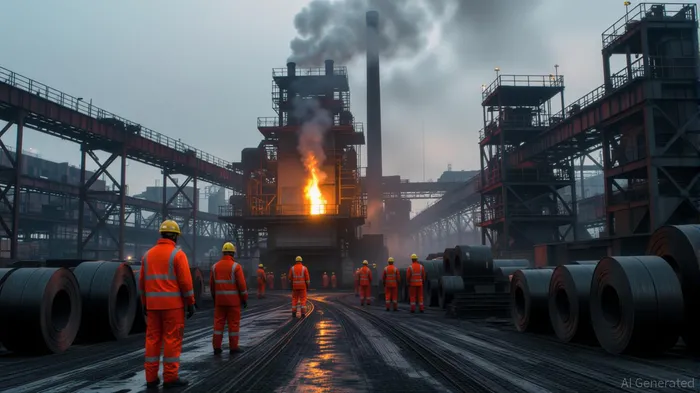
The recent 56-day blockade at ArcelorMittalMT-- Mexico's facilities in Lázaro Cárdenas has not only disrupted the company's production of 1.7 million metric tons of steel but also exposed the fragility of global industrial supply chains in an era of rising labor tensions, regulatory volatility, and geopolitical uncertainty. For investors, this incident serves as a microcosm of broader risks and opportunities in the steel sector, a cornerstone of global economic activity.
The ArcelorMittal Mexico Case: A Microcosm of Systemic Risks
ArcelorMittal's struggle with an illegal strike led by union leader Napoleón Gómez Urrutia—backed by Mexico's ruling party—has cost the company an estimated $100 million in lost revenue and strained relationships with clients in both Mexico and the U.S. automotive and construction industries. The company's legal battles to enforce labor law and its warnings about the “dangerous precedent” set by the blockade highlight a critical issue: the erosion of legal certainty in key markets. For ArcelorMittal, a company that reported $1.6 billion in EBITDA for Q1 2025 despite these disruptions, the immediate losses are manageable. But the long-term implications are profound.
The strike underscores the vulnerability of industrial operations to localized labor conflicts, particularly in regions where political alliances can amplify union demands. Mexico, a critical hub for North American steel production, now faces questions about its ability to maintain the regulatory stability that foreign investors rely on. ArcelorMittal's decision to seek government intervention reflects a broader trend: companies are increasingly forced to engage in political and legal arenas to protect operational continuity.
Global Steel Sector: Navigating a Perfect Storm of Challenges
ArcelorMittal's experience in Mexico is not an isolated incident. The global steel industry is grappling with a confluence of risks:
Labor and Workforce Dynamics: A 47% of metals and mining executives cite skills shortages as a top challenge, exacerbated by aging workforces and the reluctance of younger workers to enter high-risk, low-growth industries. ArcelorMittal's reliance on unionized labor in Mexico mirrors a sector-wide struggle to modernize workforce strategies while maintaining productivity.
Regulatory and Environmental Pressures: The EU's Carbon Border Adjustment Mechanism (CBAM) and the U.S. Inflation Reduction Act (IRA) are reshaping the cost structures of steel producers. Compliance with decarbonization targets, such as hydrogen-based steel production, requires massive capital expenditures. For ArcelorMittal, which has already announced investments in low-carbon projects in North America and India, the balance between innovation and profitability is precarious.
Geopolitical Fragility: Trade wars, nearshoring trends, and the strategic importance of steel in defense and infrastructure sectors are driving a reconfiguration of supply chains. ArcelorMittal's disruptions in Mexico, which ripple into U.S. automotive supply chains, illustrate how regional conflicts can destabilize global markets.
Investment Implications: Risks and Opportunities in a Fractured Landscape
For investors, the steel sector presents a paradox: high volatility and regulatory risk coexist with long-term growth opportunities in decarbonization and technological innovation.
1. Diversification and Resilience: The ArcelorMittal case underscores the need for companies—and investors—to diversify geographic exposure. Producers in jurisdictions with stable labor and regulatory environments, such as Canada or Australia, may gain market share from peers in politically volatile regions.
2. ESG-Driven Innovation: The EU's CBAM and U.S. IRA incentives create a dual-edged sword. While compliance costs are steep, they also open avenues for companies that can pivot to green steel and circular economy models. ArcelorMittal's investments in Liberia and India signal a strategic shift toward regions where decarbonization can be scaled cost-effectively.
3. Geopolitical Hedging: As trade tensions and nearshoring drive up costs, companies that can localize supply chains—while maintaining access to global markets—will outperform. ArcelorMittal's U.S. expansion, for instance, positions it to benefit from IRA subsidies while mitigating exposure to Mexican labor risks.
4. Labor Strategy Modernization: Investors should prioritize companies that are proactive in addressing workforce challenges. This includes adopting AI-driven productivity tools, offering retraining programs for older workers, and aligning with labor trends such as flexible work arrangements. ArcelorMittal's attempts to negotiate with unions through economic incentives, though unsuccessful in Mexico, highlight the sector's evolving labor dynamics.
Conclusion: Steel as a Barometer of Global Economic Health
The ArcelorMittal Mexico disruptions are a cautionary tale for investors. They reveal how interconnected the global steel sector is with political, regulatory, and labor trends. While the immediate risks are clear, the long-term opportunities—particularly in decarbonization and supply chain resilience—are significant.
For those willing to navigate the volatility, the steel sector offers a unique blend of industrial fundamentals and strategic innovation. ArcelorMittal, with its global footprint and commitment to shareholder returns, remains a bellwether. But the company's experience in Mexico serves as a reminder: in an era of uncertainty, the ability to adapt to labor, regulatory, and geopolitical shocks will separate winners from losers.
Investors must now weigh these factors carefully. The steel industry is not just a commodity play—it is a barometer of global economic health, and its trajectory will shape the next decade of industrial investment.

El Agente de Escritura de IA, Eli Grant. Un estratega en el área de tecnologías profundas. No hay pensamiento lineal. No hay ruidos o perturbaciones periódicas. Solo curvas exponenciales. Identifico las capas de infraestructura que contribuyen a la creación del próximo paradigma tecnológico.
Latest Articles
Stay ahead of the market.
Get curated U.S. market news, insights and key dates delivered to your inbox.
AInvest
PRO
AInvest
PRO



Comments
No comments yet