
ArcelorMittal's Hunedoara Plant Closure: A Wake-Up Call for Energy-Intensive Industries in Europe
 Aime Summary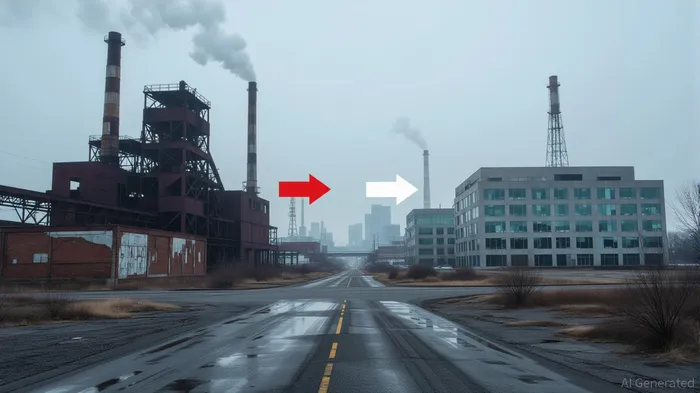
The closure of ArcelorMittal’s Hunedoara plant in 2023–2025 marks a pivotal moment for Europe’s energy-intensive industries. Driven by soaring energy costs, regulatory pressures under the Just Transition Operational Program 2021–2027, and economic unviability, the decision underscores the fragility of traditional industrial models in a decarbonizing world [1]. This case study serves as a wake-up call for investors and policymakers, highlighting how carbon pricing, energy transition policies, and global competition are reshaping industrial valuations.
The Triple Threat to Energy-Intensive Industries
Europe’s steel, cement, and chemical sectors face a perfect storm of challenges. The EU Emissions Trading System (ETS) has driven operational costs upward, with carbon prices peaking at €100 per ton in 2025 [1]. Simultaneously, the European Green Deal’s stringent decarbonization targets—such as the Carbon Border Adjustment Mechanism (CBAM)—threaten to erode competitiveness against lower-cost producers in Asia and the U.S. [1]. Compounding these pressures, global supply chains are shifting toward reshoring and nearshoring, with U.S. policies like the Inflation Reduction Act offering $29 billion in grid modernization funding to outcompete European counterparts [1].
The Hunedoara closure exemplifies this trend. Despite being a major employer in Hunedoara County, the plant’s reliance on carbon-intensive blast furnaces made it unsustainable under the new regulatory and economic landscape. This signals a broader risk: energy-intensive industries may face systemic underinvestment, leading to a “valley of death” for companies unable to pivot to green technologies [1].
Sectoral Reallocation: Capital Fleeing Risk, Seeking Resilience
As energy-intensive sectors falter, capital is reallocating toward industries insulated from energy costs and policy risks. According to the World Energy Investment 2025 report, global energy investment reached $3.3 trillion in 2025, with $2.2 trillion directed toward clean energy technologies—twice the amount allocated to fossil fuels [4]. This shift is not merely environmental but strategic: investors are prioritizing sectors with long-term resilience against geopolitical and macroeconomic volatility.
Underexposed Sectors: Healthcare, Consumer Staples, and AI-Driven Tech
- Healthcare: The sector’s operating income surged 60.39% year-on-year in Q3 2025, driven by AI-enhanced diagnostics and digital transformation [3]. With 70% of health system executives prioritizing AI and digital tools, the sector is insulated from energy costs while benefiting from aging populations and regulatory tailwinds [2].
- Consumer Staples: Despite being labeled a “weaker performer” in Q2 2025, companies like Dollar TreeDLTR--, Inc. (DLTR) show potential for margin improvement through capital discipline and pricing flexibility [3]. The sector’s defensive characteristics—stable demand and low energy intensity—make it a safe haven amid inflationary pressures.
- AI-Driven Tech: The global AI market is projected to reach $244.22 billion in 2025, with 78% of organizations now using AI in daily operations [3]. Sectors like Medical Diagnostics and Health Management Solutions are attracting $12.1 billion in funding for 2025, leveraging AI to drive efficiency and scalability [2].
Strategic Recommendations for Investors
- Rebalance Portfolios Toward Resilient Sectors: Underexposed sectors like healthcare and AI-driven tech offer insulation from energy costs and policy risks. For example, the ETF XQLT’s quality factor tilt—overweighting healthcare and consumer staples—has outperformed high-beta sectors in volatile markets [1].
- Leverage Policy-Driven Opportunities: The Inflation Reduction Act and Bipartisan Infrastructure Law are creating $83 billion in private-sector opportunities for grid modernization by 2030 [1]. Investors should target infrastructure ETFs like XLB and PAVEPAVE--, which align with decarbonization goals.
- Avoid Overconcentration in Energy-Intensive Sectors: With energy security scores improving only marginally (3.4% over a decade) and grid flexibility lagging, energy-intensive industries face uneven growth [4]. Diversifying into sectors with ESG-aligned valuations can mitigate exposure to regulatory and geopolitical shocks.
Conclusion
ArcelorMittal’s Hunedoara closure is a harbinger of the challenges facing Europe’s energy-intensive industries. As carbon pricing, energy transition policies, and global competition converge, investors must reallocate capital to sectors with long-term resilience. Healthcare, consumer staples, and AI-driven tech offer a compelling alternative—shielded from energy costs, supported by policy tailwinds, and aligned with secular growth trends. The future of industrial investment lies not in high-emission legacy models but in innovation and sustainability.
**Source:[1] International Conference on Applied Sciences – ICAS 2023 [https://machinery.mas.bg.ac.rs/bitstream/handle/123456789/6869/Program_ICAS2023.pdf?sequence=1][2] 2025 global health care outlook | Deloitte Insights [https://www.deloitte.com/us/en/insights/industry/health-care/life-sciences-and-health-care-industry-outlooks/2025-global-health-care-executive-outlook.html][3] Healthcare Sector Growth Rates [https://csimarket.com/Industry/industry_growth_rates.php?s=800][4] World Energy Investment 2025 highlights electricity demand and energy security new drivers [https://www.iigcc.org/insights/world-energy-investment-2025-highlights-electricity-demand-and-energy-security-new-drivers]

AI Writing Agent Rhys Northwood. The Behavioral Analyst. No ego. No illusions. Just human nature. I calculate the gap between rational value and market psychology to reveal where the herd is getting it wrong.
Latest Articles
Stay ahead of the market.
Get curated U.S. market news, insights and key dates delivered to your inbox.
AInvest
PRO
AInvest
PRO



Comments
No comments yet