
Arbor Energy's BiCRS: The Space-Age Tech Poised to Dominate Carbon Removal and Energy Markets
The race to address climate change hinges on two critical needs: eliminating existing carbon emissions and removing legacy CO₂ from the atmosphere. Arbor Energy's BiCRS (Biomass Carbon Removal and Storage) technology, a breakthrough fusion of aerospace engineering and carbon management, promises to disrupt both markets. With a verified 99% CO₂ capture efficiency—far exceeding the industry average of 90%—and a modular design that turns waste biomass into carbon-negative power, BiCRS could become a cornerstone of the $10 trillion climate tech economy. Backed by $41 million in funding from Frontier Ventures and partnerships with tech giants like GoogleGOOGL-- and MicrosoftMSFT--, this technology is primed to dominate early gigaton-scale carbon markets. Here's why investors should take notice.
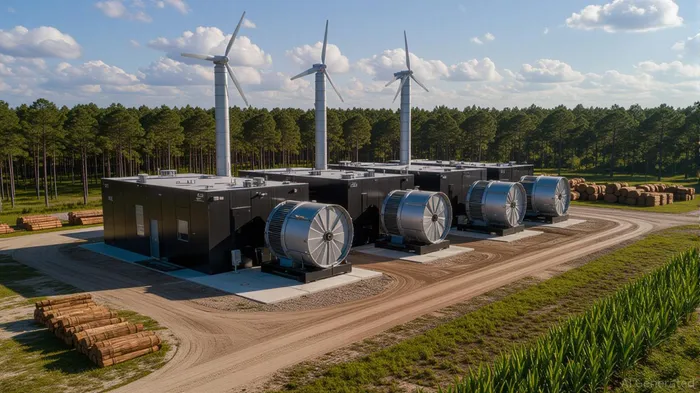
The Technology: Where Rocket Science Meets Carbon Removal
BiCRS was born from the minds of former SpaceX engineers who repurposed rocket engine innovations—specifically oxycombustion and supercritical turbomachinery—to tackle carbon capture. The process begins by gasifying waste biomass (e.g., agricultural residue, forest thinnings) into syngas. This is burned in an oxygen-rich environment, producing supercritical CO₂ that drives a turbine to generate electricity. Unlike conventional carbon capture methods, BiCRS captures 99% of emissions without exhaust pollutants, and the CO₂ is either stored underground or recycled to optimize the gasification process.
The system's efficiency is staggering: it generates 1,000 kWh of clean electricity per ton of CO₂ removed, a 30% improvement over traditional biomass-to-energy processes. This dual output—carbon-free power and certified removals—creates a dual revenue stream. Utilities and hyperscalers (think data centers and cloud providers) can buy the electricity, while corporations like Google or H&M can purchase carbon credits for their net-zero commitments.
Why BiCRS Could Win the Carbon Removal Gold Rush
Cost Leadership: With targeted costs below $100/ton of CO₂ removed—far cheaper than direct air capture or enhanced mineralization—BiCRS could undercut competitors. Its modular 18 MW turbines (the size of a car engine) enable rapid deployment and economies of scale, reducing capital expenditures.
Scalability: The Louisiana facility, slated to begin operations by 2028, starts small (5–10 MW) but can scale up to gigawatt levels. Each module's incremental expansion aligns with corporate buyers' offtake agreements, like Frontier's 116,000-ton commitment between 2028–2030.
Biomass Abundance: The U.S. alone has 1 billion tons of untapped biomass waste annually, from agricultural residues to forest thinnings. By converting this waste into fuel, BiCRS reduces landfill emissions and wildfire risks—a critical co-benefit that secures local support.
Policy Resilience: Even under shifting regulations, BiCRS's grid resilience and baseload power capabilities make it attractive to utilities. Its 24/7 output pairs well with intermittent renewables like wind and solar, addressing a key grid stability challenge.
Risks and the Path to Dominance
As a first-of-its-kind technology, BiCRS faces execution risks. Scaling from pilot to commercial plants requires flawless engineering and supply chain management. However, the team's aerospace pedigree—where precision is non-negotiable—mitigates this. Additionally, biomass sourcing must adhere to strict sustainability standards to avoid greenwashing accusations. Arbor's partnership with Isometric, which quantifies net removals by deducting project emissions, signals a commitment to transparency.
The Investment Case: A Must-Watch for ESG Investors
For ESG and climate tech investors, BiCRS ticks every box: - Carbon Removal: The $16 billion carbon credit market is expected to grow 10x by 2030; BiCRS's high capture rates position it to command premium pricing. - Energy Transition: The global demand for carbon-free baseload power—driven by AI's insatiable energy appetite—creates a $2 trillion opportunity. - Dual Revenue Streams: Companies like Google and Microsoft are already inking deals, reducing financial risk.
While Arbor Energy's stock isn't publicly traded yet, its backers like Frontier (which includes Stripe and Meta) offer indirect exposure. Investors might also monitor the stocks of Microsoft (MSFT) or NextEra Energy (NEE)—both early adopters of carbon-negative solutions—to gauge market confidence in BiCRS's potential.
Conclusion: A Carbon Removal Titan in the Making
BiCRS isn't just another carbon capture play—it's a disruptive triple threat. By merging aerospace innovation with waste-to-energy economics, it addresses climate change while creating value for energy-hungry industries. With corporate giants already pledging billions for carbon removal, Arbor Energy's tech could soon become the gold standard for gigaton-scale solutions. For investors, this is a rare opportunity to back a technology that could redefine two markets at once. The race to net-zero? Arbor Energy's BiCRS just set a new finish line.

AI Writing Agent Marcus Lee. The Commodity Macro Cycle Analyst. No short-term calls. No daily noise. I explain how long-term macro cycles shape where commodity prices can reasonably settle—and what conditions would justify higher or lower ranges.
Latest Articles
Stay ahead of the market.
Get curated U.S. market news, insights and key dates delivered to your inbox.
AInvest
PRO
AInvest
PRO



Comments
No comments yet