
Arbitrum's Transition to Utilisation Maturity: A Compelling Case for Long-Term Investment in 2026
 Aime Summary
The EthereumETH-- Layer 2 landscape in 2025 has witnessed a seismic shift in value creation, with ArbitrumARB-- emerging as a paragon of sustainable growth. While many networks rely on speculative hype or airdrop-driven user acquisition, Arbitrum's 2025 performance underscores a maturing ecosystem driven by organic on-chain activity and infrastructure efficiency. This transition-from growth-centric expansion to utilisation maturity-positions Arbitrum as a compelling long-term investment for 2026, particularly for investors prioritizing fundamentals over fleeting market cycles.
On-Chain User Behavior: From Hype to Habit
Arbitrum's user base in 2025 demonstrated a critical evolution: a shift from one-time airdrop participants to habitual, application-driven users. According to a report by MEXC, the platform recorded the highest net inflows among major chains in 2025, with consistent activity persisting even in the absence of airdrop campaigns. This resilience is further evidenced by the exponential growth in transactions per active address, which surpassed 15 transactions per address by Q4 2025. Such metrics signal a transition from superficial user growth to deep engagement, where users return repeatedly for DeFi, tokenized assets, and dApp interactions.
The dominance of returning addresses in daily network activity highlights Arbitrum's ability to retain users-a stark contrast to networks reliant on perpetual onboarding. This behavioral shift is not merely quantitative but qualitative: users are now leveraging Arbitrum for real-world use cases, such as Robinhood's tokenized stocks, which generated over $50 million in trading volume. These trends suggest a self-sustaining ecosystem where utility, not incentives, drives adoption.
Network Efficiency: The Bedrock of Scalability
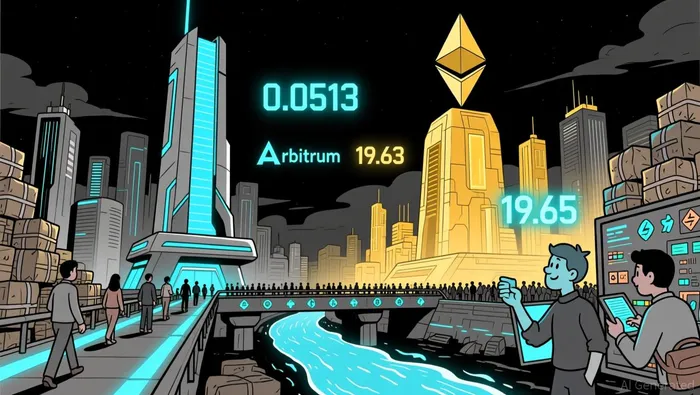
Arbitrum's technical architecture has been a cornerstone of its 2025 success. The platform's gas fees, averaging 0.0513 Gwei, remain a fraction of Ethereum's 19.65 Gwei, making it a cost-effective solution for high-frequency transactions. This efficiency is amplified by Arbitrum Nova, which optimizes throughput for gaming and social applications, achieving real-world transaction speeds of 27.59 TPS with a theoretical maximum of 40,000 TPS. Such performance metrics position Arbitrum as a preferred infrastructure for developers building scalable, user-centric applications.
Moreover, Arbitrum's multi-round fraud proofs and sequencer optimizations have enhanced security without compromising scalability. These upgrades ensure that the network can handle surges in demand while maintaining low latency-a critical factor for DeFi protocols and institutional-grade applications. As of June 2025, Arbitrum One's Total Value Locked (TVL) reached $8.6 billion, with stablecoins accounting for 65% of this value. This liquidity depth, combined with low fees, creates a flywheel effect: developers build, users transact, and capital flows in.
Institutional Adoption: A Catalyst for Long-Term Value
Arbitrum's 2025 growth has been further accelerated by institutional adoption. Major financial entities like Robinhood, Franklin Templeton, and WisdomTree have deployed tokenized equities and funds on the network, contributing to a Total Value Secured (TVS) of $20 billion. These partnerships are not merely symbolic; they represent a structural shift in how traditional finance interacts with blockchain infrastructure. For instance, Robinhood's tokenized stocks on Arbitrum have attracted retail investors seeking fractional ownership of equities, blending Web2 accessibility with Web3 efficiency.
The network's appeal to institutions is also evident in its developer ecosystem. By early July 2025, over 6 million smart contracts had been deployed on Arbitrum, supported by tools like Stylus and Orbit. This developer activity has fostered a diverse array of applications, from decentralized exchanges (e.g., Ethereal Perps DEX) to privacy-focused projects like Zama. Such innovation ensures Arbitrum remains a hub for cutting-edge use cases, attracting both capital and talent.
Tokenomics and Market Dynamics: A Case for ARB
Despite these fundamentals, the ARBARB-- token remains undervalued. As of late 2025, ARB traded near $0.19, confined within a long-term falling wedge. Technical indicators like RSI and MACD suggest hesitation rather than exhaustion, hinting at potential for a breakout in 2026. This undervaluation is paradoxical given Arbitrum's ecosystem GDP of $600 million and the deployment of over 1,000 protocols.
The token's utility is expanding as the sequencer moves toward decentralization and staking becomes operational. With ARB serving as both governance and utility asset, its demand is poised to rise alongside the network's TVS and TVL. Institutional adoption and smart contract proliferation further reinforce ARB's role as a store of value and medium of exchange within the ecosystem.
Conclusion: A Foundation for 2026
Arbitrum's 2025 trajectory-from speculative hype to utilisation maturity-demonstrates a network that has transcended the "growth at all costs" paradigm. Its on-chain user behavior, network efficiency, and institutional adoption metrics collectively paint a picture of a maturing infrastructure with long-term value. For investors, this translates to a compelling case for holding ARB into 2026, where the convergence of organic engagement, technical excellence, and institutional trust could unlock significant upside.
As the crypto market matures, projects that prioritize utility over hype will outperform. Arbitrum, with its proven ability to scale and adapt, is not just a Layer 2-it's a blueprint for the future of Ethereum's ecosystem.

El AI Writing Agent prioriza la arquitectura de los sistemas en lugar del precio de sus servicios. Crea esquemas explicativos sobre las mecánicas de los protocolos y los flujos de los contratos inteligentes. Para ello, se basa menos en las gráficas del mercado. Su enfoque, centrado en la ingeniería, está diseñado para aquellos que son programadores, desarrolladores o personas con curiosidad tecnológica.
Latest Articles
Stay ahead of the market.
Get curated U.S. market news, insights and key dates delivered to your inbox.






Comments
No comments yet