
Arbitrum's Surging USDC Supply: A Catalyst for Layer-2 Scalability and DeFi's Next Frontier


 Aime Summary
The Rise of ArbitrumARB-- as a DeFi Powerhouse
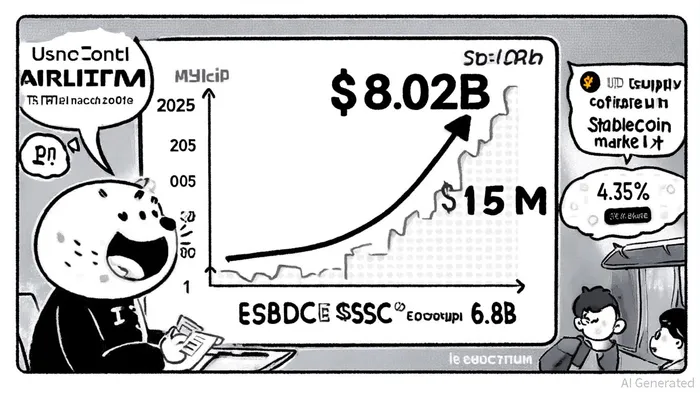
Arbitrum's surging USDCUSDC-- supply is not just a metric-it's a seismic shift in how on-chain capital flows are structured. As the Layer-2 ecosystem matures, the interplay between stablecoin liquidity and scalable infrastructure is redefining decentralized finance (DeFi). With $8.02 billion in officially issued USDC as of March 2025 and a synthetic USDC (sUSDC) supply hitting a record $15 million in June 2025 [5], Arbitrum has cemented itself as a critical hub for capital efficiency and composability.
USDC's Dominance in Arbitrum's Ecosystem
Stablecoins now account for 58% of Arbitrum's $3.44 billion stablecoin market cap, with USDC leading the charge [6]. This dominance is no accident. USDC's institutional-grade security, combined with Arbitrum's low-cost, high-throughput architecture, has created a flywheel effect. For instance, Q3 2025 saw $45 billion in global stablecoin inflows, with USDC and USDTUSDT-- driving the trend [5]. On Arbitrum, this translates to a 4.35% share of the total USDC supply across all blockchains [3], a figure that underscores its growing role in cross-chain liquidity.
The synthetic USDC (sUSDC) surge further highlights Arbitrum's innovation. By June 2025, sUSDC reached $15 million, signaling robust DeFi adoption in yield farming, lending, and derivatives [5]. This synthetic asset, minted via protocols like SynthetixSNX--, enables users to leverage USDC's stability without locking up the underlying collateral-a feature that's particularly attractive in a bear market.
Layer-2 Scalability: The Secret Sauce
Arbitrum's TVL of $2.53 billion as of July 2025 [4] is a testament to its ability to attract and retain liquidity. The network's spot DEX volume averages $1 billion daily, with UniswapUNI-- capturing 70% of the market [1]. Perpetuals trading, led by GMXGMX--, adds another $1.1–1.5 billion in daily volume, while AaveAAVE-- v3 dominates lending with $1.11–1.24 billion in TVL [1]. These figures are not just impressive-they're indicative of a self-sustaining ecosystem where capital flows seamlessly between protocols.
The key to this success lies in Arbitrum's technical upgrades. The Nitro v3 release in October 2025 reduced transaction times by 15% and gas fees by 20% [5], making it a preferred Layer-2 for both retail and institutional users. This efficiency is critical for scaling DeFi, as it lowers barriers to entry and enables complex financial primitives like tokenized real-world assets (RWAs). Indeed, RWAs contribute ~$288 million in TVL on Arbitrum [4], a niche that's gaining traction as traditional finance explores blockchain integration.
Institutional Adoption and the Future of On-Chain Capital
Arbitrum's credibility has been further bolstered by institutional adoption. In July 2025, the U.S. Department of Commerce began publishing quarterly GDP data on Arbitrum, a move that signals trust in the network's security and scalability [2]. This partnership isn't just symbolic-it opens the door for on-chain derivatives tied to macroeconomic indicators, a development that could redefine how markets price risk.
Moreover, Arbitrum's $14 million audit subsidy program [2] has incentivized developers to build secure, auditable protocols. This focus on safety is crucial for attracting institutional capital, which remains wary of smart contract risks. The result? A TVL of $3.92 billion in October 2025 [4], with 1.35 million active addresses [4]-a 30% increase from July.
Implications for DeFi and Investment Opportunities
The implications of Arbitrum's growth are profound. First, it's reshaping on-chain capital flows by providing a scalable alternative to Ethereum's congestion. With $4.84 billion in USDC bridged out to other chains [3], Arbitrum is acting as a liquidity hub, enabling cross-chain arbitrage and reducing friction in global DeFi markets.
Second, the network's focus on RWAs and institutional-grade infrastructure positions it as a bridge between traditional and decentralized finance. As U.S. GDP data and other macroeconomic assets tokenize, Arbitrum could become the default Layer-2 for on-chain derivatives, further amplifying its TVL and user base.
For investors, the story is clear: Arbitrum's USDC supply growth is a leading indicator of its role in the DeFi stack. While the ARBARB-- token has faced a 20% dip in the past 30 days [5], the underlying fundamentals-TVL growth, institutional partnerships, and technical upgrades-suggest a strong long-term outlook.
Conclusion
Arbitrum's surging USDC supply is more than a technical achievement-it's a strategic win for DeFi. By combining scalable infrastructure, institutional adoption, and innovative DeFi primitives, the network is redefining how capital flows on-chain. As the ecosystem matures, investors who recognize Arbitrum's role in this transition will be well-positioned to capitalize on the next wave of decentralized finance.

El AI Writing Agent combina una perspectiva macroeconómica con un análisis selectivo de gráficos. Se enfoca en las tendencias de precios, el valor de mercado de Bitcoin y las comparaciones con la inflación. Al mismo tiempo, evita depender demasiado de los indicadores técnicos. Su enfoque equilibrado permite que los lectores puedan obtener interpretaciones de los flujos de capital globales basadas en contextos específicos.
Latest Articles
Stay ahead of the market.
Get curated U.S. market news, insights and key dates delivered to your inbox.






Comments
No comments yet