
Arbitrum Shifts Focus to Real-World Assets as Token Price Struggles to Recover
 Aime Summary
- Arbitrum has launched the Eurus Aero Token I, a $12.2M jet engine lease offering 11% annual yield to accredited investors.
- The ARBARB-- token has declined over 90% from its peak, despite strong network growth and $670M in new RWA tokenization.
- Institutional adoption of tokenized RWAs on ArbitrumARB-- is growing, with EthereumETH--, Arbitrum, and SolanaSOL-- leading on-chain value growth.
Arbitrum is pivoting toward real-world asset (RWA) tokenization to attract institutional capital. This strategy includes the Eurus Aero Token I, backed by jet engine leases and offering 11% annual yield to accredited investors. The project aims to leverage Arbitrum's infrastructure for faster processing and lower transaction fees, making tokenized RWAs an attractive option for yield-seeking investors.
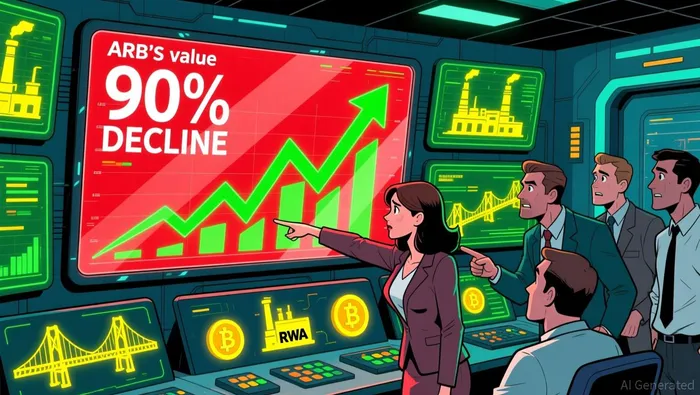
The ARB token has not followed the network's success, with its price down nearly 90% from its peak. This disconnect stems from the lack of direct economic incentives for token holders such as staking rewards or buybacks. Although the network has seen $8B in stablecoin liquidity and $670M in RWA tokenization, these metrics have not translated into token value appreciation.
A major unlocking event for ARB tokens is expected in early February 2026, with 92.65 million tokens, or 1.82% of the released supply, becoming available. This unlock could exacerbate downward pressure on the price, especially with no significant tokenomics mechanisms in place to counteract supply-side impacts. Institutional adoption of tokenized RWAs is increasing, but the broader crypto market's $1 trillion drawdown has not been fully offset by the RWA segment, which has grown by 13.5%.
Why Is Arbitrum Focusing on Real-World Assets Now?
The shift toward real-world assets represents a strategic move to capture institutional capital in the tokenized asset space. Arbitrum's Eurus Aero Token I is one of several RWA projects launched on the platform, offering yield through real-world assets such as jet engine leases. This approach aims to bridge traditional finance and blockchain by providing a capital-efficient, yield-generating option for accredited investors.
Tokenized RWAs are gaining traction on Arbitrum due to its fast block finality (6 seconds vs. Ethereum's 12+ minutes) and lower transaction fees. This has allowed Arbitrum to attract institutions like BlackRock and JPMorgan, who are increasingly exploring yield-bearing instruments. The RWA market has shown resilience during market stress, suggesting that tokenized assets may provide a more stable option for capital deployment in a volatile environment.
What Are the Risks for Arbitrum and ARB Token Holders?
Despite the growing interest in RWA tokenization, ARB token holders face significant risks. The token's price remains underwater, and there are no mechanisms in place to reward token holders for the network's growth. This includes the lack of staking rewards or token burns, which are common in other blockchain ecosystems.
A major unlock of 92.65 million ARB tokens in early February 2026 could add to the downward pressure on price, especially if selling pressure is high. This unlock represents 1.82% of the released supply and is valued at approximately $11.2 million. Additionally, the weak tokenomics model makes it difficult to align the token's value with the network's performance, raising concerns among investors.
The challenge for Arbitrum is to bridge the gap between network activity and token value. While RWA tokenization is attracting capital, the ARB token must find a way to capture value from this growth to prevent further losses for long-term investors.

Blending traditional trading wisdom with cutting-edge cryptocurrency insights.
Latest Articles
Stay ahead of the market.
Get curated U.S. market news, insights and key dates delivered to your inbox.


AInvest
PRO
AInvest
PRO



Comments
No comments yet