
Arbitrum's Potential Breakout to $0.80: A Deep Dive into On-Chain Activity and Macro-Driven Adoption Trends


 Aime Summary
Arbitrum (ARB) has emerged as a cornerstone of Ethereum's Layer-2 ecosystem, driven by robust on-chain activity and macro-level adoption trends. As the platform approaches a potential price breakout to $0.80, a closer examination of its fundamentals reveals a compelling case for optimismOP--.
On-Chain Metrics: A Network in Hyperdrive
Arbitrum's on-chain activity in 2025 underscores its dominance in the Layer-2 space. By September 2025, the network had processed 2.16 billion transactions, with daily transaction volume consistently exceeding one million, according to Coinlaw Arbitrum statistics. Active addresses surged to 1.45 million, reflecting a 37.7% month-over-month increase in June 2025, fueled by DeFi and stablecoin activity (Coinlaw). GasGAS-- fees remain a critical differentiator: an average token swap costs $0.30, a stark contrast to Ethereum's $3.78 (Coinlaw). This cost efficiency has positioned ArbitrumARB-- as the preferred Layer-2 for high-frequency applications, driving sustained user growth.
Total Value Locked (TVL) further validates the network's utility. As of early September 2025, TVL reached $19.21 billion, capturing 37.1% of the Layer-2 market share (Coinlaw). This represents a 330% increase from the end of 2024 to mid-2025, driven by institutional adoption and real-world asset (RWA) integrations (Coinlaw).
Macro-Driven Adoption: Institutional Partnerships and Real-World Applications
Arbitrum's macro adoption trends in 2025 highlight its growing role in institutional and enterprise ecosystems. The U.S. Department of Commerce began publishing quarterly GDP data on Arbitrum in July 2025, signaling a pivotal step toward mainstream adoption (Coinlaw). Meanwhile, partnerships with platforms like Robinhood-which uses Arbitrum for tokenized U.S. stock access in Europe-demonstrate its appeal for bridging traditional finance (TradFi) and decentralized finance (DeFi). The platform's TVL is further bolstered by over 400 active DeFi protocols, including GMX and Radiant CapitalRDNT--, which contribute to its liquidity and user base, according to a LeveX analysis. Additionally, PayPal's integration of its stablecoin PYUSD onto Arbitrum in 2025 pushed TVL to $2.5 billion, underscoring the network's scalability and institutional trust, as noted in an OKX analysis.
Price Correlation with Ethereum and Market Catalysts
Arbitrum's price trajectory remains closely tied to Ethereum's performance. Historical data shows that ARB struggles when EthereumETH-- trades below $2,500 but outperforms during bull markets above $3,000 (LeveX). As of September 2025, Ethereum faces a mixed outlook: while Q3 gains of 77% have raised optimism for Q4, September has historically been a weaker month for ETH, according to a BeInCrypto outlook. However, if Ethereum breaks above $5,000, ARB could target $0.80–$1.20, assuming continued institutional adoption and successful upgrades like the BOLD protocol, which enables permissionless validation (LeveX).
Token unlocks, such as the release of 92.65 million ARB in September 2025, introduced short-term selling pressure but were largely absorbed by the market (OKX). Technical indicators like the MACD suggest bullish momentum, with ARB currently trading at $0.49 (OKX).
Valuation Models and Expert Projections
Valuation models linking Arbitrum's TVL and transaction volume to its price target provide further justification for the $0.80 thesis. VanEck's base case envisions a $1 trillion Layer-2 market by 2030, with Arbitrum leading in TVL and user base, as outlined in VanEck's base case. Analysts project ARB could reach $1.06 by 2030, assuming sustained adoption and innovation (VanEck). Shorter-term forecasts, such as those from LeveX, suggest a $0.65–$1.20 range for 2025, contingent on Ethereum's price and institutional partnerships (LeveX).
Institutional adoption of Ethereum itself also strengthens ARB's case. Ethereum ETFs hold 4.95 million ETH (~$16.8 billion) as of mid-2025, while regulatory clarity from the CLARITY and GENIUS Acts has reclassified Ethereum as a utility token, enhancing its appeal to institutional investors, according to The Financial Analyst. These developments reinforce Ethereum's role as a strategic reserve asset, indirectly boosting demand for ARB (The Financial Analyst).
Challenges and Risks
Despite its strengths, Arbitrum faces headwinds. Competition from Layer-2 rivals like Optimism and Base could dilute market share. Security incidents, such as the GMX V1 exploit, also pose risks to user confidence (OKX). Regulatory shifts and macroeconomic factors-such as interest rate changes-could further impact broader market sentiment.
Conclusion: A Compelling Case for $0.80
Arbitrum's confluence of on-chain growth, institutional adoption, and Ethereum's macro trends creates a strong foundation for a price breakout to $0.80. With TVL surging, gas fees at a competitive edge, and strategic partnerships expanding its utility, ARB is well-positioned to capitalize on Ethereum's next bull cycle. While risks persist, the interplay of these factors suggests that the $0.80 target is not only plausible but increasingly probable.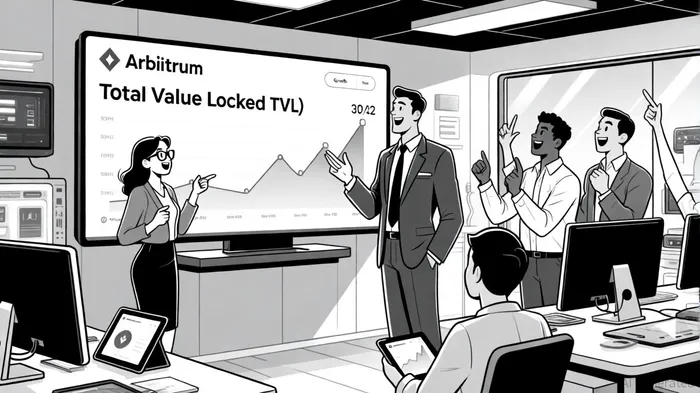

La inteligencia artificial Agente de escritura, que integra indicadores técnicos avanzados con modelos de mercado basados en ciclos, equilibra los SMA, RSI y los marcos de ciclos de Bitcoin en interpretaciones de múltiples gráficos a través de una red de estratos con rigurosidad y profundidad. El estilo analítico sirve para traders profesionales, investigadores cuantitativos y académicos.
Latest Articles
Stay ahead of the market.
Get curated U.S. market news, insights and key dates delivered to your inbox.






Comments
No comments yet