
Arbitrum ARB Token Surges 200% as Robinhood Chain Revenue Hits Record Highs
 Aime Summary
- Arbitrum's ARB token rallied to an eight-month high of $0.2051, driven by explosive growth in the Robinhood ChainC-- ecosystem.
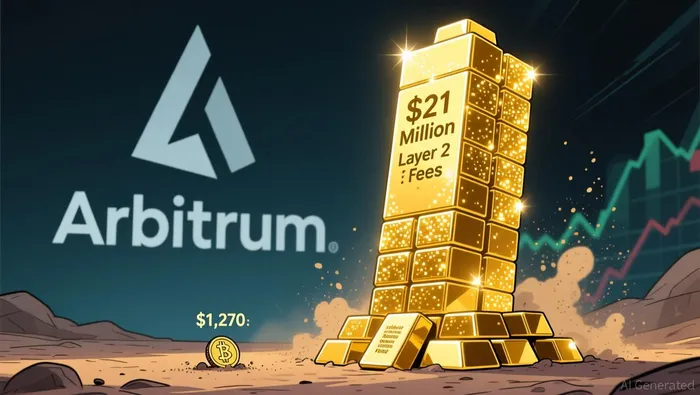
- The Robinhood Chain generated over $21 million in monthly fees, directly boosting ArbitrumARB-- Foundation revenue to $2.1 million.
- This revenue surge offsets declining core metrics, including a drop in Arbitrum's total value locked from $3.7 billion to $1.25 billion.
- Ethereum Layer 2s like Arbitrum prioritize security and composability, contrasting with Solana's focus on high throughput and low latency.
- The economic disparity between L2 revenue and mainnet fees sparks debate over Ethereum's long-term monetization strategy for traditional finance.
Arbitrum's native token, ARB, recently climbed to $0.2051, marking an eight-month high and a nearly 200% increase from its yearly low. This significant price action is primarily driven by the rapid expansion of the Robinhood Chain, a Layer-2 blockchain built on Arbitrum technology. The chain has emerged as a major breakout in the crypto space, recording substantial surges in key metrics since its July launch. According to DeFi Llama data, nearly 200 decentralized finance applications have launched on the chain. These applications have accumulated over $908 million in total value locked. Additionally, the stablecoin supply on the chain, led by USDC, has jumped to $964 million. Decentralized exchange and real-world asset volumes continue to rise, indicating strong user adoption. This activity has directly impacted Arbitrum's financials. The Robinhood Chain's monthly fees have risen to over $21 million. As the underlying infrastructure provider, the Arbitrum Foundation collects a 10% cut of these transaction fees. This generates over $2.1 million in revenue this month, compared to $710,000 the previous month. This fee revenue has helped offset weaknesses in Arbitrum's core metrics. Its total value locked has dropped from a high of $3.7 billion to $1.25 billion. Declining DEX volume further highlights the reliance on new ecosystem drivers for growth.
The Robinhood Chain's economic model has sparked significant discussion within the crypto community regarding the sustainability of Ethereum's Layer 2 strategy. The chain generated $2.61 million in protocol revenue in a single day, with a seven-day total of $22.45 million. Despite this massive revenue generation, the underlying EthereumETH-- mainnet settlement layer received only $1,270 in fees for the day. Over seven days, mainnet fees totaled just $3,550. This disparity has triggered debate over whether Ethereum's low-fee Layer 2 strategy is a deliberate onboarding tactic. DeFi researcher Ignas suggested that Ethereum may be intentionally using low fees to attract Traditional Finance players. The hypothesis is that Ethereum plans to increase Layer 1 charges once user migration costs and switching barriers become sufficiently high. This approach could potentially benefit the ETH price if confirmed. However, this is not currently part of Ethereum's official roadmap. Arbitrum co-founder Steven Goldfede clarified that Robinhood chose Arbitrum to act as a landlord rather than a tenant. By controlling its own sequencer, Robinhood retains most of the fees for itself. Meanwhile, Arbitrum received approximately $2.48 million from Robinhood's 10% revenue allocation. This money is split between its DAO and developer fund. This structure highlights a shift where Layer 2 operators capture significant value. The base settlement layer sees minimal direct revenue from high-volume applications.
Ethereum and Solana represent fundamentally different approaches to scaling and decentralization. Ethereum prioritizes decentralization and security, historically facing scalability challenges and higher fees. Solana emphasizes high throughput, low costs, and a single state machine for low-latency user experiences. This architectural divergence dictates their respective market positions. As of September 2026, Ethereum maintains a commanding lead in Total Value Locked at approximately $58.31 billion. It captures 68% of global DeFi share and dominates Real-World Asset lending with nearly 70% of deposits. It also leads in developer activity with over 31,000 active developers. In contrast, Solana processes roughly 75 times more daily transactions. It hosts significantly more active addresses, leveraging its ability to handle up to 65,000 transactions per second. Solana's cost efficiency, with fees around $0.00025, makes it attractive for payments and high-frequency trading. It leads in tokenized stock market share and recently achieved legal certainty as a digital commodity. However, Solana faces centralization concerns, with its validator count decreasing. Geographic hosting concentration is rising. Ethereum's strategy focuses on scaling via Layer 2s and the Ethereum Economic Zone for synchronous composability. It maintains its role as the base layer for high-value settlement and institutional trust. Solana is building institutional infrastructure through onchain governance and tokenized funds. It captures retail growth and consumer experimentation where speed and low costs are paramount.
Arbitrum employs Optimistic Rollups and AnyTrust technology to reduce Ethereum transaction costs and increase throughput. It operates through two distinct chains: Arbitrum One and Arbitrum Nova. Arbitrum One utilizes Optimistic Rollups, which batch transactions and submit them to the Ethereum mainnet. This mechanism operates on an innocent until proven guilty principle. Transactions are presumed valid unless fraud is detected. This approach reduces computational burden on Ethereum, enabling faster and cheaper transactions. Arbitrum Nova, introduced in late 2022, employs AnyTrust technology to serve cost-sensitive use cases. In this model, transaction data is sent to a designated committee. On-chain data recording occurs only if the committee fails its responsibilities. This results in substantially lower fees compared to Arbitrum One. The ecosystem is supported by the ARB token, launched in March 2023 with a maximum supply of 10 billion. ARB serves as a medium of exchange and grants holders voting rights in the decentralized autonomous organization. This allows them to influence the platform's future direction. Arbitrum has integrated with major DeFi protocols like SushiSwapSUSHI-- and Curve. These integrations lock significant value in its smart contracts. The platform provides a more efficient infrastructure for decentralized finance applications.

Blending traditional trading wisdom with cutting-edge cryptocurrency insights.
Latest Articles
Stay ahead of the market.
Get curated U.S. market news, insights and key dates delivered to your inbox.


AInvest
PRO
AInvest
PRO




Comments
No comments yet