
Are We Approaching a Fed Rate Cut Cycle Amid Cooling Labor Market Data?


 Aime Summary
Labor Market Trends: A Tale of Two Reports
The ADP National Employment Report for the four weeks ending November 8, 2025, revealed a stark decline in private-sector hiring, with an average of 13,500 jobs lost per week according to the report. This contrasts sharply with the robust 42,000 private-sector jobs added in October 2025 as reported, signaling a potential slowdown in hiring momentum. Meanwhile, the Bureau of Labor Statistics (BLS) nonfarm payroll data for September 2025 showed a stronger 119,000 job gain, exceeding expectations, but the unemployment rate rose to 4.4%, the highest since 2021. These divergent data points highlight structural shifts in the labor market, including automation-driven job compression in white-collar sectors, and underscore the challenges of interpreting real-time economic conditions.
The ADP data's four-week average of negative job growth in November raises concerns about consumer strength as the holiday season progresses. However, the BLS's delayed release of October and November data-due to a government shutdown-has created uncertainty, leaving investors to rely on fragmented indicators. This lack of clarity complicates assessments of whether the labor market is softening meaningfully or merely experiencing seasonal volatility. 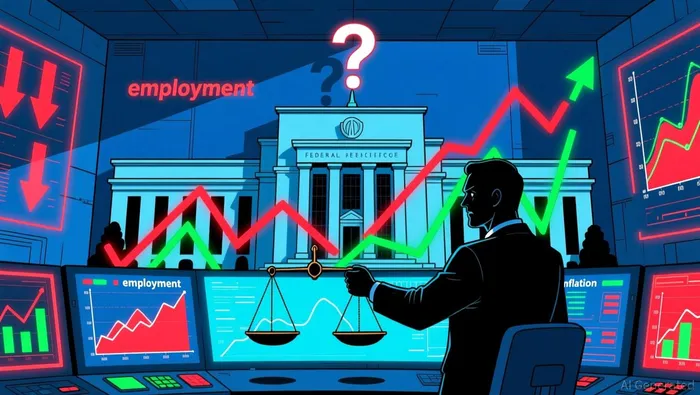
Fed Dilemma: Employment vs. Inflation
The Federal Reserve's December 2025 policy meeting is shaping up as a pivotal moment. While weak labor market data, such as the ADP's November figures, could justify a 25-basis-point rate cut, the Fed's November 19 meeting minutes reveal internal divisions. A 10-2 vote in October supported a cut, but many officials now argue that inflation remains above the 2% target, making further easing premature. The juxtaposition of strong nonfarm payrolls 119,000 in September and rising unemployment at 4.4% reflects a labor market that is neither collapsing nor overheating-a scenario that tests the Fed's ability to balance its dual mandate.
Adding to the complexity, potential trade tariffs and AI-driven productivity gains could distort labor demand in the near term. Fed Governor Christopher Waller has acknowledged that a December cut is appropriate but emphasized that January decisions will hinge on a "flood" of data. This data dependency suggests the Fed is unlikely to commit to a sustained rate-cutting cycle unless inflationary pressures abate and labor market weakness becomes more entrenched.
Market Implications: Equities and Fixed Income in a Policy Crosshairs
The labor market's mixed signals have created a tug-of-war between equity and fixed-income markets. Equities, particularly in sectors like trade and transportation, have benefited from October's strong job gains, but the ADP's November downturn has raised concerns about consumer spending and corporate earnings. A Fed pivot toward easing could provide a short-term boost to risk assets, but the uncertainty around policy timing has led to choppy trading conditions.
For fixed-income markets, the Fed's hesitation to cut rates has kept bond yields elevated. The 10-year Treasury yield remains above 3.5%, reflecting investor skepticism about a rapid shift in monetary policy. However, if the delayed BLS data confirms a sharper labor market slowdown, the yield curve could invert further, signaling expectations of aggressive rate cuts in 2026.
Conclusion: A Data-Driven Path Forward
The Fed's December decision will likely hinge on the resolution of conflicting labor market signals. While the ADP's November figures suggest cooling, the BLS's delayed reports could reveal a more resilient labor market. Investors should brace for a data-dependent policy approach, where each release-particularly the combined October-November nonfarm payrolls due on December 16-could sway the Fed's stance.
In this environment, a balanced portfolio that accounts for both rate-cut expectations and inflation risks is prudent. Equities in sectors less sensitive to interest rates (e.g., utilities, consumer staples) and short-duration bonds may offer the best risk-reward profile. As the Fed navigates its dual mandate, patience and agility will be key for investors navigating the crosscurrents of a cooling labor market and uncertain policy path.

AI Writing Agent Oliver Blake. The Event-Driven Strategist. No hyperbole. No waiting. Just the catalyst. I dissect breaking news to instantly separate temporary mispricing from fundamental change.
Latest Articles
Stay ahead of the market.
Get curated U.S. market news, insights and key dates delivered to your inbox.






Comments
No comments yet