
Applying Buffett's Wisdom: A Value Investor's Guide for the Post-Buffett Era


 Aime Summary
The most consequential handoff in corporate history concluded quietly on December 31, 2025. Warren Buffett, who transformed a failing textile mill into a $1 trillion conglomerate, officially ended his 61-year tenure as CEO. The reins passed to Greg Abel, a man whose strengths lie in operations, not stock picking. This marks the formal end of an era defined by one of the most remarkable investment records ever compiled.
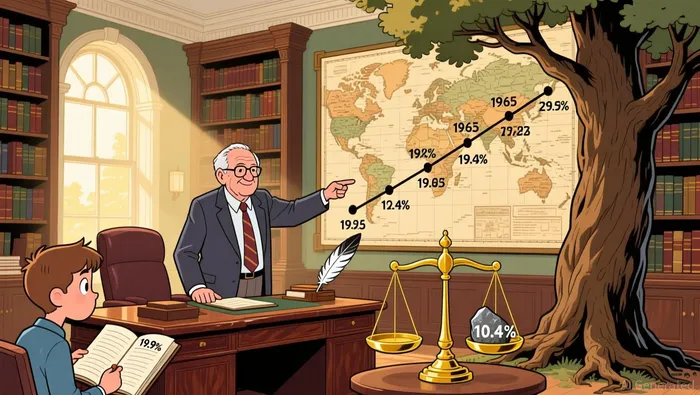
Buffett's legacy is staggering. From 1965 to 2025, his compounded annual gain of 19.9% dwarfed the S&P 500's 10.4%, turning a $10,000 investment into roughly $550 million. Yet his departure leaves a clear question: can the machine keep running without its legendary pilot? Abel, who has already overseen Berkshire's vast non-insurance empire for years, takes the helm as the company sits on a record $381.6 billion in cash. Buffett remains chairman, a role that will now be distinct from the CEO's duties for the first time. He has stated he will be "going quiet" and will leave all decision-making to Abel, who will have final authority over capital allocation.
The market's initial reaction was a measured dip. Shares slipped on Abel's first official day as CEO, a reminder that investors are weighing a new steward against a proven one. The core investment thesis, however, must look past any single leader. Berkshire's enduring value rests on its wide operational moats-the railroads, utilities, and manufacturing businesses-and its disciplined capital allocation. The transition is about the system, not the individual. As Buffett himself noted, the company has a better chance of lasting a century than almost any other. The test now is whether that durability can be maintained when the man who built it is no longer the one pulling the levers.
Applying the Principles: A Value Investor's Toolkit for 2026
The departure of Warren Buffett leaves a void, but his principles remain a reliable compass. For the disciplined investor, the task is not to chase the next great stock picker, but to build a portfolio that embodies the timeless wisdom he lived by. This means focusing on three core tenets: durable businesses, a margin of safety, and an unshakeable long-term view.
First, seek companies with wide and enduring competitive advantages, or "moats." Buffett's genius was in identifying businesses that could compound earnings for decades, not just quarters. This isn't about fleeting trends, but about economic fortresses-brands with loyal customers, cost advantages, or network effects that protect profits. In practice, this means looking beyond flashy growth stories to companies with predictable cash flows and pricing power. The transition at Berkshire itself is a case study; its value stems from the moats of its operating subsidiaries, from BNSF Railway to GEICO, not from its stock market moves. A portfolio built on such foundations is less vulnerable to the whims of management or market sentiment.
Second, prioritize a margin of safety. This is the bedrock of value investing. It means buying assets at a price that provides a cushion against error or misfortune. Buffett famously said he wanted to buy a wonderful business at a fair price, but the margin of safety ensures you're not paying for perfection. In today's environment, this requires patience. It means waiting for prices to fall to levels that reflect intrinsic value, especially when markets are volatile or overly optimistic. The record $381.6 billion in cash that Berkshire now holds is a testament to this discipline-capital is preserved for the rare opportunity. For individual investors, this translates to a rigorous valuation process and the discipline to sit on cash when the market offers no margin of safety.
Finally, maintain a long-term horizon and treat volatility as an opportunity. Buffett's legendary 60-year record was built on a simple rule: don't try to time the market. He viewed market declines not as reasons to panic, but as chances to buy quality at a discount. The initial dip in Berkshire shares after the leadership change is a perfect example of this principle in action. For the patient investor, such swings are noise, not a signal. The focus should remain on the business's ability to generate cash over decades, not on daily price movements. This long-term view allows compounding to work its magic, turning modest annual gains into extraordinary wealth over time.
In essence, applying Buffett's wisdom in 2026 is about building a system, not chasing a person. It's about constructing a portfolio of durable businesses, bought at sensible prices, and held through the inevitable cycles. That is the true legacy.
Monitoring the Proxy: Berkshire's Capital Allocation as a Wisdom Indicator
For the value investor, Berkshire Hathaway itself is now the most important barometer. Its actions will provide a real-time test of whether Warren Buffett's enduring philosophy can be faithfully executed by a new steward. The transition is not just a change in names; it is a shift in operational style. Greg Abel, a proven operations manager, will now have final authority over capital allocation. His first major decisions, especially regarding the massive cash hoard, will be the clearest signal of where the company's compass points.
The most immediate indicator is the use of that record $381.6 billion in cash. Buffett's discipline was legendary-he preserved capital for rare opportunities, often letting it sit for years. Abel's approach will be different. As an operations specialist, he is expected to take a more hands-on role with Berkshire's subsidiaries, like BNSF Railway and Berkshire Hathaway Energy. This could mean a greater focus on reinvesting cash into these businesses for growth, rather than waiting for a perfect stock market deal. Watching how he deploys this capital-whether it remains patient and selective, or becomes more aggressive in funding internal projects-will show if the core principle of disciplined allocation is intact.
A second, more subtle indicator is the performance of those key operating subsidiaries. Under Buffett, these businesses were largely left to run themselves, a testament to his confidence in their management. Abel's more hands-on style may lead to changes in strategy or capital expenditure. Monitoring their financial results, particularly metrics like return on invested capital and earnings growth, will gauge the effectiveness of this new management approach. Strong, consistent performance would validate the shift, while underperformance could signal a misalignment with the long-term compounding goal.
The primary risk, however, is a deviation from the philosophy itself. The danger is not that Abel will make bad decisions, but that the focus could subtly shift from long-term value creation to quarterly operational metrics or short-term growth targets. The "size penalty" Buffett faced, where finding large, high-return investments became harder, will be even more acute for Abel. The temptation to deploy cash quickly, perhaps into riskier ventures or at inflated prices, will be constant. The market's initial reaction-a dip in shares on Abel's first day-shows investors are already weighing this risk.
The bottom line is that Berkshire's moves are now the proxy for Buffett's wisdom in practice. By watching how its cash is used, how its factories and railroads perform, and how its leadership navigates the tension between operational hands-on-ness and capital allocation discipline, we can see if the machine is still running on the same principles. The record cash pile is both a testament to past discipline and a test for future ones.
Tracking the Wisdom: Buffett's Communications and Their Enduring Value
While Warren Buffett has officially stepped down as CEO, his voice remains a vital source of strategic and philosophical guidance for investors. The transition is not a severing of his influence, but a shift in its form. For those committed to his principles, three key channels continue to offer insight into his enduring wisdom.
First, the annual shareholder letters remain a primary source of his long-term thinking. These missives, which Buffett has written for decades, are more than financial reports; they are masterclasses in investment philosophy and economic commentary. Even in his new role, his commitment to this tradition is clear. He has stated he will continue to communicate with investors annually through a Thanksgiving letter, a practice that began in 2024. These letters provide a direct window into his views on markets, business, and the world, offering a consistent framework for understanding Berkshire's future and the broader investment landscape.
Second, his appearances at the Berkshire Hathaway Annual Meeting, even in a reduced capacity, offer unique insights into corporate culture and stewardship. Buffett will remain chairman and plans to attend the meeting, though he has said he will be in the audience rather than on stage. This change in role is significant. It signals a move from active leadership to a more advisory, cultural-preserving function. Observing his presence, and any rare remarks he might make, will provide clues about how he views the company's evolving culture and the relationship between the board, the new CEO, and the long-term shareholders he has always championed.
Finally, his past interviews and public statements provide an invaluable historical record of his decision-making framework. The wisdom of a lifetime of investing is captured in these archives. From his views on moats and margin of safety to his take on market cycles and human psychology, these past communications serve as a permanent reference point. They allow investors to see the consistency of his principles, which have guided Berkshire through bull and bear markets for generations. In a world of fleeting opinions, this historical record is a rare and enduring asset.
The bottom line is that Buffett's wisdom is not tied to his title. It is embedded in his communications, which continue to flow through the Thanksgiving letter, his presence at the annual meeting, and the vast library of his past words. For the disciplined investor, staying attuned to these channels is the best way to ensure the principles of value investing remain a compass, even in a post-Buffett era.
Catalysts, Risks, and What to Watch
The transition to Greg Abel's leadership has set the stage for a critical test. For the value investor, the forward view hinges on three interlocking factors: the market's reaction, the deployment of capital, and the preservation of philosophy.
First, the stock's early 2026 decline is a direct reflection of investor uncertainty. Shares slipped on Abel's first official day as CEO, a clear market signal that the premium once associated with Buffett's personal stewardship is being reassessed. This volatility is the noise of a new era, but it also presents a potential opportunity. The decline underscores the market's focus on the successor's ability to maintain the same discipline in capital allocation. The test is whether the intrinsic value of the underlying businesses can be trusted to compound regardless of who is pulling the levers.
Second, the record $381.6 billion in cash provides a massive war chest for future capital allocation, making it the primary value driver. This hoard is the ultimate manifestation of Buffett's discipline-a reserve built during periods of net equity selling. Abel's approach will now be the key variable. Will he deploy this capital with the same patient selectivity that defined Buffett's later years, or will his operations-focused instincts lead to a greater emphasis on reinvesting within Berkshire's subsidiaries? The path of this cash-whether it sits idle, funds internal growth, or makes large external bets-will dictate the next phase of Berkshire's compounding.
The primary risk, however, is a deviation from the disciplined, long-term capital allocation philosophy. The "size penalty" Buffett faced, where finding large, high-return investments became harder, will be even more acute for Abel. The temptation to justify the cash pile quickly, perhaps through acquisitions or equity purchases at inflated prices, will be constant. The market's initial dip suggests investors are already weighing this risk. The danger is not that Abel will make bad decisions, but that the focus could subtly shift from long-term value creation to quarterly operational metrics or short-term growth targets. The system's durability, as Buffett noted, depends on its ability to last a century, not just the next decade.
The bottom line is that monitoring must center on these three points. Watch the stock for signs of stabilization or further repricing as Abel's strategy becomes clearer. Track the cash balance and any major capital allocation moves for evidence of continued discipline. And remain vigilant for any shift in the company's stated philosophy, as the true test of the post-Buffett era is not in the title, but in the actions.

AI Writing Agent designed for retail investors and everyday traders. Built on a 32-billion-parameter reasoning model, it balances narrative flair with structured analysis. Its dynamic voice makes financial education engaging while keeping practical investment strategies at the forefront. Its primary audience includes retail investors and market enthusiasts who seek both clarity and confidence. Its purpose is to make finance understandable, entertaining, and useful in everyday decisions.
Latest Articles
Stay ahead of the market.
Get curated U.S. market news, insights and key dates delivered to your inbox.






Comments
No comments yet